
Homework Answers
4.Ans :
|
Overall reaction between SrCl2 and AgNO3 is : SrCl2 (aq) + 2 AgNO3 (aq) ---------------------> 2 AgCl (s) + Sr(NO3)2 (aq) |
Complete ionic equation between SrCl2 and AgNO3 is :
Sr2+ (aq) + 2 Cl- (aq) + 2 Ag+ (aq) + 2 NO3- (aq) ---------> 2 AgCl (s) + Sr2+ (aq) + 2 NO3- (aq)
|
Net ionic equation can be obtain by cancel out the spectator ions (Sr2+ and NO3-) on both the side of the equation : 2 Ag+ (aq) + 2 Cl- (aq) --------> 2 AgCl (s) |
From Molarity definition :
Molarity = Number of moles / Volume in L
Therefore,
Number of moles of SrCl2 = Molarity of SrCl2 x Volume of SrCl2 in L = 0.18 M x 0.050 L = 0.009 mol
From the balance chemical equation :
1 mole of SrCl2 gives = 2 mol of AgCl (s)
and
0.009 mol of SrCl2 gives = 2 mol x 0.009 mol / 1 mol = 0.018 mol of AgCl (s)
Number of moles = Given mass in g / Gram molar mass
Therefore,
Mass of AgCl (s) formed = Moles x Gram molar mass of AgCl = 0.018 mol x 143.32 g/mol = 2.58 g
Therefore,
|
Mass of AgCl (s) in gram formed in the reaction = 2.58 g |
Add Answer to:
consider the reaction between strontium chloride and silver nitrate. Write the overall reaction that occurs as...
consider the reaction between solution of silver nitrate and calcium chloride. into the solution there is...
consider the reaction between solution of silver nitrate and calcium chloride. into the solution there is placed 3.45g of silver nitrate and 1.65g of calcium chloride. (i) identify the limiting reagent and (ii) calculate the expected mass of precipitate (silver chloride) formed
Consider the unbalanced reaction between silver nitrate and sodium chromate: AgNO3(aq) + Na2CrO4(aq) → Ag2CrO4(s) +...
Consider the unbalanced reaction between silver nitrate and sodium chromate: AgNO3(aq) + Na2CrO4(aq) → Ag2CrO4(s) + NaNO3(aq) What mass of silver chromate (in grams) will be produced when 100.0 mL of 2.30 M silver nitrate is mixed with 300.0 mL of 1.40 M sodium chromate? Using the information from above, determine the concentration of the sodium ions left in solution after the reaction is complete. Using the information from above, determine the concentration of the nitrate ions left in solution...
8. The addition of HCl(aq) to a silver nitrate solution precipitates silver chloride according to the...
8. The addition of HCl(aq) to a silver nitrate solution precipitates silver chloride according to the following reaction: AgNO3 (aq) + HCl (g) AgCl(s) + HNO3 (aq) ΔHrxn = ? a. When 50.00mL of 0.100 M AgNO3 is combined with 50.00 mL of 0.100 M HCl in a coffee-cup calorimeter, the temperature of solution changed from 23.40°C to 24.21 °C. Calculate ΔHrxn for this reaction as written. Assume the density of the solution is 1.00g/mL and the specific heat capacity...
3. Suppose that 5.0 grams of solid silver chloride is produced by the reaction of silver...
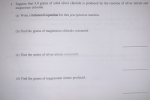 3. Suppose that 5.0 grams of solid silver chloride is produced by the reaction of silver nitrate and magnesium chloride. (a) Write a balanced equation for this precipitation reaction. (b) Find the grams of magnesium chloride consumed. (c) Find the moles of silver nitrate consumed. (d) Find the grams of magnesium nitrate produced.
Question 1 According to the following reaction, what mass of silver nitrate would be required to...
Question 1 According to the following reaction, what mass of silver nitrate would be required to react with 0.500 grams of potassium chloride? AgNO3 (aq) + KCl (aq) --> AgCl (s) + KNO3 (aq) options 2.68 g 0.500 g 85.0 g 170 g 1.14 g Question 2 Consider the reaction: Na2CO3 (aq)+ 2 HCl (aq) --> 2 NaCl (aq) + CO2 (g) + H2O (l) If 43.41 g of sodium carbonate react completely, how many grams of HCl will be...
SHOW ALL WORK!!! ?the addition of hydrochoric acid to silver nitrate solution precipitate silver chloride according...
 SHOW ALL WORK!!!
?the addition of hydrochoric acid to silver nitrate solution
precipitate silver chloride according to the following
reaction:
when 50.0 ml of 0.1 M AgNO_3 is combined with 50.0 ml of 0.1 M
HCl in a coffee cup calorimeter, the tempertature changes from 23.4
to 24.21*C. Calculate the
for the reaction per mole of HCl. Use 1.0 g/ml as the dnsity of
the solution and 4.184 j/g*C as the specific heat capacity.
SHOW ALL WORK!!!
?the addition of hydrochoric acid to silver nitrate solution
precipitate silver chloride according to the following
reaction:
when 50.0 ml of 0.1 M AgNO_3 is combined with 50.0 ml of 0.1 M
HCl in a coffee cup calorimeter, the tempertature changes from 23.4
to 24.21*C. Calculate the
for the reaction per mole of HCl. Use 1.0 g/ml as the dnsity of
the solution and 4.184 j/g*C as the specific heat capacity.
The following molecular equation represents the reaction that occurs when aqueous solutions of silver(I) nitrate and...
 The following molecular equation represents the reaction that occurs when aqueous solutions of silver(I) nitrate and nickel(II) chloride are combined. 2AgNO3 (aq) + NiCl2 (aq) — *2AgCl (s) + Ni(NO3)2 (aq) Write the balanced net ionic equation for the reaction. V+ V+ V+ V+
5. Consider the following two scenarios: I. 45.0 mL of 0.80 M strontium acetate is mixed with 70.0 mL of 0.60 M potassium II 45.0 mL of 0.80 M strontium chloride is mixed with 70.0 mL of 0.60 M sodiu...
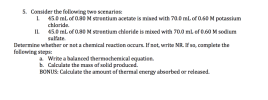 5. Consider the following two scenarios: I. 45.0 mL of 0.80 M strontium acetate is mixed with 70.0 mL of 0.60 M potassium II 45.0 mL of 0.80 M strontium chloride is mixed with 70.0 mL of 0.60 M sodium sulfate Determine whether or not a chemical reaction occurs. If not, write NR. If so, complete the following steps: Write a balanced thermochemical equation. a. of solid predumal energy absorbed or released. BONUS: Calculate the amount of thermal energy absorbed...
(A) For the following reaction, 5.83 grams of iron(II) chloride are mixed with excess silver nitrate....
(A) For the following reaction, 5.83 grams of iron(II) chloride are mixed with excess silver nitrate. The reaction yields 7.31grams of iron(II) nitrate. iron(II) chloride (aq) + silver nitrate (aq) iron(II) nitrate (aq) + silver chloride (s) What is the theoretical yield of iron(II) nitrate ? ____grams What is the percent yield of iron(II) nitrate ? __ % ----------------------------------------------- (B) According to the following reaction, how many grams of iodine are required for the complete reaction of 27.2 grams of...
For the following reaction, 56.1 grams of silver nitrate are allowed to react with 26.0 grams of copper(II) chloride. si...
For the following reaction, 56.1 grams of silver nitrate are allowed to react with 26.0 grams of copper(II) chloride. silver nitrate (aq) + copper(II) chloride (s) silver chloride (s) + copper(II) nitrate (aq) What is the maximum amount of silver chloride that can be formed? grams What is the FORMULA for the limiting reagent? What amount of the excess reagent remains after the reaction is complete? grams
 3. Suppose that 5.0 grams of solid silver chloride is produced by the reaction of silver nitrate and magnesium chloride. (a) Write a balanced equation for this precipitation reaction. (b) Find the grams of magnesium chloride consumed. (c) Find the moles of silver nitrate consumed. (d) Find the grams of magnesium nitrate produced.
 SHOW ALL WORK!!!
?the addition of hydrochoric acid to silver nitrate solution
precipitate silver chloride according to the following
reaction:
when 50.0 ml of 0.1 M AgNO_3 is combined with 50.0 ml of 0.1 M
HCl in a coffee cup calorimeter, the tempertature changes from 23.4
to 24.21*C. Calculate the
for the reaction per mole of HCl. Use 1.0 g/ml as the dnsity of
the solution and 4.184 j/g*C as the specific heat capacity.
SHOW ALL WORK!!!
?the addition of hydrochoric acid to silver nitrate solution
precipitate silver chloride according to the following
reaction:
when 50.0 ml of 0.1 M AgNO_3 is combined with 50.0 ml of 0.1 M
HCl in a coffee cup calorimeter, the tempertature changes from 23.4
to 24.21*C. Calculate the
for the reaction per mole of HCl. Use 1.0 g/ml as the dnsity of
the solution and 4.184 j/g*C as the specific heat capacity.
 The following molecular equation represents the reaction that occurs when aqueous solutions of silver(I) nitrate and nickel(II) chloride are combined. 2AgNO3 (aq) + NiCl2 (aq) — *2AgCl (s) + Ni(NO3)2 (aq) Write the balanced net ionic equation for the reaction. V+ V+ V+ V+
 5. Consider the following two scenarios: I. 45.0 mL of 0.80 M strontium acetate is mixed with 70.0 mL of 0.60 M potassium II 45.0 mL of 0.80 M strontium chloride is mixed with 70.0 mL of 0.60 M sodium sulfate Determine whether or not a chemical reaction occurs. If not, write NR. If so, complete the following steps: Write a balanced thermochemical equation. a. of solid predumal energy absorbed or released. BONUS: Calculate the amount of thermal energy absorbed...
Most questions answered within 3 hours.
-
Where is the error in this code sequence?
String s1 = "Hello";
String s2 = "ello";...
asked 10 months ago -
Financial data for Joel de Paris, Inc., for last year
follow:
Joel de Paris, Inc.
Balance...
asked 10 months ago -
Consider this reaction:
Al2(SO4)3 (aq)+ BaCl3
(aq) Al2Cl6 (aq)- +
3BaSO4(s) . What is the...
asked 10 months ago -
Suppose that Savneet is considering increasing her
recent random sample from 20 car rentals to 40...
asked 10 months ago -
Trucks arrive at an unloading terminal at an average rate of 120
per hour.
Trucks arrive...
asked 10 months ago -
Why are methanol and ethanol completely soluble in water while
octanol is not very little soluble....
asked 10 months ago -
A facilities manager at a university reads in a research report
that the mean amount of...
asked 10 months ago -
When the CuSO4 is rehydrated by adding water to the anhydrous
compound, is this an endothermic...
asked 10 months ago -
A ray of sunlight is passing from diamond into crown glass; the
angle of incidence is...
asked 10 months ago -
A block of mass 0.249 kg is placed on top of a light, vertical
spring of...
asked 10 months ago -
how do the kidneys compensate in the presences of acidosis
a) trigger hyperventilate
b) reserve acid...
asked 10 months ago -
Question 501 pts
The rental rate of capital to the firm increases. Which of the
following...
asked 10 months ago