
Homework Answers
Answer to part (a)
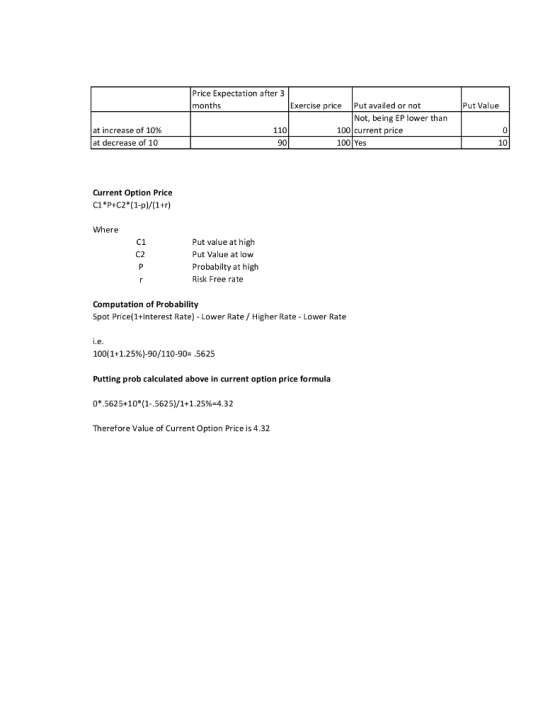
Part (b) No. of stock would be 0.50.
i.e. Change in Put value/ Change in Share value = 0-10/110-90=0.50
Add Answer to:
4. Consider six months European put option with a strike price of $100 on a stock...
A European call option and put option on a stock both have a strike price of...
A European call option and put option on a stock both have a strike price of $25 and an expiration date in six months. Both sell for $3. The risk-free interest rate is 10% per annum, the current stock price is $23, and a $1 per share dividend is expected in 2 months. Identify the arbitrage opportunity open to a trader.
A European call option and put option on a stock both have a strike price of...
A European call option and put option on a stock both have a strike price of $45 and an expiration date in six months. Both sell for $2. The risk-free interest rate is 5% p.a. The current stock price is $43. There is no dividend expected for the next six months. a) If the stock price in three months is $48, which option is in the money and which one is out of the money? b) As an arbitrageur, can...
The price of a European call that expires in six months and has a strike price...
The price of a European call that expires in six months and has a strike price of $49 is $4.5. The underlying stock price is $50, and a dividend of $1.00 is expected in three months. The term structure is flat, with all risk-free interest rates being 10%. a. What is the price of a European put option that expires in six months and has a strike price of $49? [1 mark] b. Explain in detail the arbitrage opportunities if...
Consider a European put option on the stock of XYZ, with a strike price of $30...
 Consider a European put option on the stock of XYZ, with a strike price of $30 and two months to expiration. The stock pays continuous dividends at the annual continuously com- pounded yield rate of 5%. The annual continuously compounded risk free interst rate is 11%. The stock currently trades for $23 per share. Suppose that in two months, the stock will trade for either $18 per share or $29 per share. Use the one-period binomial option pricing to find...
Problem 12. A European call and put option on a stock both have a strike price...
 Problem 12. A European call and put option on a stock both have a strike price of $30 and an expiration date in three months. The price of the call is $3, and the price of the put is $2.25. The risk free interest rate is 10% per annum, the current stock price is $31. Indentify the arbitrage opportunity open to a trader.
What is the price of a European put option on a non-dividend paying stock when the...
What is the price of a European put option on a non-dividend paying stock when the stock price is $69, the strike price is $70, the risk-free interest rate is 5% per annum, the volatility is 35%per annum, and the time to maturity is six months? Please give me step by step by step instructions.
Problem 12.25. Consider a European call option on a non-dividend-paying stock where the stock price is $40, the strike price is $40, the risk-free rate is 4% per annum, the volatility is 30% per annu...
 Problem 12.25. Consider a European call option on a non-dividend-paying stock where the stock price is $40, the strike price is $40, the risk-free rate is 4% per annum, the volatility is 30% per annum, and the time to maturity is six months a. Calculate u, d, and p for a two step tree b. Value the option using a two step tree. c. Verify that DerivaGem gives the same answer d. Use DerivaGem to value the option with 5,...
There is a European put option in two months. The stock price is 58,u=0.2239 ,d=-0.183.The option...
There is a European put option in two months. The stock price is 58,u=0.2239 ,d=-0.183.The option has a strike price of 65, and the risk-free interest rate is a 5 percent annual percentage rate. What is the price of the put option today using one month steps?
3. A 6-month European put option with a strike price of $20 sells for $1.44. The...
3. A 6-month European put option with a strike price of $20 sells for $1.44. The stock is priced at $17.50 and the risk-free rate is 10% per annum. (a) (5 points) What are the upper and lower bounds for this option? (b) (10 points) Is there an arbitrage opportunity in part (a)? If so, conduct an arbitrage with 100 shares of stock (clearly illustrate the steps of an arbitrage). What is the arbitrage profit?
Question 1 - 35 Points Consider a European put option on a non-dividend-paying stock where the...
 Question 1 - 35 Points Consider a European put option on a non-dividend-paying stock where the stock price is $15, the strike price is $13, the risk-free rate is 3% per annum, the volatility is 30% per annum and the time to maturity is 9 months. Consider a three-step troc. (Hint: dt = 3 months). (a) Compute u and d. (b) Compute the European put price using a three-step binomial tree. (c) If the option in (b) is American instead...
 Consider a European put option on the stock of XYZ, with a strike price of $30 and two months to expiration. The stock pays continuous dividends at the annual continuously com- pounded yield rate of 5%. The annual continuously compounded risk free interst rate is 11%. The stock currently trades for $23 per share. Suppose that in two months, the stock will trade for either $18 per share or $29 per share. Use the one-period binomial option pricing to find...
 Problem 12. A European call and put option on a stock both have a strike price of $30 and an expiration date in three months. The price of the call is $3, and the price of the put is $2.25. The risk free interest rate is 10% per annum, the current stock price is $31. Indentify the arbitrage opportunity open to a trader.
 Problem 12.25. Consider a European call option on a non-dividend-paying stock where the stock price is $40, the strike price is $40, the risk-free rate is 4% per annum, the volatility is 30% per annum, and the time to maturity is six months a. Calculate u, d, and p for a two step tree b. Value the option using a two step tree. c. Verify that DerivaGem gives the same answer d. Use DerivaGem to value the option with 5,...
 Question 1 - 35 Points Consider a European put option on a non-dividend-paying stock where the stock price is $15, the strike price is $13, the risk-free rate is 3% per annum, the volatility is 30% per annum and the time to maturity is 9 months. Consider a three-step troc. (Hint: dt = 3 months). (a) Compute u and d. (b) Compute the European put price using a three-step binomial tree. (c) If the option in (b) is American instead...
Most questions answered within 3 hours.
-
Where is the error in this code sequence?
String s1 = "Hello";
String s2 = "ello";...
asked 10 months ago -
Financial data for Joel de Paris, Inc., for last year
follow:
Joel de Paris, Inc.
Balance...
asked 10 months ago -
Consider this reaction:
Al2(SO4)3 (aq)+ BaCl3
(aq) Al2Cl6 (aq)- +
3BaSO4(s) . What is the...
asked 10 months ago -
Suppose that Savneet is considering increasing her
recent random sample from 20 car rentals to 40...
asked 10 months ago -
Trucks arrive at an unloading terminal at an average rate of 120
per hour.
Trucks arrive...
asked 10 months ago -
Why are methanol and ethanol completely soluble in water while
octanol is not very little soluble....
asked 10 months ago -
A facilities manager at a university reads in a research report
that the mean amount of...
asked 10 months ago -
When the CuSO4 is rehydrated by adding water to the anhydrous
compound, is this an endothermic...
asked 10 months ago -
A ray of sunlight is passing from diamond into crown glass; the
angle of incidence is...
asked 10 months ago -
A block of mass 0.249 kg is placed on top of a light, vertical
spring of...
asked 10 months ago -
how do the kidneys compensate in the presences of acidosis
a) trigger hyperventilate
b) reserve acid...
asked 10 months ago -
Question 501 pts
The rental rate of capital to the firm increases. Which of the
following...
asked 10 months ago