If the production possibilities frontiers shown are each for two days of production, then which of...
If the production possibilities frontiers shown are each for two
days of production, then which of the following combinations of
bolts and nails could Uzbekistan and Azerbaijan together not make
in a given 2-day production period?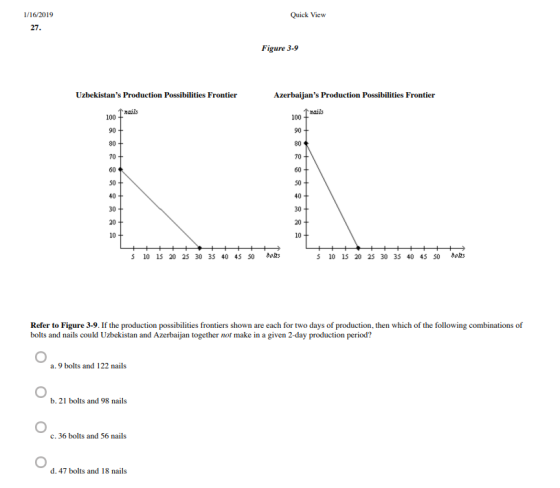
Homework Answers
Answer
The correct answer is (d) 47 bolts and 18 nails
We can see from above production function that both functions opportunity cost of producing 30 bolts for Uzbekistan is 60 nails.
Hence, opportunity cost of producing 1 bolts for Uzbekistan is 60/30 = 2 nails. Similarly opportunity cost of producing 1 bolts for Azerbaijan is 80/20 = 4 nails.
Hence As opportunity cost of producing 1 bolts in Uzbekistan < opportunity cost of producing 1 bolt in Azerbaijan.
Hence Uzbekistan will specialize in Bolts and Azerbaijan will specialize in nails.
Now lets check which option is incorrect:
(a) 9 bolts and 122 nails - As Azerbaijan will specialize in nails, It will use its entire time on Nails and will produce 80 nails. We can see from the PPF that Uzbekistan can produce 9 bolts and 42 nails. Hence Option (a) is achievable
(b) 21 bolts and 98 nails - As Azerbaijan will specialize in nails, It will use its entire time on Nails and will produce 80 nails. We can see from the PPF that Uzbekistan can produce 21 bolts and 18 nails. Hence Option (b) is achievable
(c) 36 bolts and 56 nails - Uzbekistan will specialize in Bolts, It will use its entire time on bolts and will produce 30 bolts. We can see from the PPF that Azerbaijan can produce 6 bolts and 56 nails. Hence Option (c) is achievable
(d) 47 bolts and 18 nails - Uzbekistan will specialize in Bolts, It will use its entire time on bolts and will produce 30 bolts. We can see from the PPF that Azerbaijan can produce 17 bolts and 12 nails. Hence Option (d) is not achievable. Hence option (d) is incorect.
Note :
PPF equation of Uzbekistan is N + 2B = 60
PPF equation of Azerbaijan is N + 4B = 80
Add Answer to:
If the production possibilities frontiers shown are each for two days of production, then which of...
Figure 3-9 Uzbekistan's Production Possibilities Frontier Azerbaijan's Production Possbuitiles Fromtier 5 10 15 20 23 30...
 Figure 3-9 Uzbekistan's Production Possibilities Frontier Azerbaijan's Production Possbuitiles Fromtier 5 10 15 20 23 30 35 40 45 5r 5 10 15 2 25 3 3540 30 8. Refer to Figure 3-9 a) If Uzbekistan and Azerbaijian each divides its time equally between making bolts and making nails, then total production is bolts andnails b) Label these points on the graph for each country as point A e) If Uzbekistan and Azerbaijan switch from each country dividing its time...
Figure 3-6 Maxine's Production Possibilities Frontier Daisy's Production Possibilities Frontier TA 20 T 3 6 9...
 Figure 3-6 Maxine's Production Possibilities Frontier Daisy's Production Possibilities Frontier TA 20 T 3 6 9 12 15 18 21 24 27 30 per 6 9 12 15 18 21 24 27 10 pies 11. Refer to Figure 3-6. If the production possibilities frontiers shown are each for one day of work, then which of the following combinations of pies and tarts could Maxine and Daisy together not make in a given day? a. 2 pies and 25 tarts b....
. Below please find the production possibilities frontiers (PPFs) of Ghana and Spain. Ghana PPF &nbs
. Below please find the production possibilities frontiers (PPFs) of Ghana and Spain. Ghana PPF Spain PPF Possible Combinations Possible Combinations Cars T-shirts Cars T-shirts 0 8,000 0 12,000 100 6,000 100 9,000 200 4,000 200 6,000 300 2,000 300 3,000 400 0 400 0 Given these PPFs, which country would you predict would specialize in each good? Why? Suppose a free trade deal is negotiated. What is the range of potential terms of trade?
Question 10 2 pts Question 11 1 pts The figure below shows the production possibilities frontiers...
 Question 10 2 pts Question 11 1 pts The figure below shows the production possibilities frontiers of countries X and Y. The points on each axis represent the maximum quantities that each country could produce if they specialized entirely in one good or the other. According to this graph, the opportunity cost of producing a ton of wheat is... The figure below shows the production-possibilities frontiers of countries X and Y. The points on each axis represent the maximum quantities...
The production possibilities frontiers below show how much Dave and Sam can each produce in 8...
 The production possibilities frontiers below show how much Dave and Sam can each produce in 8 hours of time Dave's Production Possibilities Sam's Production Possibilities 8מ 11 quarts 11 10 10 9 9 8 7 9 10 2 3 6 7 4 5 6 4 5 8 9 10 Cake Cake a. Who has an absolute advantage in Ice Cream? How about in Cake? Explain. b. Who has a comparative advantage in Ice Cream? How about in Cake? Explain. c....
Can you please explain in detail how to solve this problem? D Question 16 1 pts...
 Can you please explain in detail how to solve this
problem?
D Question 16 1 pts Figure 3-4 Perry's Production Possibilities Frontier Jordan's Production Possibilities Frontier 20 18 16 14 12 10 20 18 16 14 12 10 zovels 12 3 4 5 6 78 1 2 3 4 5 678 Refer to Figure 3-4. If the production possibilities frontiers shown are each for one year of writing. then which of the following combinations of novels and poems could Perry...
Can you please explain in detail how to solve this
problem?
D Question 16 1 pts Figure 3-4 Perry's Production Possibilities Frontier Jordan's Production Possibilities Frontier 20 18 16 14 12 10 20 18 16 14 12 10 zovels 12 3 4 5 6 78 1 2 3 4 5 678 Refer to Figure 3-4. If the production possibilities frontiers shown are each for one year of writing. then which of the following combinations of novels and poems could Perry...
Shown below are the production possibilities curves for two nations: the United States and Chile. Suppose...
 Shown below are the production possibilities curves for two
nations: the United States and Chile. Suppose these two nations do
not currently engage in international trade or specialization, and
suppose that points A and
a show the combinations of wheat and
copper they now produce and consume.
United States Chile 10 10 2 10 Copper (thousands of pounds) 8 10 Copper (thousands of pounds)
Shown below are the production possibilities curves for two
nations: the United States and Chile. Suppose these two nations do
not currently engage in international trade or specialization, and
suppose that points A and
a show the combinations of wheat and
copper they now produce and consume.
United States Chile 10 10 2 10 Copper (thousands of pounds) 8 10 Copper (thousands of pounds)
Two countries, Alpha and Beta, have identical production possibilities frontiers. Capital goods (per person) If Alpha...
 Two countries, Alpha and Beta, have identical production possibilities frontiers. Capital goods (per person) If Alpha produces at point A and Beta produces at point B, then _ O A. Alpha's and Beta's economic growth rates will be the same O B. Beta's future consumption will be less than than Alpha's O C. Alpha consumes more than Beta today, but it will grow slower than Beta OD. Alpha's economic growth rate will exceed Beta's PPF Consumption goods (per person)
Shown below are the production possibilities curves for two nations: the United States and Chile. Suppose...
 Shown below are the production possibilities curves for two nations: the United States and Chile. Suppose these two nations do not currently engage in international trade or specialization, and suppose that points A and a show the combinations of wheat and copper they now produce and consume United States Chile 10 10 10 10 Copper (thousands of pounds) Copper (thousands of pounds) 1. What is the United States opportunity cost for wheat and copper - show your math work? 2....
Assume an economy with only two commodities. The production possibilities curve of this economy shows: a....
Assume an economy with only two commodities. The production possibilities curve of this economy shows: a. all possible combinations of the two commodities that can be produced by utilizing all of the society's resources. b. all possible combinations of the two commodities that a given person can buy. c. all possible combinations of the two commodities that a given person wants. d. all possible combinations of the two goods that the society as a whole wants. e. none of the...
 Figure 3-9 Uzbekistan's Production Possibilities Frontier Azerbaijan's Production Possbuitiles Fromtier 5 10 15 20 23 30 35 40 45 5r 5 10 15 2 25 3 3540 30 8. Refer to Figure 3-9 a) If Uzbekistan and Azerbaijian each divides its time equally between making bolts and making nails, then total production is bolts andnails b) Label these points on the graph for each country as point A e) If Uzbekistan and Azerbaijan switch from each country dividing its time...
 Figure 3-6 Maxine's Production Possibilities Frontier Daisy's Production Possibilities Frontier TA 20 T 3 6 9 12 15 18 21 24 27 30 per 6 9 12 15 18 21 24 27 10 pies 11. Refer to Figure 3-6. If the production possibilities frontiers shown are each for one day of work, then which of the following combinations of pies and tarts could Maxine and Daisy together not make in a given day? a. 2 pies and 25 tarts b....
 Question 10 2 pts Question 11 1 pts The figure below shows the production possibilities frontiers of countries X and Y. The points on each axis represent the maximum quantities that each country could produce if they specialized entirely in one good or the other. According to this graph, the opportunity cost of producing a ton of wheat is... The figure below shows the production-possibilities frontiers of countries X and Y. The points on each axis represent the maximum quantities...
 The production possibilities frontiers below show how much Dave and Sam can each produce in 8 hours of time Dave's Production Possibilities Sam's Production Possibilities 8מ 11 quarts 11 10 10 9 9 8 7 9 10 2 3 6 7 4 5 6 4 5 8 9 10 Cake Cake a. Who has an absolute advantage in Ice Cream? How about in Cake? Explain. b. Who has a comparative advantage in Ice Cream? How about in Cake? Explain. c....
 Can you please explain in detail how to solve this
problem?
D Question 16 1 pts Figure 3-4 Perry's Production Possibilities Frontier Jordan's Production Possibilities Frontier 20 18 16 14 12 10 20 18 16 14 12 10 zovels 12 3 4 5 6 78 1 2 3 4 5 678 Refer to Figure 3-4. If the production possibilities frontiers shown are each for one year of writing. then which of the following combinations of novels and poems could Perry...
Can you please explain in detail how to solve this
problem?
D Question 16 1 pts Figure 3-4 Perry's Production Possibilities Frontier Jordan's Production Possibilities Frontier 20 18 16 14 12 10 20 18 16 14 12 10 zovels 12 3 4 5 6 78 1 2 3 4 5 678 Refer to Figure 3-4. If the production possibilities frontiers shown are each for one year of writing. then which of the following combinations of novels and poems could Perry...
 Shown below are the production possibilities curves for two
nations: the United States and Chile. Suppose these two nations do
not currently engage in international trade or specialization, and
suppose that points A and
a show the combinations of wheat and
copper they now produce and consume.
United States Chile 10 10 2 10 Copper (thousands of pounds) 8 10 Copper (thousands of pounds)
Shown below are the production possibilities curves for two
nations: the United States and Chile. Suppose these two nations do
not currently engage in international trade or specialization, and
suppose that points A and
a show the combinations of wheat and
copper they now produce and consume.
United States Chile 10 10 2 10 Copper (thousands of pounds) 8 10 Copper (thousands of pounds)
 Two countries, Alpha and Beta, have identical production possibilities frontiers. Capital goods (per person) If Alpha produces at point A and Beta produces at point B, then _ O A. Alpha's and Beta's economic growth rates will be the same O B. Beta's future consumption will be less than than Alpha's O C. Alpha consumes more than Beta today, but it will grow slower than Beta OD. Alpha's economic growth rate will exceed Beta's PPF Consumption goods (per person)
 Shown below are the production possibilities curves for two nations: the United States and Chile. Suppose these two nations do not currently engage in international trade or specialization, and suppose that points A and a show the combinations of wheat and copper they now produce and consume United States Chile 10 10 10 10 Copper (thousands of pounds) Copper (thousands of pounds) 1. What is the United States opportunity cost for wheat and copper - show your math work? 2....
Most questions answered within 3 hours.
-
Where is the error in this code sequence?
String s1 = "Hello";
String s2 = "ello";...
asked 10 months ago -
Financial data for Joel de Paris, Inc., for last year
follow:
Joel de Paris, Inc.
Balance...
asked 10 months ago -
Consider this reaction:
Al2(SO4)3 (aq)+ BaCl3
(aq) Al2Cl6 (aq)- +
3BaSO4(s) . What is the...
asked 10 months ago -
Suppose that Savneet is considering increasing her
recent random sample from 20 car rentals to 40...
asked 10 months ago -
Trucks arrive at an unloading terminal at an average rate of 120
per hour.
Trucks arrive...
asked 10 months ago -
Why are methanol and ethanol completely soluble in water while
octanol is not very little soluble....
asked 10 months ago -
A facilities manager at a university reads in a research report
that the mean amount of...
asked 10 months ago -
When the CuSO4 is rehydrated by adding water to the anhydrous
compound, is this an endothermic...
asked 10 months ago -
A ray of sunlight is passing from diamond into crown glass; the
angle of incidence is...
asked 10 months ago -
A block of mass 0.249 kg is placed on top of a light, vertical
spring of...
asked 10 months ago -
how do the kidneys compensate in the presences of acidosis
a) trigger hyperventilate
b) reserve acid...
asked 10 months ago -
Question 501 pts
The rental rate of capital to the firm increases. Which of the
following...
asked 10 months ago