
Homework Answers
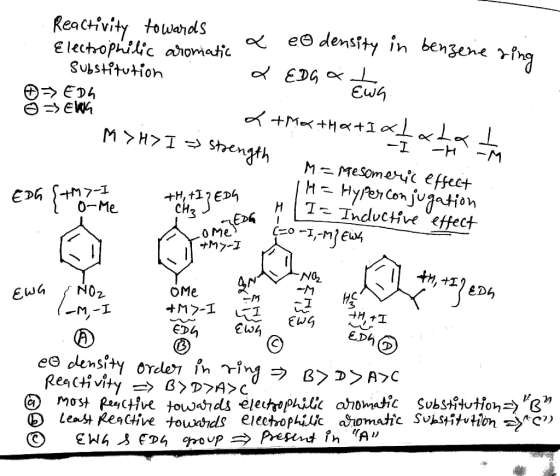
Reactivity towards electrophilic aromatic substitution depends upon electron density in ring.
Add Answer to:
5. Given the following molecules, answer the given questions: CH3 TecDE OMe I cot T bernable...
Given the following molecules, answer the following questions. 5. Given the following molecules, answer the given...
 Given the following molecules, answer the following
questions.
5. Given the following molecules, answer the given questions: CH3 OMe TOMe 0 OМен NO2 NO₂ H₃c OMe ON NO, H3C А a. Which structure is the most reactive towards any electrophilic aromatic substitution? B b. Which structure is the least reactive towards any electrophilic aromatic substitution? c. Which structure has both EWG and EDG moieties?'
Given the following molecules, answer the following
questions.
5. Given the following molecules, answer the given questions: CH3 OMe TOMe 0 OМен NO2 NO₂ H₃c OMe ON NO, H3C А a. Which structure is the most reactive towards any electrophilic aromatic substitution? B b. Which structure is the least reactive towards any electrophilic aromatic substitution? c. Which structure has both EWG and EDG moieties?'
Which of the following molecules is the most reactive towards electrophilic aromatic substitution (EAS)? (all EDG...
 Which of the following molecules is the most reactive towards electrophilic aromatic substitution (EAS)? (all EDG on the benzene) Н. CH3 CN SO3H NO2 OME 1 II IV
. Given the following molecules, answer the given questions: (2 pts Ha Me OMe ??? NO...
 . Given the following molecules, answer the given questions: (2 pts Ha Me OMe ??? NO Which molecule will mot undergo any electrophilic substitution reaction? Which molecule will have exclusively one product upon bromination in presence of FeBr? Which molecule has the most acidic proton? Which molecule is most reactive towards any electrophilic aromatic substitution? Which molecule will give a tricarboxylic acid upon reacting with KMnOHSo b. d. 6. Give the reagents for the following reactions, then explain (to yourselt)...
1.) (9 points) Give structures for the following compounds: a) meta-phenylphenol b) 6-benzyl-3-heptanol e) ortho-sec-butyltoluene 2.)...
 1.) (9 points) Give structures for the following compounds: a) meta-phenylphenol b) 6-benzyl-3-heptanol e) ortho-sec-butyltoluene 2.) (9 points) Name the following compounds: 3.) (8 points) Label the following molecules as aromatic, anti-aromatic, or non-aromatic. For the ones th aren't aromatic, explain why they are either non-aromatic or anti-aromatic. 0.8 4.) (11 points) For the following electrophilic aromatic substitution reaction: Вт, FeBr; a) Which product is the major one? b) Draw a complete mechanism for the formation of the major product...
I need some help to answer these following questions. Thanks. 41. Which molecule(s) is/are aromatic? I1...
 I need some help to answer these following questions.
Thanks.
41. Which molecule(s) is/are aromatic? I1 IV (A) I only (C) I, III, and IV (B) I and IV (D) I, II, III, and IV OH OH 42. Which Fischer projection represents this structure? HO OH OH H CHO CHO (A) H-OH (B) HOH HOH CH2OH CH2OH CHO HOH CHO но -н CH2OH CH2OH 43. Which is a product of this ozonolysis reaction? 1.03 2. (CH3)2S H O I BHs/THF...
I need some help to answer these following questions.
Thanks.
41. Which molecule(s) is/are aromatic? I1 IV (A) I only (C) I, III, and IV (B) I and IV (D) I, II, III, and IV OH OH 42. Which Fischer projection represents this structure? HO OH OH H CHO CHO (A) H-OH (B) HOH HOH CH2OH CH2OH CHO HOH CHO но -н CH2OH CH2OH 43. Which is a product of this ozonolysis reaction? 1.03 2. (CH3)2S H O I BHs/THF...
 Given the following molecules, answer the following
questions.
5. Given the following molecules, answer the given questions: CH3 OMe TOMe 0 OМен NO2 NO₂ H₃c OMe ON NO, H3C А a. Which structure is the most reactive towards any electrophilic aromatic substitution? B b. Which structure is the least reactive towards any electrophilic aromatic substitution? c. Which structure has both EWG and EDG moieties?'
Given the following molecules, answer the following
questions.
5. Given the following molecules, answer the given questions: CH3 OMe TOMe 0 OМен NO2 NO₂ H₃c OMe ON NO, H3C А a. Which structure is the most reactive towards any electrophilic aromatic substitution? B b. Which structure is the least reactive towards any electrophilic aromatic substitution? c. Which structure has both EWG and EDG moieties?'
 Which of the following molecules is the most reactive towards electrophilic aromatic substitution (EAS)? (all EDG on the benzene) Н. CH3 CN SO3H NO2 OME 1 II IV
 . Given the following molecules, answer the given questions: (2 pts Ha Me OMe ??? NO Which molecule will mot undergo any electrophilic substitution reaction? Which molecule will have exclusively one product upon bromination in presence of FeBr? Which molecule has the most acidic proton? Which molecule is most reactive towards any electrophilic aromatic substitution? Which molecule will give a tricarboxylic acid upon reacting with KMnOHSo b. d. 6. Give the reagents for the following reactions, then explain (to yourselt)...
 1.) (9 points) Give structures for the following compounds: a) meta-phenylphenol b) 6-benzyl-3-heptanol e) ortho-sec-butyltoluene 2.) (9 points) Name the following compounds: 3.) (8 points) Label the following molecules as aromatic, anti-aromatic, or non-aromatic. For the ones th aren't aromatic, explain why they are either non-aromatic or anti-aromatic. 0.8 4.) (11 points) For the following electrophilic aromatic substitution reaction: Вт, FeBr; a) Which product is the major one? b) Draw a complete mechanism for the formation of the major product...
 I need some help to answer these following questions.
Thanks.
41. Which molecule(s) is/are aromatic? I1 IV (A) I only (C) I, III, and IV (B) I and IV (D) I, II, III, and IV OH OH 42. Which Fischer projection represents this structure? HO OH OH H CHO CHO (A) H-OH (B) HOH HOH CH2OH CH2OH CHO HOH CHO но -н CH2OH CH2OH 43. Which is a product of this ozonolysis reaction? 1.03 2. (CH3)2S H O I BHs/THF...
I need some help to answer these following questions.
Thanks.
41. Which molecule(s) is/are aromatic? I1 IV (A) I only (C) I, III, and IV (B) I and IV (D) I, II, III, and IV OH OH 42. Which Fischer projection represents this structure? HO OH OH H CHO CHO (A) H-OH (B) HOH HOH CH2OH CH2OH CHO HOH CHO но -н CH2OH CH2OH 43. Which is a product of this ozonolysis reaction? 1.03 2. (CH3)2S H O I BHs/THF...
Most questions answered within 3 hours.
-
Where is the error in this code sequence?
String s1 = "Hello";
String s2 = "ello";...
asked 10 months ago -
Financial data for Joel de Paris, Inc., for last year
follow:
Joel de Paris, Inc.
Balance...
asked 10 months ago -
Consider this reaction:
Al2(SO4)3 (aq)+ BaCl3
(aq) Al2Cl6 (aq)- +
3BaSO4(s) . What is the...
asked 10 months ago -
Suppose that Savneet is considering increasing her
recent random sample from 20 car rentals to 40...
asked 10 months ago -
Trucks arrive at an unloading terminal at an average rate of 120
per hour.
Trucks arrive...
asked 10 months ago -
Why are methanol and ethanol completely soluble in water while
octanol is not very little soluble....
asked 10 months ago -
A facilities manager at a university reads in a research report
that the mean amount of...
asked 10 months ago -
When the CuSO4 is rehydrated by adding water to the anhydrous
compound, is this an endothermic...
asked 10 months ago -
A ray of sunlight is passing from diamond into crown glass; the
angle of incidence is...
asked 10 months ago -
A block of mass 0.249 kg is placed on top of a light, vertical
spring of...
asked 10 months ago -
how do the kidneys compensate in the presences of acidosis
a) trigger hyperventilate
b) reserve acid...
asked 10 months ago -
Question 501 pts
The rental rate of capital to the firm increases. Which of the
following...
asked 10 months ago