
Homework Answers


2. Let X ~ Exp(3), that is, fx (x) = t-, where x 〉 0 (and...
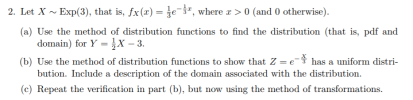 2. Let X ~ Exp(3), that is, fx (x) = t-, where x 〉 0 (and 0 otherwise). (a) Use the method of distribution functions to find the distribution (that is, pdf and (b) Use the method of distribution functions to show that Z e (c) Repeat the verification in part (b), but now using the method of transformations. domain) for Y X -3. has a uniform distri- bution. Include a description of the domain associated with the distribution
Question 5 15 marks] Let X be a random variable with pdf -{ fx(z) = - 0<r<1 (1) 0 :otherwise, Xa, n>2, be...
 Question 5 15 marks] Let X be a random variable with pdf -{ fx(z) = - 0<r<1 (1) 0 :otherwise, Xa, n>2, be iid. random variables with pdf where 0> 0. Let X. X2.... given by (1) (a) Let Ylog X, where X has pdf given by (1). Show that the pdf of Y is Be- otherwise, (b) Show that the log-likelihood given the X, is = n log0+ (0- 1)log X (0 X) Hence show that the maximum likelihood...
Question 5 15 marks] Let X be a random variable with pdf -{ fx(z) = -...
 Question 5 15 marks] Let X be a random variable with pdf -{ fx(z) = - 0<r<1 (1) 0 :otherwise, Xa, n>2, be iid. random variables with pdf where 0> 0. Let X. X2.... given by (1) (a) Let Ylog X, where X has pdf given by (1). Show that the pdf of Y is Be- otherwise, (b) Show that the log-likelihood given the X, is = n log0+ (0- 1)log X (0 X) Hence show that the maximum likelihood...
3-5.2. Let X, Y, and Z have the joint pdf 3/2 1 |ryz exp exp 27T...
 3-5.2. Let X, Y, and Z have the joint pdf 3/2 1 |ryz exp exp 27T 2 where -o<x < o,-00< y < oo, and 00< z < 00. While X, Y, and Z are obviously dependent, show that X, Y, and Z are pairwise independent and that each pair has a bivariate normal distribution
3-5.2. Let X, Y, and Z have the joint pdf 3/2 1 |ryz exp exp 27T 2 where -o
3-5.2. Let X, Y, and Z have the joint pdf 3/2 1 |ryz exp exp 27T 2 where -o<x < o,-00< y < oo, and 00< z < 00. While X, Y, and Z are obviously dependent, show that X, Y, and Z are pairwise independent and that each pair has a bivariate normal distribution
3-5.2. Let X, Y, and Z have the joint pdf 3/2 1 |ryz exp exp 27T 2 where -o
4.4.19 Random variableX has PDE fx(a)-1/4 -1s-33, 0 otherwise Define the random variable Y by Y...
 4.4.19 Random variableX has PDE fx(a)-1/4 -1s-33, 0 otherwise Define the random variable Y by Y = h(X)X2. (a) Find E[X and VarX (b) Find h(E[X]) and Eh(X) (c) Find ElY and Var[Y .4.6 The cumulative distribution func- tion of random variable V is 0 Fv(v)v5)/144-5<7, v> 7. (a) What are EV) and Var(V)? (b) What is EIV? 4.5.4 Y is an exponential random variable with variance Var(Y) 25. (a) What is the PDF of Y? (b) What is EY...
4. Suppose that X and Y have the following joint PDF: e-(z+y) fx,Y(x,y) = :x>0, y...
 4. Suppose that X and Y have the following joint PDF: e-(z+y) fx,Y(x,y) = :x>0, y > 0 : otherwise Use the CDF method to find and identify the distribution of WX
3. Let X X be a random sample from Uniform[0, where > 0 is unknown. (a)...
 3. Let X X be a random sample from Uniform[0, where > 0 is unknown. (a) Show that = max{X,X is the MLE of 0. (b) Let the CDF of @ be F(-). Find F(t) for any t e R (c) Find the pdf of 0 Hint: Find the distribution function of Z maxX1,X. The first feu steps will be as follous: F2(2) P(Z) P (maxX, x) ) = P (XS2, X X,) Nert use the fact that Xis are...
2.6.9 Let X have density function fx(x) = x/4 for 0 < x < 2, otherwise...
 2.6.9 Let X have density function fx(x) = x/4 for 0 < x < 2, otherwise fx(x)=0. (a) Let Y = X. Compute the density function fy(y) for Y. (b) Let Z = X. Compute the density function fz(z) for Z.
Let Z N(0,1), and let X = max(Z, 0) 1. Find Fx in terms of Φ(t). Ís X a continuous random variabl...
 Please explain
Let Z N(0,1), and let X = max(Z, 0) 1. Find Fx in terms of Φ(t). Ís X a continuous random variable ? 2. Compute p(X0) 3. Compute E(X) . Find the PDF fxa(u) 5. Compute V(X) (Hint: use fxa found above
Let Z N(0,1), and let X = max(Z, 0) 1. Find Fx in terms of Φ(t). Ís X a continuous random variable ? 2. Compute p(X0) 3. Compute E(X) . Find the PDF fxa(u) 5. Compute...
Please explain
Let Z N(0,1), and let X = max(Z, 0) 1. Find Fx in terms of Φ(t). Ís X a continuous random variable ? 2. Compute p(X0) 3. Compute E(X) . Find the PDF fxa(u) 5. Compute V(X) (Hint: use fxa found above
Let Z N(0,1), and let X = max(Z, 0) 1. Find Fx in terms of Φ(t). Ís X a continuous random variable ? 2. Compute p(X0) 3. Compute E(X) . Find the PDF fxa(u) 5. Compute...
Let X be a continuous random variable with PDF fx(x)- 0 otherwise We know that given Xx, the rand...
 Let X be a continuous random variable with PDF fx(x)- 0 otherwise We know that given Xx, the random variable Y is uniformly distributed on [-x,x. 1. Find the joint PDF fx(x, y) 2. Find fyo). 3. Find P(IYI <x3)
Let X be a continuous random variable with PDF fx(x)- 0 otherwise We know that given Xx, the random variable Y is uniformly distributed on [-x,x. 1. Find the joint PDF fx(x, y) 2. Find fyo). 3. Find P(IYI
Let X be a continuous random variable with PDF fx(x)- 0 otherwise We know that given Xx, the random variable Y is uniformly distributed on [-x,x. 1. Find the joint PDF fx(x, y) 2. Find fyo). 3. Find P(IYI <x3)
Let X be a continuous random variable with PDF fx(x)- 0 otherwise We know that given Xx, the random variable Y is uniformly distributed on [-x,x. 1. Find the joint PDF fx(x, y) 2. Find fyo). 3. Find P(IYI
 2. Let X ~ Exp(3), that is, fx (x) = t-, where x 〉 0 (and 0 otherwise). (a) Use the method of distribution functions to find the distribution (that is, pdf and (b) Use the method of distribution functions to show that Z e (c) Repeat the verification in part (b), but now using the method of transformations. domain) for Y X -3. has a uniform distri- bution. Include a description of the domain associated with the distribution
 Question 5 15 marks] Let X be a random variable with pdf -{ fx(z) = - 0<r<1 (1) 0 :otherwise, Xa, n>2, be iid. random variables with pdf where 0> 0. Let X. X2.... given by (1) (a) Let Ylog X, where X has pdf given by (1). Show that the pdf of Y is Be- otherwise, (b) Show that the log-likelihood given the X, is = n log0+ (0- 1)log X (0 X) Hence show that the maximum likelihood...
 Question 5 15 marks] Let X be a random variable with pdf -{ fx(z) = - 0<r<1 (1) 0 :otherwise, Xa, n>2, be iid. random variables with pdf where 0> 0. Let X. X2.... given by (1) (a) Let Ylog X, where X has pdf given by (1). Show that the pdf of Y is Be- otherwise, (b) Show that the log-likelihood given the X, is = n log0+ (0- 1)log X (0 X) Hence show that the maximum likelihood...
 3-5.2. Let X, Y, and Z have the joint pdf 3/2 1 |ryz exp exp 27T 2 where -o<x < o,-00< y < oo, and 00< z < 00. While X, Y, and Z are obviously dependent, show that X, Y, and Z are pairwise independent and that each pair has a bivariate normal distribution
3-5.2. Let X, Y, and Z have the joint pdf 3/2 1 |ryz exp exp 27T 2 where -o
3-5.2. Let X, Y, and Z have the joint pdf 3/2 1 |ryz exp exp 27T 2 where -o<x < o,-00< y < oo, and 00< z < 00. While X, Y, and Z are obviously dependent, show that X, Y, and Z are pairwise independent and that each pair has a bivariate normal distribution
3-5.2. Let X, Y, and Z have the joint pdf 3/2 1 |ryz exp exp 27T 2 where -o
 4.4.19 Random variableX has PDE fx(a)-1/4 -1s-33, 0 otherwise Define the random variable Y by Y = h(X)X2. (a) Find E[X and VarX (b) Find h(E[X]) and Eh(X) (c) Find ElY and Var[Y .4.6 The cumulative distribution func- tion of random variable V is 0 Fv(v)v5)/144-5<7, v> 7. (a) What are EV) and Var(V)? (b) What is EIV? 4.5.4 Y is an exponential random variable with variance Var(Y) 25. (a) What is the PDF of Y? (b) What is EY...
 4. Suppose that X and Y have the following joint PDF: e-(z+y) fx,Y(x,y) = :x>0, y > 0 : otherwise Use the CDF method to find and identify the distribution of WX
 3. Let X X be a random sample from Uniform[0, where > 0 is unknown. (a) Show that = max{X,X is the MLE of 0. (b) Let the CDF of @ be F(-). Find F(t) for any t e R (c) Find the pdf of 0 Hint: Find the distribution function of Z maxX1,X. The first feu steps will be as follous: F2(2) P(Z) P (maxX, x) ) = P (XS2, X X,) Nert use the fact that Xis are...
 2.6.9 Let X have density function fx(x) = x/4 for 0 < x < 2, otherwise fx(x)=0. (a) Let Y = X. Compute the density function fy(y) for Y. (b) Let Z = X. Compute the density function fz(z) for Z.
 Please explain
Let Z N(0,1), and let X = max(Z, 0) 1. Find Fx in terms of Φ(t). Ís X a continuous random variable ? 2. Compute p(X0) 3. Compute E(X) . Find the PDF fxa(u) 5. Compute V(X) (Hint: use fxa found above
Let Z N(0,1), and let X = max(Z, 0) 1. Find Fx in terms of Φ(t). Ís X a continuous random variable ? 2. Compute p(X0) 3. Compute E(X) . Find the PDF fxa(u) 5. Compute...
Please explain
Let Z N(0,1), and let X = max(Z, 0) 1. Find Fx in terms of Φ(t). Ís X a continuous random variable ? 2. Compute p(X0) 3. Compute E(X) . Find the PDF fxa(u) 5. Compute V(X) (Hint: use fxa found above
Let Z N(0,1), and let X = max(Z, 0) 1. Find Fx in terms of Φ(t). Ís X a continuous random variable ? 2. Compute p(X0) 3. Compute E(X) . Find the PDF fxa(u) 5. Compute...
 Let X be a continuous random variable with PDF fx(x)- 0 otherwise We know that given Xx, the random variable Y is uniformly distributed on [-x,x. 1. Find the joint PDF fx(x, y) 2. Find fyo). 3. Find P(IYI <x3)
Let X be a continuous random variable with PDF fx(x)- 0 otherwise We know that given Xx, the random variable Y is uniformly distributed on [-x,x. 1. Find the joint PDF fx(x, y) 2. Find fyo). 3. Find P(IYI
Let X be a continuous random variable with PDF fx(x)- 0 otherwise We know that given Xx, the random variable Y is uniformly distributed on [-x,x. 1. Find the joint PDF fx(x, y) 2. Find fyo). 3. Find P(IYI <x3)
Let X be a continuous random variable with PDF fx(x)- 0 otherwise We know that given Xx, the random variable Y is uniformly distributed on [-x,x. 1. Find the joint PDF fx(x, y) 2. Find fyo). 3. Find P(IYI
Most questions answered within 3 hours.
-
Where is the error in this code sequence?
String s1 = "Hello";
String s2 = "ello";...
asked 10 months ago -
Financial data for Joel de Paris, Inc., for last year
follow:
Joel de Paris, Inc.
Balance...
asked 10 months ago -
Consider this reaction:
Al2(SO4)3 (aq)+ BaCl3
(aq) Al2Cl6 (aq)- +
3BaSO4(s) . What is the...
asked 10 months ago -
Suppose that Savneet is considering increasing her
recent random sample from 20 car rentals to 40...
asked 10 months ago -
Trucks arrive at an unloading terminal at an average rate of 120
per hour.
Trucks arrive...
asked 10 months ago -
Why are methanol and ethanol completely soluble in water while
octanol is not very little soluble....
asked 10 months ago -
A facilities manager at a university reads in a research report
that the mean amount of...
asked 10 months ago -
When the CuSO4 is rehydrated by adding water to the anhydrous
compound, is this an endothermic...
asked 10 months ago -
A ray of sunlight is passing from diamond into crown glass; the
angle of incidence is...
asked 10 months ago -
A block of mass 0.249 kg is placed on top of a light, vertical
spring of...
asked 10 months ago -
how do the kidneys compensate in the presences of acidosis
a) trigger hyperventilate
b) reserve acid...
asked 10 months ago -
Question 501 pts
The rental rate of capital to the firm increases. Which of the
following...
asked 10 months ago