I did the physic lab and had a question. Beside the friction ( i dont think...
I did the physic lab and had a question. Beside the friction ( i dont think it had in the track ), what is the factor that affect the kinetic energy in inelastic collision and explosion.
Homework Answers
In inelastic collision and explosion Kinetic energy is lost due to deformation of body, heat , Sound energy etc in addition to friction and all these factor plays major role in loosing kinetic energy
Add Answer to:
I did the physic lab and had a question. Beside the friction ( i dont think...
I need help figuring out what kinds of collisions we did in lab and what they...
I need help figuring out what kinds of collisions we did in lab and what they should hypothetically be. All parts use 2 Vernier Encoder Standard Cart, unless stated otherwise. Cart I is always pushed towards Cart II's specified surface of collision and motion sensor is used to record on both sides. "Classify each collision as elastic, inelastic, perfectly inelastic, or explosive." Part I - Cart I: VES cart. Cart II: Vernier Dynamics Cart with plunger. The no velcro/magnetic end...
how do I factor in collision and friction PART A Hardcopy due 11 am Moody December...
 how do I factor in collision and friction
PART A Hardcopy due 11 am Moody December 12 A m, 500 object released with an iniull speed o120 oms from the top of a Iough track im above p a table which is h-2m high is desetmised that friction does 5l af wark alung the trakk lo the bullum. It these collides ouple with a m 1kg block that is initially at rest on Lable as shown. (a) Find the veiociy...
how do I factor in collision and friction
PART A Hardcopy due 11 am Moody December 12 A m, 500 object released with an iniull speed o120 oms from the top of a Iough track im above p a table which is h-2m high is desetmised that friction does 5l af wark alung the trakk lo the bullum. It these collides ouple with a m 1kg block that is initially at rest on Lable as shown. (a) Find the veiociy...
I need help with a kinetic friction lab... We set up a level cart track with...
I need help with a kinetic friction lab... We set up a level cart track with a motion detector at one end and then gave a wooden block a push on the track towards the motion sensor to measure the deceleration of the block. How do I calculate the kinetic coefficient using our measured results? The block weighed 131.1g. The slope of the velocity graphs for our 3 trials were 3.73, 2.72 and 2.9 m/s/s.
Solution This question,Where did 1 / 3ML ^ 2 come from? I dont understand.Can you explain...
 Solution
This question,Where did 1 / 3ML ^ 2 come from? I dont
understand.Can you explain in detail?How did we get that number?Why
didn't we use 1 / 12ML2?
Q18 (15 points): A paintball gun is fired at a rod of total length L-40 cm and mass M-210 g. The rod is fixed from one end and can freely rotate without friction. The ball hits the rod and sticks to it, so that the ball+rod system starts rotating. What is...
Solution
This question,Where did 1 / 3ML ^ 2 come from? I dont
understand.Can you explain in detail?How did we get that number?Why
didn't we use 1 / 12ML2?
Q18 (15 points): A paintball gun is fired at a rod of total length L-40 cm and mass M-210 g. The rod is fixed from one end and can freely rotate without friction. The ball hits the rod and sticks to it, so that the ball+rod system starts rotating. What is...
i dont think i did all of these right, so i wanted to check how to...
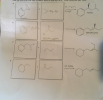 i dont think i did all of these right, so i wanted to check how to
solve for the starting mayerials that make the target molecule on
the right.
Use oprically active and racemic where appropriure. Une Holecule per DUX. OH 1.) > Mg-Br 2.) H20 racemic tacchic optically active Cically active cat. H2SO4
i dont think i did all of these right, so i wanted to check how to
solve for the starting mayerials that make the target molecule on
the right.
Use oprically active and racemic where appropriure. Une Holecule per DUX. OH 1.) > Mg-Br 2.) H20 racemic tacchic optically active Cically active cat. H2SO4
I want you guys to rewrite this lab procedure, and it is fine if it was shorter than this. An air...
I want you guys to rewrite this lab procedure, and it is fine if it was shorter than this. An air track was fitted with two photocell bridges, one on each side of the collision region. Each bridge was operating in a gate mode timer that allows the collection of time intervals before and after collision. To ensure that friction and gravity have minimal effects, the track was leveled. Before starting the experiment, we ensured that loss in velocity was...
Unsure on all parts of this question Pre-lab Assignment- Experiment 11 Conservation of Momentum Using the...
 Unsure on all parts of this question
Pre-lab Assignment- Experiment 11 Conservation of Momentum Using the Air Track 1. Suppose that before collision, slider A (MA-200 g) is traveling at 3.6 m/s and slider B (Ma 210 g) is at rest. a) (1 pt) What is the total momentum before collision? (Find the momentum of each slider befone the collision and then add them together.) b). (1 pt) After the collision, presume that the sliders move in the same direction...
Unsure on all parts of this question
Pre-lab Assignment- Experiment 11 Conservation of Momentum Using the Air Track 1. Suppose that before collision, slider A (MA-200 g) is traveling at 3.6 m/s and slider B (Ma 210 g) is at rest. a) (1 pt) What is the total momentum before collision? (Find the momentum of each slider befone the collision and then add them together.) b). (1 pt) After the collision, presume that the sliders move in the same direction...
i need help with these questions about physics. Elastic Collision Question 8 A 2 kg ball...
 i need help with these questions about physics.
Elastic Collision Question 8 A 2 kg ball initially at rest rolls down a 30-degree inclined plane from a height of 4 meters (assume kinetic and rolling friction are negligible). A 2 kg box initially at rest slides down a 30-degree directionless inclined plane from a height of 4 meters. How do the velocities of the ball and the box compare when they both reach the bottom of their respective inclined planes?...
i need help with these questions about physics.
Elastic Collision Question 8 A 2 kg ball initially at rest rolls down a 30-degree inclined plane from a height of 4 meters (assume kinetic and rolling friction are negligible). A 2 kg box initially at rest slides down a 30-degree directionless inclined plane from a height of 4 meters. How do the velocities of the ball and the box compare when they both reach the bottom of their respective inclined planes?...
Conservation of Momentum PHY 121 Lab 10 7) Now seeing what you saw, were you right?...
 Conservation of Momentum PHY 121 Lab 10 7) Now seeing what you saw, were you right? What can you say about the momentum before the collision and the momentum after the collision? Final Total Kinetic Energy after the collision: nǐ--%Error_07__ Now change the red cart to being heavier than the blue cart and the blue cart is again initially stationary (0m/s) Initial momentum: 10 N Initial Kinetic Energy: 25 J 8.) Write what you expect to happen to the carts...
Genetics 207 help! I did question #5 but I don’t think I did it correctly. I...
 Genetics 207 help! I did question #5 but I don’t think I did
it correctly. I don’t understand how to do question #7
7. Imagine you had a large collection of Drosophila mutants and wanted to find mutants who were more tolerant to alcohol than WT flies. Design an experiment that would allow you to find these mutants. You can draw on the literature posted for Assignment 2 for ideas. (2)
Genetics 207 help! I did question #5 but I don’t think I did
it correctly. I don’t understand how to do question #7
7. Imagine you had a large collection of Drosophila mutants and wanted to find mutants who were more tolerant to alcohol than WT flies. Design an experiment that would allow you to find these mutants. You can draw on the literature posted for Assignment 2 for ideas. (2)
 how do I factor in collision and friction
PART A Hardcopy due 11 am Moody December 12 A m, 500 object released with an iniull speed o120 oms from the top of a Iough track im above p a table which is h-2m high is desetmised that friction does 5l af wark alung the trakk lo the bullum. It these collides ouple with a m 1kg block that is initially at rest on Lable as shown. (a) Find the veiociy...
how do I factor in collision and friction
PART A Hardcopy due 11 am Moody December 12 A m, 500 object released with an iniull speed o120 oms from the top of a Iough track im above p a table which is h-2m high is desetmised that friction does 5l af wark alung the trakk lo the bullum. It these collides ouple with a m 1kg block that is initially at rest on Lable as shown. (a) Find the veiociy...
 Solution
This question,Where did 1 / 3ML ^ 2 come from? I dont
understand.Can you explain in detail?How did we get that number?Why
didn't we use 1 / 12ML2?
Q18 (15 points): A paintball gun is fired at a rod of total length L-40 cm and mass M-210 g. The rod is fixed from one end and can freely rotate without friction. The ball hits the rod and sticks to it, so that the ball+rod system starts rotating. What is...
Solution
This question,Where did 1 / 3ML ^ 2 come from? I dont
understand.Can you explain in detail?How did we get that number?Why
didn't we use 1 / 12ML2?
Q18 (15 points): A paintball gun is fired at a rod of total length L-40 cm and mass M-210 g. The rod is fixed from one end and can freely rotate without friction. The ball hits the rod and sticks to it, so that the ball+rod system starts rotating. What is...
 i dont think i did all of these right, so i wanted to check how to
solve for the starting mayerials that make the target molecule on
the right.
Use oprically active and racemic where appropriure. Une Holecule per DUX. OH 1.) > Mg-Br 2.) H20 racemic tacchic optically active Cically active cat. H2SO4
i dont think i did all of these right, so i wanted to check how to
solve for the starting mayerials that make the target molecule on
the right.
Use oprically active and racemic where appropriure. Une Holecule per DUX. OH 1.) > Mg-Br 2.) H20 racemic tacchic optically active Cically active cat. H2SO4
 Unsure on all parts of this question
Pre-lab Assignment- Experiment 11 Conservation of Momentum Using the Air Track 1. Suppose that before collision, slider A (MA-200 g) is traveling at 3.6 m/s and slider B (Ma 210 g) is at rest. a) (1 pt) What is the total momentum before collision? (Find the momentum of each slider befone the collision and then add them together.) b). (1 pt) After the collision, presume that the sliders move in the same direction...
Unsure on all parts of this question
Pre-lab Assignment- Experiment 11 Conservation of Momentum Using the Air Track 1. Suppose that before collision, slider A (MA-200 g) is traveling at 3.6 m/s and slider B (Ma 210 g) is at rest. a) (1 pt) What is the total momentum before collision? (Find the momentum of each slider befone the collision and then add them together.) b). (1 pt) After the collision, presume that the sliders move in the same direction...
 i need help with these questions about physics.
Elastic Collision Question 8 A 2 kg ball initially at rest rolls down a 30-degree inclined plane from a height of 4 meters (assume kinetic and rolling friction are negligible). A 2 kg box initially at rest slides down a 30-degree directionless inclined plane from a height of 4 meters. How do the velocities of the ball and the box compare when they both reach the bottom of their respective inclined planes?...
i need help with these questions about physics.
Elastic Collision Question 8 A 2 kg ball initially at rest rolls down a 30-degree inclined plane from a height of 4 meters (assume kinetic and rolling friction are negligible). A 2 kg box initially at rest slides down a 30-degree directionless inclined plane from a height of 4 meters. How do the velocities of the ball and the box compare when they both reach the bottom of their respective inclined planes?...
 Conservation of Momentum PHY 121 Lab 10 7) Now seeing what you saw, were you right? What can you say about the momentum before the collision and the momentum after the collision? Final Total Kinetic Energy after the collision: nǐ--%Error_07__ Now change the red cart to being heavier than the blue cart and the blue cart is again initially stationary (0m/s) Initial momentum: 10 N Initial Kinetic Energy: 25 J 8.) Write what you expect to happen to the carts...
 Genetics 207 help! I did question #5 but I don’t think I did
it correctly. I don’t understand how to do question #7
7. Imagine you had a large collection of Drosophila mutants and wanted to find mutants who were more tolerant to alcohol than WT flies. Design an experiment that would allow you to find these mutants. You can draw on the literature posted for Assignment 2 for ideas. (2)
Genetics 207 help! I did question #5 but I don’t think I did
it correctly. I don’t understand how to do question #7
7. Imagine you had a large collection of Drosophila mutants and wanted to find mutants who were more tolerant to alcohol than WT flies. Design an experiment that would allow you to find these mutants. You can draw on the literature posted for Assignment 2 for ideas. (2)
Most questions answered within 3 hours.
-
Where is the error in this code sequence?
String s1 = "Hello";
String s2 = "ello";...
asked 10 months ago -
Financial data for Joel de Paris, Inc., for last year
follow:
Joel de Paris, Inc.
Balance...
asked 10 months ago -
Consider this reaction:
Al2(SO4)3 (aq)+ BaCl3
(aq) Al2Cl6 (aq)- +
3BaSO4(s) . What is the...
asked 10 months ago -
Suppose that Savneet is considering increasing her
recent random sample from 20 car rentals to 40...
asked 10 months ago -
Trucks arrive at an unloading terminal at an average rate of 120
per hour.
Trucks arrive...
asked 10 months ago -
Why are methanol and ethanol completely soluble in water while
octanol is not very little soluble....
asked 10 months ago -
A facilities manager at a university reads in a research report
that the mean amount of...
asked 10 months ago -
When the CuSO4 is rehydrated by adding water to the anhydrous
compound, is this an endothermic...
asked 10 months ago -
A ray of sunlight is passing from diamond into crown glass; the
angle of incidence is...
asked 10 months ago -
A block of mass 0.249 kg is placed on top of a light, vertical
spring of...
asked 10 months ago -
how do the kidneys compensate in the presences of acidosis
a) trigger hyperventilate
b) reserve acid...
asked 10 months ago -
Question 501 pts
The rental rate of capital to the firm increases. Which of the
following...
asked 10 months ago