
Homework Answers
Option C
- A good is said to have a perfectly elastic demand if it is highly responsive to the changes in price.
- A perfectly elastic demand increases with a fall in the price of a good and decreases with a rise in the price of a good.
- In the above question, it is given that the draught causes the equilibrium price of wheat to rise by 10% , therefore if the total expenditure falls by 10% demand for wheat, we can say that the wheat has a perfectly elastic demand.
Add Answer to:
Question 2 A drought hits the market for wheat. If the equilibrium price of wheat rises...
1. Draw the supply and demand for wheat on a graph, and indicate the equilibrium price...
1. Draw the supply and demand for wheat on a graph, and indicate the equilibrium price and quantity. Suppose rice and wheat are consumption substitutes, and corn and wheat are production substitutes. Describe and show what happens in the market for wheat when 2 events occur at the same time: 1) the price of corn increases, and 2), a drought (lack of rain) occurs in rice-growing regions, causing the supply of rice to fall.. Suppose the drought in rice has...
Question 34 (1 point) Assume the market for wheat is perfectly competitive. At the current price...
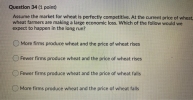 Question 34 (1 point) Assume the market for wheat is perfectly competitive. At the current price of wheat wheat farmers are making a large economic loss. Which of the follow would we expect to happen in the long run? More firms produce wheat and the price of wheat rises Fewer firms produce wheat and the price of wheat rises Fewer firms produce wheat and the price of wheat falls More firms produce wheat and the price of wheat falls
3. (20%) Consider the market was unregulated, with an equilibrium price of $200, and a quantity of 20,000 The suppl...
 3. (20%) Consider the market was unregulated, with an equilibrium price of $200, and a quantity of 20,000 The supply curve is perfectly inelastic, while the demand curve is perfectly elastic. (a) What burden of taxation falls on producers (this is an amount from $0 to $16)?3 (b) What is the Deadweight Loss from the tax? a tax on producers of $16 per unit. Before the tax's imposition,
3. (20%) Consider the market was unregulated, with an equilibrium price of...
3. (20%) Consider the market was unregulated, with an equilibrium price of $200, and a quantity of 20,000 The supply curve is perfectly inelastic, while the demand curve is perfectly elastic. (a) What burden of taxation falls on producers (this is an amount from $0 to $16)?3 (b) What is the Deadweight Loss from the tax? a tax on producers of $16 per unit. Before the tax's imposition,
3. (20%) Consider the market was unregulated, with an equilibrium price of...
QUESTION 7 Refer to the accompanying figure. The equilibrium price is and the equilibrium quantity is...
 QUESTION 7 Refer to the accompanying figure. The equilibrium price is and the equilibrium quantity is a. $4; 6 b.$6; 4 OC $2;8 d. $8; 6 QUESTION 8 The demand for a good is elastic if the price elasticity of demand is: a. equal to one b.equal to zero greater than one d.less than one QUESTION 9 If the price of textbooks increases by one percent and the quantity demanded falls by one-half percent, then demand for textbooks is: a....
Question 21 2.5 pts The following chart shows the yearly productivities of the average U.S.worker and...
 Question 21 2.5 pts The following chart shows the yearly productivities of the average U.S.worker and the average French worker in wine and bread. WINE BREAD (loaves/worker) (bottles/worker) U.S. 20 60 France 10 10 According to our trade models, which of the following statements is true? O Mutually beneficial trade is not possible in this case because France is equaly productive in both wine and bread Mutually beneficial trade can occur at aratio of a loaf of bread per bottle...
When prices decrease, total revenue O A. rises when demand is price elastic. O B. falls when demand is unit elastic O C...
 When prices decrease, total revenue O A. rises when demand is price elastic. O B. falls when demand is unit elastic O C. rises when demand is price inelastic O D. falls when demand is price elastic.
Question 17 Which of the following statements is true? If the price of a good is...
 Question 17 Which of the following statements is true? If the price of a good is lowered and total revenue decreases, demand is elastic, If the price of a good is raised and total revenue increases, demand is inelastic. If the price of a good is raised and total revenue does not change demand is perfectly elastic, If the price of a good is lowered and total revenue increases, demand is inelastic.
NAME SECTION LAST NAME FIRST NAME PRICE ELASTICITY OF DEMAND price elasticity of demand measures how...
 NAME SECTION LAST NAME FIRST NAME PRICE ELASTICITY OF DEMAND price elasticity of demand measures how much in percentage terms demand fails to the left) when price is demandes (shifts to the right when price ralls quantity demanded falls when price is quantity demanded rises when price rises the graphs below to answer questions 2 and 3. Graph A Price Price Graph B Demand Demand - Quantity Quantity demand. Graph A represents unit elastic zer elastic perfectly inclastic perfectly elastic...
Demand rises more than supply rises. Equilibrium price (remains unchanged, falls, or rises) Equilibrium quantity (remains...
 Demand rises more than supply rises.
Equilibrium price (remains unchanged, falls, or
rises)
Equilibrium quantity (remains unchanged, falls, or
rises)
Demand falls more than supply falls.
Equilibrium price (remains unchanged, falls, or
rises)
Equilibrium quantity (remains unchanged, falls, or
rises)
Back to Assignment Attempts: Average: 1 9. Working wth Numbers and Graphs Q9 Use the following graph to answer the question that follows. You will not be graded on any changes you make to the graph. Hint: Select and drag...
Demand rises more than supply rises.
Equilibrium price (remains unchanged, falls, or
rises)
Equilibrium quantity (remains unchanged, falls, or
rises)
Demand falls more than supply falls.
Equilibrium price (remains unchanged, falls, or
rises)
Equilibrium quantity (remains unchanged, falls, or
rises)
Back to Assignment Attempts: Average: 1 9. Working wth Numbers and Graphs Q9 Use the following graph to answer the question that follows. You will not be graded on any changes you make to the graph. Hint: Select and drag...
Which of the following statements is true? If the price of a good is lowered and...
 Which of the following statements is true? If the price of a good is lowered and total revenue decreases, demand is elastic. If the price of a good is raised and total revenue does not change, demand is perfectly elastic. If the price of a good is lowered and total revenue increases, demand is inelastic. If the price of a good is raised and total revenue increases, demand is inelastic. and relatively inelastic demand is represented by a demand curve...
 Question 34 (1 point) Assume the market for wheat is perfectly competitive. At the current price of wheat wheat farmers are making a large economic loss. Which of the follow would we expect to happen in the long run? More firms produce wheat and the price of wheat rises Fewer firms produce wheat and the price of wheat rises Fewer firms produce wheat and the price of wheat falls More firms produce wheat and the price of wheat falls
 3. (20%) Consider the market was unregulated, with an equilibrium price of $200, and a quantity of 20,000 The supply curve is perfectly inelastic, while the demand curve is perfectly elastic. (a) What burden of taxation falls on producers (this is an amount from $0 to $16)?3 (b) What is the Deadweight Loss from the tax? a tax on producers of $16 per unit. Before the tax's imposition,
3. (20%) Consider the market was unregulated, with an equilibrium price of...
3. (20%) Consider the market was unregulated, with an equilibrium price of $200, and a quantity of 20,000 The supply curve is perfectly inelastic, while the demand curve is perfectly elastic. (a) What burden of taxation falls on producers (this is an amount from $0 to $16)?3 (b) What is the Deadweight Loss from the tax? a tax on producers of $16 per unit. Before the tax's imposition,
3. (20%) Consider the market was unregulated, with an equilibrium price of...
 QUESTION 7 Refer to the accompanying figure. The equilibrium price is and the equilibrium quantity is a. $4; 6 b.$6; 4 OC $2;8 d. $8; 6 QUESTION 8 The demand for a good is elastic if the price elasticity of demand is: a. equal to one b.equal to zero greater than one d.less than one QUESTION 9 If the price of textbooks increases by one percent and the quantity demanded falls by one-half percent, then demand for textbooks is: a....
 Question 21 2.5 pts The following chart shows the yearly productivities of the average U.S.worker and the average French worker in wine and bread. WINE BREAD (loaves/worker) (bottles/worker) U.S. 20 60 France 10 10 According to our trade models, which of the following statements is true? O Mutually beneficial trade is not possible in this case because France is equaly productive in both wine and bread Mutually beneficial trade can occur at aratio of a loaf of bread per bottle...
 When prices decrease, total revenue O A. rises when demand is price elastic. O B. falls when demand is unit elastic O C. rises when demand is price inelastic O D. falls when demand is price elastic.
 Question 17 Which of the following statements is true? If the price of a good is lowered and total revenue decreases, demand is elastic, If the price of a good is raised and total revenue increases, demand is inelastic. If the price of a good is raised and total revenue does not change demand is perfectly elastic, If the price of a good is lowered and total revenue increases, demand is inelastic.
 NAME SECTION LAST NAME FIRST NAME PRICE ELASTICITY OF DEMAND price elasticity of demand measures how much in percentage terms demand fails to the left) when price is demandes (shifts to the right when price ralls quantity demanded falls when price is quantity demanded rises when price rises the graphs below to answer questions 2 and 3. Graph A Price Price Graph B Demand Demand - Quantity Quantity demand. Graph A represents unit elastic zer elastic perfectly inclastic perfectly elastic...
 Demand rises more than supply rises.
Equilibrium price (remains unchanged, falls, or
rises)
Equilibrium quantity (remains unchanged, falls, or
rises)
Demand falls more than supply falls.
Equilibrium price (remains unchanged, falls, or
rises)
Equilibrium quantity (remains unchanged, falls, or
rises)
Back to Assignment Attempts: Average: 1 9. Working wth Numbers and Graphs Q9 Use the following graph to answer the question that follows. You will not be graded on any changes you make to the graph. Hint: Select and drag...
Demand rises more than supply rises.
Equilibrium price (remains unchanged, falls, or
rises)
Equilibrium quantity (remains unchanged, falls, or
rises)
Demand falls more than supply falls.
Equilibrium price (remains unchanged, falls, or
rises)
Equilibrium quantity (remains unchanged, falls, or
rises)
Back to Assignment Attempts: Average: 1 9. Working wth Numbers and Graphs Q9 Use the following graph to answer the question that follows. You will not be graded on any changes you make to the graph. Hint: Select and drag...
 Which of the following statements is true? If the price of a good is lowered and total revenue decreases, demand is elastic. If the price of a good is raised and total revenue does not change, demand is perfectly elastic. If the price of a good is lowered and total revenue increases, demand is inelastic. If the price of a good is raised and total revenue increases, demand is inelastic. and relatively inelastic demand is represented by a demand curve...
Most questions answered within 3 hours.
-
Where is the error in this code sequence?
String s1 = "Hello";
String s2 = "ello";...
asked 10 months ago -
Financial data for Joel de Paris, Inc., for last year
follow:
Joel de Paris, Inc.
Balance...
asked 10 months ago -
Consider this reaction:
Al2(SO4)3 (aq)+ BaCl3
(aq) Al2Cl6 (aq)- +
3BaSO4(s) . What is the...
asked 10 months ago -
Suppose that Savneet is considering increasing her
recent random sample from 20 car rentals to 40...
asked 10 months ago -
Trucks arrive at an unloading terminal at an average rate of 120
per hour.
Trucks arrive...
asked 10 months ago -
Why are methanol and ethanol completely soluble in water while
octanol is not very little soluble....
asked 10 months ago -
A facilities manager at a university reads in a research report
that the mean amount of...
asked 10 months ago -
When the CuSO4 is rehydrated by adding water to the anhydrous
compound, is this an endothermic...
asked 10 months ago -
A ray of sunlight is passing from diamond into crown glass; the
angle of incidence is...
asked 10 months ago -
A block of mass 0.249 kg is placed on top of a light, vertical
spring of...
asked 10 months ago -
how do the kidneys compensate in the presences of acidosis
a) trigger hyperventilate
b) reserve acid...
asked 10 months ago -
Question 501 pts
The rental rate of capital to the firm increases. Which of the
following...
asked 10 months ago