For a radical addition reaction involving HBr and propene, sort each reaction step into the following...
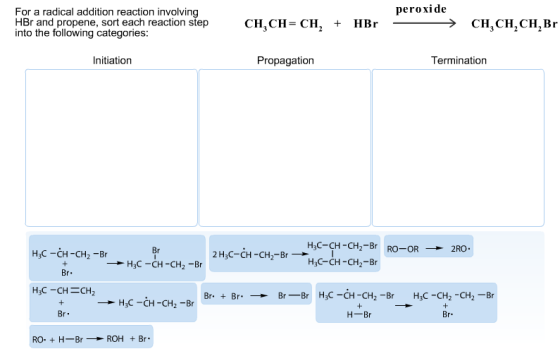
For a radical addition reaction involving HBr and propene, sort each reaction step into the following categories:
Homework Answers
Free radical addition reactions:
A free radical addition reaction is a chemical reaction which requires free radicals to initiate the reaction. There are three steps in the reaction. They are: the initiation step, propagation step and termination step.
Three steps for the free radical reaction:
I.Initiation
II.Propagation
III.Termination
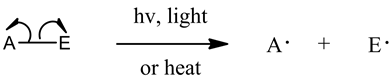
Initiation step:
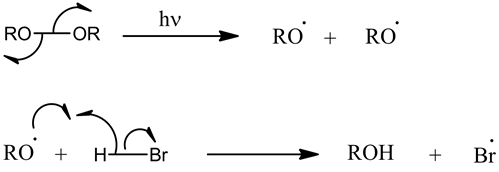
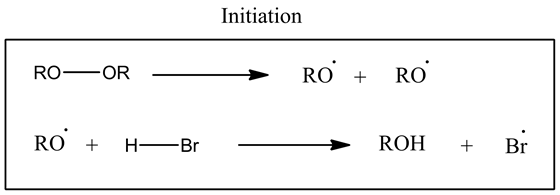
An initiation step is the first step in the reaction where free radicals are generated from neutral species (non-radicals).
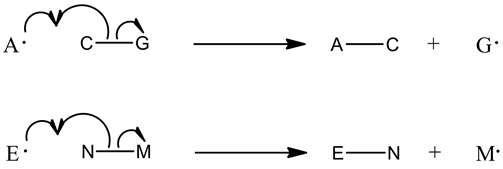
Propagation step:
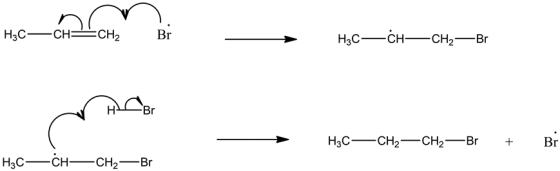
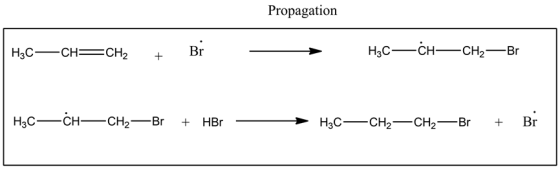
A propagation step is the second step in the reaction in which new free radicals are produced from the highly reactive free radical.
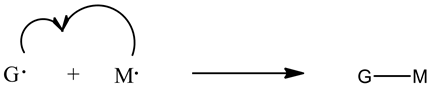
Termination step:
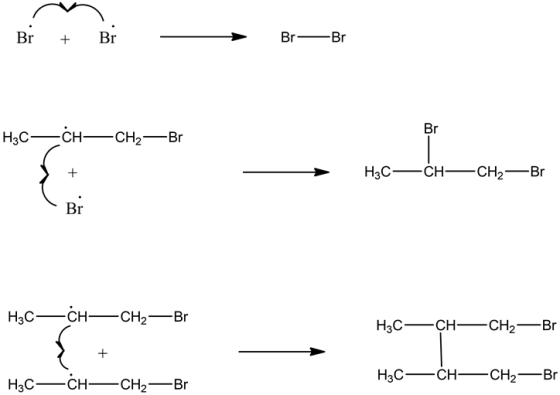
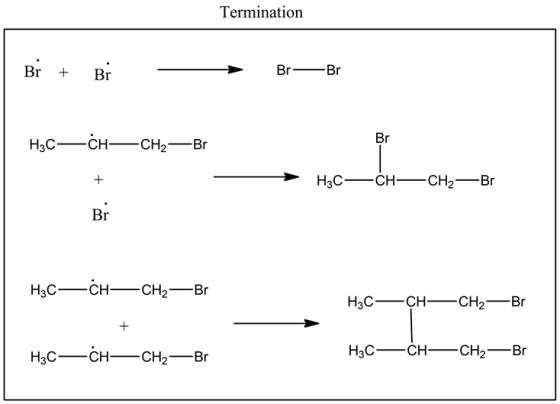
A termination step is the last step in the reaction. Two free radicals combine with each other, forming a neutral molecule (non-radicals).
Initiation steps:
Propagation steps:
Termination steps:
Add Answer to:
For a radical addition reaction involving HBr and propene, sort each reaction step into the following...
4) Which of the following reactions is faster: Addition of HBr to 2-methyl propene or addition...
 4) Which of the following reactions is faster: Addition of HBr to 2-methyl propene or addition of HBr to trans-2-butene. Assume the energy difference between starting alkenes can be ignored. Explain. (2 pts)
Hydroboration of propene involves 'Anti-Markovnikov' addition while addition of HBr to propene follows the Markovnikov rule....
Hydroboration of propene involves 'Anti-Markovnikov' addition while addition of HBr to propene follows the Markovnikov rule. Show that both of these apparently contrasting reactions actually reflect a single underlying mechanistic principle
1. Specifically explain the differences between the addition of HBr to propene by the ionic mechanism...
 1. Specifically explain the differences between the addition of HBr to propene by the ionic mechanism and by the free-radical mechanism. Differences should include: (a) Reactants (when writing a mechanism be sure to write out (b) Mechanisms complete structures.) (c) Product (may be abbreviated with a line-angle drawing if you wish) differences
Draw the mechanism arrows for both propagation steps for the radical addition of HBr to the...
 Draw the mechanism arrows for both propagation steps for the
radical addition of HBr to the alkene.
Draw the mechanism arrows for both propagation steps for the radical addition of HBr to the alkene.Draw the mechanism arrows for both propagation steps for the radical addition of HBr to the alkene. To add curved arrows that meet in space, first add a generic atom X, then add the curved arrows so that they terminate at the X, In each box, do...
Draw the mechanism arrows for both propagation steps for the
radical addition of HBr to the alkene.
Draw the mechanism arrows for both propagation steps for the radical addition of HBr to the alkene.Draw the mechanism arrows for both propagation steps for the radical addition of HBr to the alkene. To add curved arrows that meet in space, first add a generic atom X, then add the curved arrows so that they terminate at the X, In each box, do...
The chlorination of propane proceeds as a radical chain reaction. Sort the 7 reaction steps
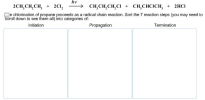 The chlorination of propane proceeds as a radical chain reaction. Sort the 7 reaction steps (you may need to scroll down to see them all) into categories of:
Give the structures of the free-radical intermediates in the peroxide-initiated reaction of HBr with the following...
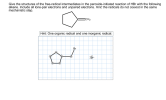 Give the structures of the free-radical intermediates in the peroxide-initiated reaction of HBr with the following alkene. Include all lone-pair electrons and unpaired electrons. Hint: the radicals do not coexist in the same mechanistic step. CH2 Hint: One organic radical and one inorganic radical.
Show the mechanism for the following radical reaction. Classifyeach step as one of the 6 patterns...
 Show the mechanism for the following radical reaction. Classifyeach step as one of the 6 patterns listed on pages 506-507 and label each step as one of the following categories: initiation, propagation, ortermination. (Hint:Each step is going to have two classifications.On of the six patterns and one of the three categories.) (5 pts.) 2. Br2, hv
Give the structures of the free-radical intermediates in the peroxide-initiated reaction of HBr with the following...
 Give the structures of the free-radical intermediates in the
peroxide-initiated reaction of HBr with the following alkene.
Include all lone-pair electrons and unpaired electrons. Hint: the
radicals do not coexist in the same mechanistic step.
Give the structures of the free-radical intermediates in the
peroxide-initiated reaction of HBr with the following alkene.
Include all lone-pair electrons and unpaired electrons. Hint: the
radicals do not coexist in the same mechanistic step.
Question 6 Free-radical addition of HBr/peroxides to an alkene goes through A) a carbocation intermediate that...
 Question 6 Free-radical addition of HBr/peroxides to an alkene goes through A) a carbocation intermediate that is formed on the more substituted carbon B) a carbocation intermediate that is formed on the least substituted carbon C) a radical intermediate that is formed on the least substituted carbon. D) a radical intermediate that is formed on the most substituted carbon.
Question 6 Free-radical addition of HBr/peroxides to an alkene goes through A) a carbocation intermediate that is formed on the more...
Question 6 Free-radical addition of HBr/peroxides to an alkene goes through A) a carbocation intermediate that is formed on the more substituted carbon B) a carbocation intermediate that is formed on the least substituted carbon C) a radical intermediate that is formed on the least substituted carbon. D) a radical intermediate that is formed on the most substituted carbon.
Question 6 Free-radical addition of HBr/peroxides to an alkene goes through A) a carbocation intermediate that is formed on the more...
What is Wrong? Select the keyword or phrase that will best complete each sentence. Key terms: A radical...
 What is Wrong?
Select the keyword or phrase that will best complete each sentence. Key terms: A radical is a reactive intermediate with a single unpaired electron, formed by homoloysis of a covalent bond. paired unpaired Allylic radicals are stabilized by resonance, making them more stable than tertiary radicals increases inductive effects A compound that contains an especially weak bond that serves as a source of radicals is called a radical initiator ess homoloysis decreases more J Treatment of cyclohexene...
What is Wrong?
Select the keyword or phrase that will best complete each sentence. Key terms: A radical is a reactive intermediate with a single unpaired electron, formed by homoloysis of a covalent bond. paired unpaired Allylic radicals are stabilized by resonance, making them more stable than tertiary radicals increases inductive effects A compound that contains an especially weak bond that serves as a source of radicals is called a radical initiator ess homoloysis decreases more J Treatment of cyclohexene...
 4) Which of the following reactions is faster: Addition of HBr to 2-methyl propene or addition of HBr to trans-2-butene. Assume the energy difference between starting alkenes can be ignored. Explain. (2 pts)
 1. Specifically explain the differences between the addition of HBr to propene by the ionic mechanism and by the free-radical mechanism. Differences should include: (a) Reactants (when writing a mechanism be sure to write out (b) Mechanisms complete structures.) (c) Product (may be abbreviated with a line-angle drawing if you wish) differences
 Draw the mechanism arrows for both propagation steps for the
radical addition of HBr to the alkene.
Draw the mechanism arrows for both propagation steps for the radical addition of HBr to the alkene.Draw the mechanism arrows for both propagation steps for the radical addition of HBr to the alkene. To add curved arrows that meet in space, first add a generic atom X, then add the curved arrows so that they terminate at the X, In each box, do...
Draw the mechanism arrows for both propagation steps for the
radical addition of HBr to the alkene.
Draw the mechanism arrows for both propagation steps for the radical addition of HBr to the alkene.Draw the mechanism arrows for both propagation steps for the radical addition of HBr to the alkene. To add curved arrows that meet in space, first add a generic atom X, then add the curved arrows so that they terminate at the X, In each box, do...
 Give the structures of the free-radical intermediates in the peroxide-initiated reaction of HBr with the following alkene. Include all lone-pair electrons and unpaired electrons. Hint: the radicals do not coexist in the same mechanistic step. CH2 Hint: One organic radical and one inorganic radical.
 Show the mechanism for the following radical reaction. Classifyeach step as one of the 6 patterns listed on pages 506-507 and label each step as one of the following categories: initiation, propagation, ortermination. (Hint:Each step is going to have two classifications.On of the six patterns and one of the three categories.) (5 pts.) 2. Br2, hv
 Give the structures of the free-radical intermediates in the
peroxide-initiated reaction of HBr with the following alkene.
Include all lone-pair electrons and unpaired electrons. Hint: the
radicals do not coexist in the same mechanistic step.
Give the structures of the free-radical intermediates in the
peroxide-initiated reaction of HBr with the following alkene.
Include all lone-pair electrons and unpaired electrons. Hint: the
radicals do not coexist in the same mechanistic step.
 Question 6 Free-radical addition of HBr/peroxides to an alkene goes through A) a carbocation intermediate that is formed on the more substituted carbon B) a carbocation intermediate that is formed on the least substituted carbon C) a radical intermediate that is formed on the least substituted carbon. D) a radical intermediate that is formed on the most substituted carbon.
Question 6 Free-radical addition of HBr/peroxides to an alkene goes through A) a carbocation intermediate that is formed on the more...
Question 6 Free-radical addition of HBr/peroxides to an alkene goes through A) a carbocation intermediate that is formed on the more substituted carbon B) a carbocation intermediate that is formed on the least substituted carbon C) a radical intermediate that is formed on the least substituted carbon. D) a radical intermediate that is formed on the most substituted carbon.
Question 6 Free-radical addition of HBr/peroxides to an alkene goes through A) a carbocation intermediate that is formed on the more...
 What is Wrong?
Select the keyword or phrase that will best complete each sentence. Key terms: A radical is a reactive intermediate with a single unpaired electron, formed by homoloysis of a covalent bond. paired unpaired Allylic radicals are stabilized by resonance, making them more stable than tertiary radicals increases inductive effects A compound that contains an especially weak bond that serves as a source of radicals is called a radical initiator ess homoloysis decreases more J Treatment of cyclohexene...
What is Wrong?
Select the keyword or phrase that will best complete each sentence. Key terms: A radical is a reactive intermediate with a single unpaired electron, formed by homoloysis of a covalent bond. paired unpaired Allylic radicals are stabilized by resonance, making them more stable than tertiary radicals increases inductive effects A compound that contains an especially weak bond that serves as a source of radicals is called a radical initiator ess homoloysis decreases more J Treatment of cyclohexene...
Most questions answered within 3 hours.
-
Where is the error in this code sequence?
String s1 = "Hello";
String s2 = "ello";...
asked 11 months ago -
Financial data for Joel de Paris, Inc., for last year
follow:
Joel de Paris, Inc.
Balance...
asked 11 months ago -
Consider this reaction:
Al2(SO4)3 (aq)+ BaCl3
(aq) Al2Cl6 (aq)- +
3BaSO4(s) . What is the...
asked 11 months ago -
Suppose that Savneet is considering increasing her
recent random sample from 20 car rentals to 40...
asked 11 months ago -
Trucks arrive at an unloading terminal at an average rate of 120
per hour.
Trucks arrive...
asked 11 months ago -
Why are methanol and ethanol completely soluble in water while
octanol is not very little soluble....
asked 11 months ago -
A facilities manager at a university reads in a research report
that the mean amount of...
asked 11 months ago -
When the CuSO4 is rehydrated by adding water to the anhydrous
compound, is this an endothermic...
asked 11 months ago -
A ray of sunlight is passing from diamond into crown glass; the
angle of incidence is...
asked 11 months ago -
A block of mass 0.249 kg is placed on top of a light, vertical
spring of...
asked 11 months ago -
how do the kidneys compensate in the presences of acidosis
a) trigger hyperventilate
b) reserve acid...
asked 11 months ago -
Question 501 pts
The rental rate of capital to the firm increases. Which of the
following...
asked 11 months ago