![Problem 0.1 Let Xt be the number of people who enter a bank by time> 0. Suppose t*e-! for k = 0,1,2 ,and for t > s > 0, and k > r = 0,1,2, (b) Find ElXyIX,-1]. Useful information: Dont eat yellow snow, and e- .*/k!](http://img.homeworklib.com/questions/3e44aa90-4988-11ea-8e07-33c77a06a361.png?x-oss-process=image/resize,w_560)
Homework Answers


Add Answer to:
Problem 0.1 Let Xt be the number of people who enter a bank by time> 0....
Problem 0.1 Let X be the number of people who enter a bank by time t>0....
 Problem 0.1 Let X be the number of people who enter a bank by time t>0. Suppose ke-t k! for k 0,1,2,., and for t>s > 0, and k-r=0,1,2, . . . . (a) Find Pr(X2 = k | X,-1) for k = 0, 1, 2, . . . . (b) Find E[X2 X1-1 Useful information: Don't eat yellow snow, and et-L=0 tk/k! Problem 0.2 Recall the Geometric(p) distribution where Xnumber of flips of a coin until you get a...
Problem o.1 Let X, be the number of people who enter a bank by time t...
 Problem o.1 Let X, be the number of people who enter a bank by time t > 0. Suppose k! for k- 0,1,2,..., and s (t - s)k-e-t for t>s> 0, and k2r 0,1,2,.... (a) Find Pr[X2 k| X 1 for k 0,1,2,.... (b) Find E2 X1 1 Useful information: Don't eat yellow snow, andeot/k! Problem o.2 Recall the Geometric(p) distribution where X- number of flips of a coin until you get a head (H) with Pr(H) - p. The...
Problem 0.1 Let Xt be the number of people who enter a bank by time t...
Problem 0.1 Let Xt be the number of people who enter a bank by time t > 0. Suppose Pr[Xt = k] ... Problem 0.1 Let Xt be the number of people who enter a bank by time t > 0. Suppose Pr[Xt = k] = (tk e−t )/k! , for k = [0, 1, 2, . . . ,] and Pr[Xt = k, Xs = r] = sr *(t − s)k−r *e−t /(r!(k − r)!) , for t >...
Problem 0.1 Let Xt be the number of people who enter a bank by time t...
Problem 0.1 Let Xt be the number of people who enter a bank by time t > 0. Suppose Pr[Xt = k] = (t k e −t )/k! , for k = [0, 1, 2, . . . ,] and Pr[Xt = k, Xs = r] = sr *(t − s)k−r *e−t /(r!(k − r)!) , for t > s > 0, and k ≥ r = 0, 1, 2, . . . . (a) Find Pr[X2 = k |...
1. Let {Xt;t >0} be a pure birth process with rate 1x > 0, for x...
 1. Let {Xt;t >0} be a pure birth process with rate 1x > 0, for x € S = {0,1,2,...}. (a) Write the backward equations (KBE) and use it to solve for Prz(t). (b) Use the result to part (a) to show that the waiting time in state x, say Wx, is exponentially distributed (c) Suppose 1x = 1 is constant for all x E S. Prove by induction that Px-kx(t) = (at) ke Af/k! for k = 0,..., and...
Let X-(Xt ,0 < t < 1} be an arithmetic Brownian motion starting from 0 with...
 Let X-(Xt ,0 < t < 1} be an arithmetic Brownian motion starting from 0 with drift parameter μ-0.2 and variance parameter ơ2-0.125. 1. Calculate the probability that X2 is between 0.1 and 0.5 2. Given that X 0.6, find the probability that X2 is between 0.1 and 0.5 3. Given that Xi- 0.2, find the covariance between X2 and X3
3. (a) Let (X,Y) have the joint pmf (2 + y + k – 1)! P(X = 1, Y = y) => pip (1- P1 - p2), r!y!(k − 1)! where r, y=0,...
 3. (a) Let (X,Y) have the joint pmf (2 + y + k – 1)! P(X = 1, Y = y) => pip (1- P1 - p2), r!y!(k − 1)! where r, y=0,1,2, ..., k> 1 is an integer, 0 <P1 <1,0 <p2 <1, and p1 + P2 <1, find the marginal pmfs of X and Y and the conditional pmf of Y given X = r.
Let Xi X, lid f(r 0) with f(r:0)-e ( e) for r > ? and ?...
 Let Xi X, lid f(r 0) with f(r:0)-e ( e) for r > ? and ? e R. (a) Find the MLE of ? (c) Using the prior density ?(0)-e-91(0,0)( ?), find the Bayesian estimator of ?
3. Let X be a ry, with m.gj. M given by M()-eat+βι2, ț e R(α e...
 3. Let X be a ry, with m.gj. M given by M()-eat+βι2, ț e R(α e R, β > 0). Find the ch.f. of X and identify its p.d.f. Also, use the ch.f. of X in order to calculate E(X4). at+ Br
Let K be the number of heads in 180 flips of a coin. The null hypothesis...
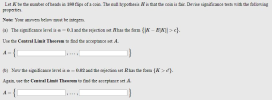 Let K be the number of heads in 180 flips of a coin. The null hypothesis H is that the coin is fair. Devise significance tests with the following properties Note: 1our answers below must be integers. (a) The significance level is a 0.1 and the rejection set Rhas the form {K Use the Central Limit Theorem to find the acceptance set A. EK] c Now the significance level is ? (b) Again, use the Central Limit Theorem to find...
 Problem 0.1 Let X be the number of people who enter a bank by time t>0. Suppose ke-t k! for k 0,1,2,., and for t>s > 0, and k-r=0,1,2, . . . . (a) Find Pr(X2 = k | X,-1) for k = 0, 1, 2, . . . . (b) Find E[X2 X1-1 Useful information: Don't eat yellow snow, and et-L=0 tk/k! Problem 0.2 Recall the Geometric(p) distribution where Xnumber of flips of a coin until you get a...
 Problem o.1 Let X, be the number of people who enter a bank by time t > 0. Suppose k! for k- 0,1,2,..., and s (t - s)k-e-t for t>s> 0, and k2r 0,1,2,.... (a) Find Pr[X2 k| X 1 for k 0,1,2,.... (b) Find E2 X1 1 Useful information: Don't eat yellow snow, andeot/k! Problem o.2 Recall the Geometric(p) distribution where X- number of flips of a coin until you get a head (H) with Pr(H) - p. The...
 1. Let {Xt;t >0} be a pure birth process with rate 1x > 0, for x € S = {0,1,2,...}. (a) Write the backward equations (KBE) and use it to solve for Prz(t). (b) Use the result to part (a) to show that the waiting time in state x, say Wx, is exponentially distributed (c) Suppose 1x = 1 is constant for all x E S. Prove by induction that Px-kx(t) = (at) ke Af/k! for k = 0,..., and...
 Let X-(Xt ,0 < t < 1} be an arithmetic Brownian motion starting from 0 with drift parameter μ-0.2 and variance parameter ơ2-0.125. 1. Calculate the probability that X2 is between 0.1 and 0.5 2. Given that X 0.6, find the probability that X2 is between 0.1 and 0.5 3. Given that Xi- 0.2, find the covariance between X2 and X3
 3. (a) Let (X,Y) have the joint pmf (2 + y + k – 1)! P(X = 1, Y = y) => pip (1- P1 - p2), r!y!(k − 1)! where r, y=0,1,2, ..., k> 1 is an integer, 0 <P1 <1,0 <p2 <1, and p1 + P2 <1, find the marginal pmfs of X and Y and the conditional pmf of Y given X = r.
 Let Xi X, lid f(r 0) with f(r:0)-e ( e) for r > ? and ? e R. (a) Find the MLE of ? (c) Using the prior density ?(0)-e-91(0,0)( ?), find the Bayesian estimator of ?
 3. Let X be a ry, with m.gj. M given by M()-eat+βι2, ț e R(α e R, β > 0). Find the ch.f. of X and identify its p.d.f. Also, use the ch.f. of X in order to calculate E(X4). at+ Br
 Let K be the number of heads in 180 flips of a coin. The null hypothesis H is that the coin is fair. Devise significance tests with the following properties Note: 1our answers below must be integers. (a) The significance level is a 0.1 and the rejection set Rhas the form {K Use the Central Limit Theorem to find the acceptance set A. EK] c Now the significance level is ? (b) Again, use the Central Limit Theorem to find...
Most questions answered within 3 hours.
-
Where is the error in this code sequence?
String s1 = "Hello";
String s2 = "ello";...
asked 11 months ago -
Financial data for Joel de Paris, Inc., for last year
follow:
Joel de Paris, Inc.
Balance...
asked 11 months ago -
Consider this reaction:
Al2(SO4)3 (aq)+ BaCl3
(aq) Al2Cl6 (aq)- +
3BaSO4(s) . What is the...
asked 11 months ago -
Suppose that Savneet is considering increasing her
recent random sample from 20 car rentals to 40...
asked 11 months ago -
Trucks arrive at an unloading terminal at an average rate of 120
per hour.
Trucks arrive...
asked 11 months ago -
Why are methanol and ethanol completely soluble in water while
octanol is not very little soluble....
asked 11 months ago -
A facilities manager at a university reads in a research report
that the mean amount of...
asked 11 months ago -
When the CuSO4 is rehydrated by adding water to the anhydrous
compound, is this an endothermic...
asked 11 months ago -
A ray of sunlight is passing from diamond into crown glass; the
angle of incidence is...
asked 11 months ago -
A block of mass 0.249 kg is placed on top of a light, vertical
spring of...
asked 11 months ago -
how do the kidneys compensate in the presences of acidosis
a) trigger hyperventilate
b) reserve acid...
asked 11 months ago -
Question 501 pts
The rental rate of capital to the firm increases. Which of the
following...
asked 11 months ago