Biochemistry question Glycogen phosphorylase is able to binds glucose molecules, which acts as a competitive inhibitor...
Biochemistry question
Glycogen phosphorylase is able to binds glucose molecules, which acts as a competitive inhibitor of the enzyme. What is the physiological advantage of this?
Homework Answers

Add Answer to:
Biochemistry question Glycogen phosphorylase is able to binds glucose molecules, which acts as a competitive inhibitor...
Q5. The phosphorylase enzyme, which is involved in breakdown of glycogen to glucose, is controlled by...
 Q5. The phosphorylase enzyme, which is involved in breakdown of glycogen to glucose, is controlled by both allosteric mechanisms and posttranslational modification. A) Describe how the T to R transition and activity of glycogen phosphorylase would change under the following conditions: i) high AMP levels and activation of phosphoprotein phosphatase, ii) activation of phosphorylase kinase, ili) activation of phosphorylase kinase and high glucose levels. B) What properties would an uncompetitive inhibitor of glycogen phosphorylase have, what would the Lineweaver Burk...
To answer this question, you may reference the Metabolic Map. Glycogen phosphorylase catalyzes a reaction that...
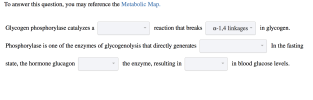 To answer this question, you may reference the Metabolic Map.
Glycogen phosphorylase catalyzes a
reaction that breaks glycogen. Phosphorylase is one
of the enzymes of glycogenolysis that directly
generates In the fasting state, the hormone
glucagon the enzyme, resulting in
in blood glucose levels.
To answer this question, you may reference the Metabolic Map. Glycogen phosphorylase catalyzes a reaction that breaks -1,4 linkages in glycogen. Phosphorylase is one of the enzymes of glycogenolysis that directly generates - In the fasting state, the...
To answer this question, you may reference the Metabolic Map.
Glycogen phosphorylase catalyzes a
reaction that breaks glycogen. Phosphorylase is one
of the enzymes of glycogenolysis that directly
generates In the fasting state, the hormone
glucagon the enzyme, resulting in
in blood glucose levels.
To answer this question, you may reference the Metabolic Map. Glycogen phosphorylase catalyzes a reaction that breaks -1,4 linkages in glycogen. Phosphorylase is one of the enzymes of glycogenolysis that directly generates - In the fasting state, the...
In its non-phosphorylated state, glycogen phosphorylase can be activated by which of the following molecules? 0...
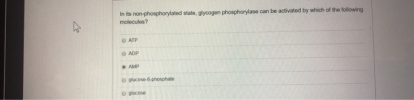 In its non-phosphorylated state, glycogen phosphorylase can be activated by which of the following molecules? 0 АТР ADP AMP glucose-6-phosphate glucose
BIOCHEMISTRY PALA (shown below) binds to the active site of ATCase and is an important probe...
 BIOCHEMISTRY
PALA (shown below) binds to the active site of ATCase and is an
important probe molecule to study ATCase regulation. PALA acts as
_______________ type of inhibitor and acts to stabilize the
__________-state of the enzyme.
PALA{N-(phosphonasetyl)-L-aspartate.
A) uncompetitive/T
B) competitive/T
C) Uncompetitive/R
D) Competitive/R
E) Noncompetitive/R
HN Cooc Jacooo
BIOCHEMISTRY
PALA (shown below) binds to the active site of ATCase and is an
important probe molecule to study ATCase regulation. PALA acts as
_______________ type of inhibitor and acts to stabilize the
__________-state of the enzyme.
PALA{N-(phosphonasetyl)-L-aspartate.
A) uncompetitive/T
B) competitive/T
C) Uncompetitive/R
D) Competitive/R
E) Noncompetitive/R
HN Cooc Jacooo
Which of these enzymes is correctly paired with one of its immediate products? a. Glycogen phosphorylase:...
Which of these enzymes is correctly paired with one of its immediate products? a. Glycogen phosphorylase: Glucose 6-P b. Fatty acid synthase: Oleate c. HMG CoA Reductase: HMG CoA d. Debranching enzyme: Free glucose
Reset Help noncompetitive enzyme irreversible acetylcholinesterase competitive active site 1. A inhibitor binds to a site...
 Reset Help noncompetitive enzyme irreversible acetylcholinesterase competitive active site 1. A inhibitor binds to a site on the enzyme that is not the active site. 2. Insecticides and nerve gases act as irreversible inhibitors of nerve conduction. an enzyme needed for 3. A inhibitor has a structure that is so similar to the substrate that it can bond to the enzyme just like the substrate. 4. Usually, an nhibitor forms a covalent bond with an amino acid side group within...
Exact question An inhibitor that binds to the active site and ends up forming a permanent...
Exact question An inhibitor that binds to the active site and ends up forming a permanent covalent bond with an enzyme is a (select all that apply) 1) irreversible inhibitor 2) competitive inhibitor 3) transition state analog 4) mechanism based inhibitor 5) reversible inhibitor
An enzyme binds to a competitive inhibitor with Kd = 1.2 × 10⁻⁶ M at pH 7.0 and 25°C.
An enzyme binds to a competitive inhibitor with Kd = 1.2 × 10⁻⁶ M at pH 7.0 and 25°C.(a)At what inhibitor concentration will 75% of the enzyme be bound to the inhibitor if there is no substrate present? (b) This enzyme has a Km of 4.0 × 10⁻⁵ M and a Vmax of 50 μM/s. At a substrate concentration of 3.0 × 10⁻⁴ M, calculate (i) the velocity of reaction in the presence of the inhibitor at 4.8 x 10⁻⁵ M (ii) the degree of...
On Glycogen storage disease, Alex has a deficiency in the enzyme muscle phosphorylase a which leads...
On Glycogen storage disease, Alex has a deficiency in the enzyme muscle phosphorylase a which leads to high levels of glycogen. Explain why Alex has lower levels of lactate compared to a control after a workout? Be sure to mention what is the purpose of producing lactate in a healthy human.
QUESTION 14 What is the ratio of carbon-bound hydrogens to carbon of glucose? O 6/6 O...
 QUESTION 14 What is the ratio of carbon-bound hydrogens to carbon of glucose? O 6/6 O 7/6 O 12/6 6/7 QUESTION 22 Which of the following is false about gluconeogenesis? Glycolysis is catabolic, while gluconeogenesis is anabolic There are four reactions unique to gluconeogenesis Gluconeogenesis is simply the reverse of glycolysis Gluconeogenesis synthesizes glucose All of these are true QUESTION 36 Use the information below to answer questions 36-38 The concentration of glucose in human blood plasma is maintained at...
 Q5. The phosphorylase enzyme, which is involved in breakdown of glycogen to glucose, is controlled by both allosteric mechanisms and posttranslational modification. A) Describe how the T to R transition and activity of glycogen phosphorylase would change under the following conditions: i) high AMP levels and activation of phosphoprotein phosphatase, ii) activation of phosphorylase kinase, ili) activation of phosphorylase kinase and high glucose levels. B) What properties would an uncompetitive inhibitor of glycogen phosphorylase have, what would the Lineweaver Burk...
 To answer this question, you may reference the Metabolic Map.
Glycogen phosphorylase catalyzes a
reaction that breaks glycogen. Phosphorylase is one
of the enzymes of glycogenolysis that directly
generates In the fasting state, the hormone
glucagon the enzyme, resulting in
in blood glucose levels.
To answer this question, you may reference the Metabolic Map. Glycogen phosphorylase catalyzes a reaction that breaks -1,4 linkages in glycogen. Phosphorylase is one of the enzymes of glycogenolysis that directly generates - In the fasting state, the...
To answer this question, you may reference the Metabolic Map.
Glycogen phosphorylase catalyzes a
reaction that breaks glycogen. Phosphorylase is one
of the enzymes of glycogenolysis that directly
generates In the fasting state, the hormone
glucagon the enzyme, resulting in
in blood glucose levels.
To answer this question, you may reference the Metabolic Map. Glycogen phosphorylase catalyzes a reaction that breaks -1,4 linkages in glycogen. Phosphorylase is one of the enzymes of glycogenolysis that directly generates - In the fasting state, the...
 In its non-phosphorylated state, glycogen phosphorylase can be activated by which of the following molecules? 0 АТР ADP AMP glucose-6-phosphate glucose
 BIOCHEMISTRY
PALA (shown below) binds to the active site of ATCase and is an
important probe molecule to study ATCase regulation. PALA acts as
_______________ type of inhibitor and acts to stabilize the
__________-state of the enzyme.
PALA{N-(phosphonasetyl)-L-aspartate.
A) uncompetitive/T
B) competitive/T
C) Uncompetitive/R
D) Competitive/R
E) Noncompetitive/R
HN Cooc Jacooo
BIOCHEMISTRY
PALA (shown below) binds to the active site of ATCase and is an
important probe molecule to study ATCase regulation. PALA acts as
_______________ type of inhibitor and acts to stabilize the
__________-state of the enzyme.
PALA{N-(phosphonasetyl)-L-aspartate.
A) uncompetitive/T
B) competitive/T
C) Uncompetitive/R
D) Competitive/R
E) Noncompetitive/R
HN Cooc Jacooo
 Reset Help noncompetitive enzyme irreversible acetylcholinesterase competitive active site 1. A inhibitor binds to a site on the enzyme that is not the active site. 2. Insecticides and nerve gases act as irreversible inhibitors of nerve conduction. an enzyme needed for 3. A inhibitor has a structure that is so similar to the substrate that it can bond to the enzyme just like the substrate. 4. Usually, an nhibitor forms a covalent bond with an amino acid side group within...
 QUESTION 14 What is the ratio of carbon-bound hydrogens to carbon of glucose? O 6/6 O 7/6 O 12/6 6/7 QUESTION 22 Which of the following is false about gluconeogenesis? Glycolysis is catabolic, while gluconeogenesis is anabolic There are four reactions unique to gluconeogenesis Gluconeogenesis is simply the reverse of glycolysis Gluconeogenesis synthesizes glucose All of these are true QUESTION 36 Use the information below to answer questions 36-38 The concentration of glucose in human blood plasma is maintained at...
Most questions answered within 3 hours.
-
Where is the error in this code sequence?
String s1 = "Hello";
String s2 = "ello";...
asked 10 months ago -
Financial data for Joel de Paris, Inc., for last year
follow:
Joel de Paris, Inc.
Balance...
asked 10 months ago -
Consider this reaction:
Al2(SO4)3 (aq)+ BaCl3
(aq) Al2Cl6 (aq)- +
3BaSO4(s) . What is the...
asked 10 months ago -
Suppose that Savneet is considering increasing her
recent random sample from 20 car rentals to 40...
asked 10 months ago -
Trucks arrive at an unloading terminal at an average rate of 120
per hour.
Trucks arrive...
asked 10 months ago -
Why are methanol and ethanol completely soluble in water while
octanol is not very little soluble....
asked 10 months ago -
A facilities manager at a university reads in a research report
that the mean amount of...
asked 10 months ago -
When the CuSO4 is rehydrated by adding water to the anhydrous
compound, is this an endothermic...
asked 10 months ago -
A ray of sunlight is passing from diamond into crown glass; the
angle of incidence is...
asked 10 months ago -
A block of mass 0.249 kg is placed on top of a light, vertical
spring of...
asked 10 months ago -
how do the kidneys compensate in the presences of acidosis
a) trigger hyperventilate
b) reserve acid...
asked 10 months ago -
Question 501 pts
The rental rate of capital to the firm increases. Which of the
following...
asked 10 months ago