Sometimes the specific heat capacity is described as the thermal inertia of a substance. What does...
Sometimes the specific heat capacity is described as the thermal inertia of a substance. What does this mean in general terms?
Homework Answers
Thermal Inertia by definition refers to the rate at which a given object (or system) absorbs or releases thermal energy to its environment (or surroundings) to achieve equilibrium with that environment. In this case Specific Heat (where I assume you mean Specific Heat Capacity) appears to be a factor in determining the thermal inertia of an object.
This is because specific heat capacity happens to be the amount of thermal energy (heat energy or heat) required to change the temperature of one gram of a substance (or object or system) by one Kelvin (or Celsius). Therefore the magnitude of the specific heat capacity (whether, relatively speaking big or small) will play a factor in determining the rate at which the temperature of the object changes in relation to its environment to achieve equilibrium with the environment(thermal inertia)
Add Answer to:
Sometimes the specific heat capacity is described as the thermal inertia of a substance. What does...
You heat up a substance with larger specific heat capacity. Compared with a substance with a...
You heat up a substance with larger specific heat capacity. Compared with a substance with a lower specific heat capacity, will its temperature rise
Calculating specific heat capacity A constant-pressure calorimeter is often used to find the specific heat capacity...
Calculating specific heat capacity A constant-pressure calorimeter is often used to find the specific heat capacity of a substance if it is not known. A known mass of the substance can be heated and added to water of known mass and initial temperature. Since the specific heat capacity of water is known ( C s,water =4.184J/(g⋅ ∘ C)) , the amount of heat transferred to the water can be calculated by measuring the final temperature of the mixture at thermal...
16. What is the specific heat capacity of a substance if 24100 J are needed to...
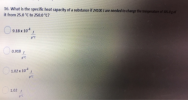 16. What is the specific heat capacity of a substance if 24100 J are needed to change the temperature of it from 25.0 °C to 250.0°C? 9.18 x 10, 0.918 1.02 x 10 1.02
The table lists the specific heat capacities of select substances. Substance Specific heat capacity (J/g °C)...
 The table lists the specific heat capacities of select substances. Substance Specific heat capacity (J/g °C) lead 0.128 silver 0.235 copper 0.385 iron 0.449 aluminum 0.903 water 4.184 An unknown substance has a mass of 13.3 g. The temperature of the substance increases by 16.7 °C when 52.2 J of heat is added to the substance. What is the most likely identity of the substance? O lead O aluminum iron O copper water O silver
2a. If a substance A has a higher heat capacity than another substance B and they...
2a. If a substance A has a higher heat capacity than another substance B and they are both exposed to the same amount of heat input, which substance will show the greatest change in temperature. Explain your answer 2b. List the equations and define each term for… A Heat when specific heat capacity is used. B Heat when heat capacity is used.
Question 4 of 8 > Substance lead Specific heat capacity (J/g °C) 0.128 0.235 0.385 silver...
 Question 4 of 8 > Substance lead Specific heat capacity (J/g °C) 0.128 0.235 0.385 silver copper iron 0.449 aluminum 0.903 4.184 water An unknown substance has a mass of 18.9 g. The temperature of the substance increases by 18.3 °C when 81.3 J of heat is added to the substance. What is the most likely identity of the substance? O aluminum silver O water O copper
Consider the following data for an unknown substance X: AHvap = 21.00 kJ/mol Specific heat capacity...
 Consider the following data for an unknown substance X: AHvap = 21.00 kJ/mol Specific heat capacity of liquid = 2.40 J/g. °C Boiling point = 70.0°C Molar mass=92.00 g/mol When the temperature of 1.000 mole of X(g) is lowered from 94.0°C to form X(1) at 46.0°C, 29.97 kJ of heat is released. Calculate the specific heat capacity of X(9). Specific heat capacity = J/g. °C Submit Answer Try Another Version 5 item attempts remaining
The value of the heat capacity for a substance depends on whether it’s measured under constant...
 The value of the heat capacity for a substance depends on
whether it’s measured under constant pressure conditions or
constant volume conditions. The constant-pressure molar heat
capacity is given by
= (dq/dT)P
and the constant-volume heat capacity is given by
= (dq/dT)V
Note that we use d instead of
because q is not a state function of temperature, volume, and
pressure; its value depends on how we execute the process.
Here are several questions regarding heat capacity.
a. When we...
The value of the heat capacity for a substance depends on
whether it’s measured under constant pressure conditions or
constant volume conditions. The constant-pressure molar heat
capacity is given by
= (dq/dT)P
and the constant-volume heat capacity is given by
= (dq/dT)V
Note that we use d instead of
because q is not a state function of temperature, volume, and
pressure; its value depends on how we execute the process.
Here are several questions regarding heat capacity.
a. When we...
What is the difference between specific heat and heat capacity? What are the units for these...
 What is the difference between specific heat and heat capacity? What are the units for these two quantities? 5. Calculate the standard enthalpy of this reaction, based on the following ΔΗ? values for each substance in the reaction: 6, NH2N,04(g)6NO(g) 2H200) N20(g) 9.66 kJ/mol N2H(0) NO(g) H0() -2858 kJ/mol 50.4 kJ/mol 90.4 kJ/mol
A 150.0 g block of iron absorbs 750.0 J of thermal energy. The specific heat capacity...
A 150.0 g block of iron absorbs 750.0 J of thermal energy. The specific heat capacity of iron is 0.449 J/(g·◦C). The initial temperature of the block is 20.0 ◦C. What is its final temperature? (A) 111.3 ◦C (B) 31.1 ◦C (C) 22.2 ◦C (D) 20.4 ◦C (E) 8.86 ◦C
 16. What is the specific heat capacity of a substance if 24100 J are needed to change the temperature of it from 25.0 °C to 250.0°C? 9.18 x 10, 0.918 1.02 x 10 1.02
 The table lists the specific heat capacities of select substances. Substance Specific heat capacity (J/g °C) lead 0.128 silver 0.235 copper 0.385 iron 0.449 aluminum 0.903 water 4.184 An unknown substance has a mass of 13.3 g. The temperature of the substance increases by 16.7 °C when 52.2 J of heat is added to the substance. What is the most likely identity of the substance? O lead O aluminum iron O copper water O silver
 Question 4 of 8 > Substance lead Specific heat capacity (J/g °C) 0.128 0.235 0.385 silver copper iron 0.449 aluminum 0.903 4.184 water An unknown substance has a mass of 18.9 g. The temperature of the substance increases by 18.3 °C when 81.3 J of heat is added to the substance. What is the most likely identity of the substance? O aluminum silver O water O copper
 Consider the following data for an unknown substance X: AHvap = 21.00 kJ/mol Specific heat capacity of liquid = 2.40 J/g. °C Boiling point = 70.0°C Molar mass=92.00 g/mol When the temperature of 1.000 mole of X(g) is lowered from 94.0°C to form X(1) at 46.0°C, 29.97 kJ of heat is released. Calculate the specific heat capacity of X(9). Specific heat capacity = J/g. °C Submit Answer Try Another Version 5 item attempts remaining
 The value of the heat capacity for a substance depends on
whether it’s measured under constant pressure conditions or
constant volume conditions. The constant-pressure molar heat
capacity is given by
= (dq/dT)P
and the constant-volume heat capacity is given by
= (dq/dT)V
Note that we use d instead of
because q is not a state function of temperature, volume, and
pressure; its value depends on how we execute the process.
Here are several questions regarding heat capacity.
a. When we...
The value of the heat capacity for a substance depends on
whether it’s measured under constant pressure conditions or
constant volume conditions. The constant-pressure molar heat
capacity is given by
= (dq/dT)P
and the constant-volume heat capacity is given by
= (dq/dT)V
Note that we use d instead of
because q is not a state function of temperature, volume, and
pressure; its value depends on how we execute the process.
Here are several questions regarding heat capacity.
a. When we...
 What is the difference between specific heat and heat capacity? What are the units for these two quantities? 5. Calculate the standard enthalpy of this reaction, based on the following ΔΗ? values for each substance in the reaction: 6, NH2N,04(g)6NO(g) 2H200) N20(g) 9.66 kJ/mol N2H(0) NO(g) H0() -2858 kJ/mol 50.4 kJ/mol 90.4 kJ/mol
Most questions answered within 3 hours.
-
Where is the error in this code sequence?
String s1 = "Hello";
String s2 = "ello";...
asked 10 months ago -
Financial data for Joel de Paris, Inc., for last year
follow:
Joel de Paris, Inc.
Balance...
asked 10 months ago -
Consider this reaction:
Al2(SO4)3 (aq)+ BaCl3
(aq) Al2Cl6 (aq)- +
3BaSO4(s) . What is the...
asked 10 months ago -
Suppose that Savneet is considering increasing her
recent random sample from 20 car rentals to 40...
asked 10 months ago -
Trucks arrive at an unloading terminal at an average rate of 120
per hour.
Trucks arrive...
asked 10 months ago -
Why are methanol and ethanol completely soluble in water while
octanol is not very little soluble....
asked 10 months ago -
A facilities manager at a university reads in a research report
that the mean amount of...
asked 10 months ago -
When the CuSO4 is rehydrated by adding water to the anhydrous
compound, is this an endothermic...
asked 10 months ago -
A ray of sunlight is passing from diamond into crown glass; the
angle of incidence is...
asked 10 months ago -
A block of mass 0.249 kg is placed on top of a light, vertical
spring of...
asked 10 months ago -
how do the kidneys compensate in the presences of acidosis
a) trigger hyperventilate
b) reserve acid...
asked 10 months ago -
Question 501 pts
The rental rate of capital to the firm increases. Which of the
following...
asked 10 months ago