
Homework Answers
Add Answer to:
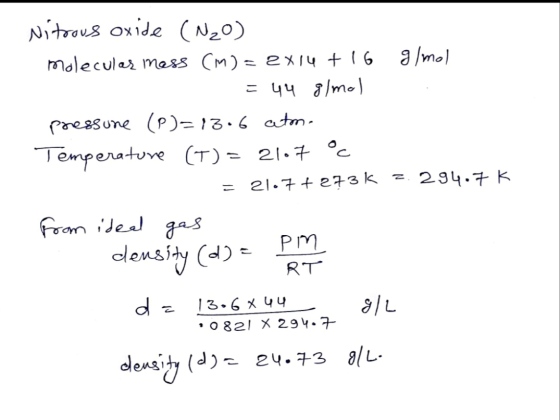
Nitrous oxide (dinitrogen monoxide) is an anesthetic often referred to as laughing gas. What is its...
Dinitrogen monoxide, commonly known as laughing gas, is used in dental procedures as an anesthetic. At...
Dinitrogen monoxide, commonly known as laughing gas, is used in dental procedures as an anesthetic. At elevated temperatures, dinitrogen monoxide can be produced from the reaction of ammonia and oxygen: 2 NH3 (g) + 2 O2 (g) ---> N2O (g) + 3 H2O (g) If you begin with 7.8 L of NH3 (g), what is the theoretical yield of H2O in liters?
What is the density of laughing gas, dinitrogen monoxide, N2O, at a temperature of 400°K and...
What is the density of laughing gas, dinitrogen monoxide, N2O, at a temperature of 400°K and a pressure of 1.12 atm?
Dinitrogen oxide, commonly called laughing gas, is sometimes used as an anesthetic in dentistry. It is...
Dinitrogen oxide, commonly called laughing gas, is sometimes used as an anesthetic in dentistry. It is produced by the decomposition of ammonium nitrate. The other product of this reaction is water. A balanced equation indicates the mole ratios of reactants and products. The molar mass of a substance allows you to convert between moles and mass. ______________________________________________________________________________ Write the balanced equation for the production of dinitrogen oxide and water from ammonium nitrate. How many grams of ammonium nitrate are required...
Nitrous oxide (N2O) is used as an anesthetic (laughing gas) and in aerosol cans to produce...
Nitrous oxide (N2O) is used as an anesthetic (laughing gas) and in aerosol cans to produce whipped cream. It is also a potent greenhouse gas. The decomposition of N2O is first order. It decomposes slowly to N2 and O2: How many half-lives will it take for the concentration of the N2O to reach 25.00 % of its original concentration?
Part A Nitrous axide, N20, is a common anesthetic also known as laughing gas, or simply...
 Part A Nitrous axide, N20, is a common anesthetic also known as laughing gas, or simply "Cnitrous If a cylinder of nitrous contains 3.1 kg of NgO what volume of N,O can be obtained from this cinder temperature of 20 C and standard pressure of 1.00 atm? (R 0.0821 L atm/(moke K)) Express your answer to two significant figures and include the appropriate units. uA Value Umits Volume Request Answer Submt Provide Feedback
48. What is the density of laughing gas, dinitrogen monoxide, N2O, at a temperature of 325...
48. What is the density of laughing gas, dinitrogen monoxide, N2O, at a temperature of 325 K and a pressure of 113.0 kPa? (College) College, Openstax. Chemistry. OpenStax College, 2015. VitalBook file.
1A. The decomposition of dinitrogen monoxide (nitrous oxide) occurs in two steps. The mechanism that has...
1A. The decomposition of dinitrogen monoxide (nitrous oxide) occurs in two steps. The mechanism that has been proposed is as follows: Step 1: N2O (g) à N2(g) + O(g) Step 2: N2O (g) + O(g) à N2(g) + O2(g) Write the chemical equation for the overall reaction and identify any reaction intermediates (spectators). What is the molecularity of each of the elementary (steps) reactions?
A 10.00 L tank at 23.2 degrees Celsius is filled with 15.8 g of dinitrogen monoxide...
A 10.00 L tank at 23.2 degrees Celsius is filled with 15.8 g of dinitrogen monoxide gas and 4.94 g of sulfur tetrafluoride gas. You can assume both gases behave as ideal gases under these conditions. What is the mole fraction and partial pressure for dinitrogen monoxide? Mole fraction: ? Partial pressure: ? atm What is the mole fraction and partial pressure for sulfur tetrafluoride? Mole fraction:? Partial pressure: ? atm What is the total pressure in the tank? Round...
A 10.00 L tank at 9.3 °C is filled with 14.3 g of dinitrogen monoxide gas...
 A 10.00 L tank at 9.3 °C is filled with 14.3 g of dinitrogen monoxide gas and 2.62 g of sulfur tetrafluoride gas. You can assume both gases behave as ideal gases under these conditions. Calculate the mole fraction of each gas. Round each of your answers to 3 significant digits. gas dinitrogen monoxide sulfur tetrafluoride mole fraction Chock Explanation
Question 15 N2O (laughing gas) is used as an anesthetic. A dentist has a 2.00 L...
Question 15 N2O (laughing gas) is used as an anesthetic. A dentist has a 2.00 L flask of N2O at a pressure of 1.00 atm and a 3.00 L flask of nitrogen gas at 2.00 atm that are separated by a valve. What is the pressure in the flasks when the valve is opened, and the gases mix together? Both flasks are at the same temperature, and the temperature does not change when the gases mix.
 Part A Nitrous axide, N20, is a common anesthetic also known as laughing gas, or simply "Cnitrous If a cylinder of nitrous contains 3.1 kg of NgO what volume of N,O can be obtained from this cinder temperature of 20 C and standard pressure of 1.00 atm? (R 0.0821 L atm/(moke K)) Express your answer to two significant figures and include the appropriate units. uA Value Umits Volume Request Answer Submt Provide Feedback
 A 10.00 L tank at 9.3 °C is filled with 14.3 g of dinitrogen monoxide gas and 2.62 g of sulfur tetrafluoride gas. You can assume both gases behave as ideal gases under these conditions. Calculate the mole fraction of each gas. Round each of your answers to 3 significant digits. gas dinitrogen monoxide sulfur tetrafluoride mole fraction Chock Explanation
Most questions answered within 3 hours.
-
Where is the error in this code sequence?
String s1 = "Hello";
String s2 = "ello";...
asked 10 months ago -
Financial data for Joel de Paris, Inc., for last year
follow:
Joel de Paris, Inc.
Balance...
asked 10 months ago -
Consider this reaction:
Al2(SO4)3 (aq)+ BaCl3
(aq) Al2Cl6 (aq)- +
3BaSO4(s) . What is the...
asked 10 months ago -
Suppose that Savneet is considering increasing her
recent random sample from 20 car rentals to 40...
asked 10 months ago -
Trucks arrive at an unloading terminal at an average rate of 120
per hour.
Trucks arrive...
asked 10 months ago -
Why are methanol and ethanol completely soluble in water while
octanol is not very little soluble....
asked 10 months ago -
A facilities manager at a university reads in a research report
that the mean amount of...
asked 10 months ago -
When the CuSO4 is rehydrated by adding water to the anhydrous
compound, is this an endothermic...
asked 10 months ago -
A ray of sunlight is passing from diamond into crown glass; the
angle of incidence is...
asked 10 months ago -
A block of mass 0.249 kg is placed on top of a light, vertical
spring of...
asked 10 months ago -
how do the kidneys compensate in the presences of acidosis
a) trigger hyperventilate
b) reserve acid...
asked 10 months ago -
Question 501 pts
The rental rate of capital to the firm increases. Which of the
following...
asked 10 months ago