
Homework Answers
Solution:
U(c, b) = 20c - c2 + 18b - 3b2
(a) Ucb is the mixed partial derivative, with differentiation of
U with respect to c, and then the whole differentiation with
respect to b. So, Ucb =
= 20 - 2c
So,
= 0
Or Ucb = 0. This implies that change in utility due to change in consumption of glasses of brandy, is not influenced by how J.P. changes his consumption of cigars. In same context, the change in rate of how utility changes due to change in consumption of cigars is also not influenced by how consumption of brandy changes. In simple terms, it basically gives an idea of independence between consumption of two goods, influencing the utility attained.
Denoting optimal consumption bundle by (c*, b*)
b) Since, money is not a problem, no budget constraint (unconstrained optimization):
We calculate the optimal consumption using the first order
conditions (FOCs):
= 0 and
= 0
= 20 - 2c
So, from FOC, we have 20 - 2c* = 0, giving us c* = 20/2 = 10 cigars
And,
= 18 - 2*3b
So, from FOC, we have 18 - 6b* = 0, giving us b* = 18/6 = 3 glasses of brandy
So, on a Friday evening, J.P. will consume 10 cigars and 3 glasses of brandy.
Verifying that the obtained consumption bundle indeed maximizes the utility: (using Hessian matrix methodology)
A combination maximizes utility if
> 0 and
< 0,
< 0
is another way of writing
, which we have already seen, equals 0.
=
= -6 < 0 and,
=
= -2 < 0, which is negative.
= (-6)*(-2) - (0)2 = 12 > 0
Thus, we have verified that this gives the maximum utility.
c) Now we have one constraint of c + b = 5 (so, constrained optimization)
Then, c = 5 - b, substituting this in the utility function, and then doing the maximization problem.
U(b) = 20(5-b) - (5-b)2 + 18b - 3b2
U(b) = 100 - 20b - (25 + b2 - 10b) + 18b -3b2
U(b) = 75 + 8b - 4b2
Then, maximizing by differentiating U(b) with respect to b (finding the first order condition):
= 0 + 8 - 2*4b
= 0 then gives us 8 - 8b* = 0 or b* = 1
Putting this in the constraint above, we have c* = 5 - b* = 5 - 1 = 4
Thus, given the advice of constraint, optimal consumption for J.P. is 4 cigars and 1 glass of brandy.
Add Answer to:
5. John Paul derives utility from the consumption of cigars and brandy on friday evenings. His...
On a given evening, J. P. enjoys the consumption of cigars () and brandy (c) according...
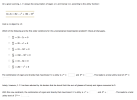 On a given evening, J. P. enjoys the consumption of cigars () and brandy (c) according to the utility function U(c,b) 20c - c2 + 18h 32 Cost is no object to J.P Which of the following are the first order conditions for this unconstrained maximization problem? Check all that apply. dU-20 -2c0 20 c2 dll 186b0 du -20c -c20 dlJ The combination of cigars and brandy that maximizes P.J.'s utility is and b* . This leads to a total...
Question 5 10 pts 5) On a given day Adam enjoys the consumption of beer (B)...
 Question 5 10 pts 5) On a given day Adam enjoys the consumption of beer (B) and wine (W) according to the function: U (BW) = 20B - B2 + 18W - 3W2 1. (5) How many glasses of beer and glasses of wine does he consume during a day? How much utility does he get from this consumption? (Cost is no object to Adam) 2. (5) Lately, however, Adam has been advised by his doctor to limit the sum...
Question 5 10 pts 5) On a given day Adam enjoys the consumption of beer (B)...
 Question 5 10 pts 5) On a given day Adam enjoys the consumption of beer (B) and wine (W) according to the function: U (B, W) = 20B – B2 + 18W – 3W2 1. (5) How many glasses of beer and glasses of wine does he consume during a day? How much utility does he get from this consumption? (Cost is no object to Adam) 2. (5) Lately, however, Adam has been advised by his doctor to limit the...
5) On a given day Adam enjoys the consumption of beer (B) and wine (W) according...
 5) On a given day Adam enjoys the consumption of beer (B) and wine (W) according to the function: U (B,W) = 20B – B2 + 18W – 3W2 1. (5) How many glasses of beer and glasses of wine does he consume during a day? How much utility does he get from this consumption? (Cost is no object to Adam) 2. (5) Lately, however, Adam has been advised by his doctor to limit the sum of glasses of wine...
5) On a given day Adam enjoys the consumption of beer (B) and wine (W) according...
 5) On a given day Adam enjoys the consumption of beer (B) and wine (W) according to the function: U (B,W) = 20B – B2 + 18W – 3W2 1. (5) How many glasses of beer and glasses of wine does he consume during a day? How much utility does he get from this consumption? (Cost is no object to Adam) 2. (5) Lately, however, Adam has been advised by his doctor to limit the sum of glasses of wine...
NEED HELP PLZ!!!!!!! 5) On a given day Adam enjoys the consumption of beer (B) and...
 NEED HELP PLZ!!!!!!!
5) On a given day Adam enjoys the consumption of beer (B) and wine (W) according to the function: U (B,W) 20B – B2 + 18W – 3W2 1.(5) How many glasses of beer and glasses of wine does he consume during a day? How much utility does he get from this consumption? (Cost is no object to Adam) 2. (5) Lately, however, Adam has been advised by his doctor to limit the sum of glasses of...
NEED HELP PLZ!!!!!!!
5) On a given day Adam enjoys the consumption of beer (B) and wine (W) according to the function: U (B,W) 20B – B2 + 18W – 3W2 1.(5) How many glasses of beer and glasses of wine does he consume during a day? How much utility does he get from this consumption? (Cost is no object to Adam) 2. (5) Lately, however, Adam has been advised by his doctor to limit the sum of glasses of...
5) On a given day Adam enjoys the consumption of beer (B) and wine (W) according...
5) On a given day Adam enjoys the consumption of beer (B) and wine (W) according to the function: U ( B , W ) = 20 B − B 2 + 18 W − 3 W 2 1. (5) How many glasses of beer and glasses of wine does he consume during a day? How much utility does he get from this consumption? (Cost is no object to Adam) 2. (5) Lately, however, Adam has been advised by his...
 On a given evening, J. P. enjoys the consumption of cigars () and brandy (c) according to the utility function U(c,b) 20c - c2 + 18h 32 Cost is no object to J.P Which of the following are the first order conditions for this unconstrained maximization problem? Check all that apply. dU-20 -2c0 20 c2 dll 186b0 du -20c -c20 dlJ The combination of cigars and brandy that maximizes P.J.'s utility is and b* . This leads to a total...
 Question 5 10 pts 5) On a given day Adam enjoys the consumption of beer (B) and wine (W) according to the function: U (BW) = 20B - B2 + 18W - 3W2 1. (5) How many glasses of beer and glasses of wine does he consume during a day? How much utility does he get from this consumption? (Cost is no object to Adam) 2. (5) Lately, however, Adam has been advised by his doctor to limit the sum...
 Question 5 10 pts 5) On a given day Adam enjoys the consumption of beer (B) and wine (W) according to the function: U (B, W) = 20B – B2 + 18W – 3W2 1. (5) How many glasses of beer and glasses of wine does he consume during a day? How much utility does he get from this consumption? (Cost is no object to Adam) 2. (5) Lately, however, Adam has been advised by his doctor to limit the...
 5) On a given day Adam enjoys the consumption of beer (B) and wine (W) according to the function: U (B,W) = 20B – B2 + 18W – 3W2 1. (5) How many glasses of beer and glasses of wine does he consume during a day? How much utility does he get from this consumption? (Cost is no object to Adam) 2. (5) Lately, however, Adam has been advised by his doctor to limit the sum of glasses of wine...
 5) On a given day Adam enjoys the consumption of beer (B) and wine (W) according to the function: U (B,W) = 20B – B2 + 18W – 3W2 1. (5) How many glasses of beer and glasses of wine does he consume during a day? How much utility does he get from this consumption? (Cost is no object to Adam) 2. (5) Lately, however, Adam has been advised by his doctor to limit the sum of glasses of wine...
 NEED HELP PLZ!!!!!!!
5) On a given day Adam enjoys the consumption of beer (B) and wine (W) according to the function: U (B,W) 20B – B2 + 18W – 3W2 1.(5) How many glasses of beer and glasses of wine does he consume during a day? How much utility does he get from this consumption? (Cost is no object to Adam) 2. (5) Lately, however, Adam has been advised by his doctor to limit the sum of glasses of...
NEED HELP PLZ!!!!!!!
5) On a given day Adam enjoys the consumption of beer (B) and wine (W) according to the function: U (B,W) 20B – B2 + 18W – 3W2 1.(5) How many glasses of beer and glasses of wine does he consume during a day? How much utility does he get from this consumption? (Cost is no object to Adam) 2. (5) Lately, however, Adam has been advised by his doctor to limit the sum of glasses of...
Most questions answered within 3 hours.
-
Where is the error in this code sequence?
String s1 = "Hello";
String s2 = "ello";...
asked 10 months ago -
Financial data for Joel de Paris, Inc., for last year
follow:
Joel de Paris, Inc.
Balance...
asked 10 months ago -
Consider this reaction:
Al2(SO4)3 (aq)+ BaCl3
(aq) Al2Cl6 (aq)- +
3BaSO4(s) . What is the...
asked 10 months ago -
Suppose that Savneet is considering increasing her
recent random sample from 20 car rentals to 40...
asked 10 months ago -
Trucks arrive at an unloading terminal at an average rate of 120
per hour.
Trucks arrive...
asked 10 months ago -
Why are methanol and ethanol completely soluble in water while
octanol is not very little soluble....
asked 10 months ago -
A facilities manager at a university reads in a research report
that the mean amount of...
asked 10 months ago -
When the CuSO4 is rehydrated by adding water to the anhydrous
compound, is this an endothermic...
asked 10 months ago -
A ray of sunlight is passing from diamond into crown glass; the
angle of incidence is...
asked 10 months ago -
A block of mass 0.249 kg is placed on top of a light, vertical
spring of...
asked 10 months ago -
how do the kidneys compensate in the presences of acidosis
a) trigger hyperventilate
b) reserve acid...
asked 10 months ago -
Question 501 pts
The rental rate of capital to the firm increases. Which of the
following...
asked 10 months ago