Consider the hypothetical serine protease below, which shows the specificity pockets. The S1 pocket has a...
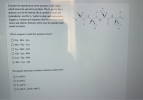
Consider the hypothetical serine protease below, which shows the specificity pockets. The S1 pocket has a glutamic acid in the bottom, the S2 pocket is small and hydrophobic, and the S1\' pocket is deep and hydrophobic. Suggest a 3 amino acid sequence that this protease would cleave and indicate between which sites the peptide bond would be broken.

Homework Answers
Enzymes are the biological catalysts that enhance the rate of biological reactions by lowering the activation energy required for the reaction to take place without being itself consumed in the reaction. A French chemist, Anselme Payen first discovered the enzyme, diastase in the year, 1833. The word enzyme was first used by Wilhelm Kuhne in the year, 1877.
Enzymes are mostly proteins by nature and are known to catalyze more than 5,000 biochemical reactions. The enzymes act on the substrate and convert it into product. The active site of the enzyme interacts with the substrate to form an enzyme substrate complex. Serine proteases are the enzymes that act on the peptide bonds between the proteins. Some examples of serine proteases include Chymotrypsin, trypsin, elastase, etc.
The given hypothetical structure is:

The given hypothetical structure contains the pockets S1, S2, and S1’. The S1 pocket has glutamic acid at its bottom. The S1’ is deep and hydrophobic that can accommodate bulky side chains. The S2 pocket is small and hydrophobic. Therefore, the sequence that the protease would cleave is Glycine-Lysine-Phenylalanine (Gly-Lys-Phe).
The cleavage takes place between the amino acid end and the carboxyl end of an amino acid sequence. The given sequence has amino acid end at the Si and carboxyl end at the S1’. Therefore, the cleavage occurs between S1 and S1’.
Ans:

Add Answer to:
Consider the hypothetical serine protease
below, which shows the specificity pockets. The S1 pocket has a...
Biochemistry multiple choice question related to biochemistry Consider the hypothetical serine protease in the image, which...
 Biochemistry
multiple choice question related to biochemistry
Consider the hypothetical serine protease in the image, which shows the specificity pockets. The S, pocket has a glutamic acid in the bottom, the S, pocket is small and hydrophobic, and the S,' pocket is deep and hydrophobic Suggest a 3-amino acid sequence that this prolcase would cleave and indicate between which sites the peptide bond would be broken. Which sequence would this protease cleave? O Gly-Met-Lys Met-Gly-Lys Lys-Met-Gly O Gly-Lys-- Met Lys-Gly...
Biochemistry
multiple choice question related to biochemistry
Consider the hypothetical serine protease in the image, which shows the specificity pockets. The S, pocket has a glutamic acid in the bottom, the S, pocket is small and hydrophobic, and the S,' pocket is deep and hydrophobic Suggest a 3-amino acid sequence that this prolcase would cleave and indicate between which sites the peptide bond would be broken. Which sequence would this protease cleave? O Gly-Met-Lys Met-Gly-Lys Lys-Met-Gly O Gly-Lys-- Met Lys-Gly...
If a serine protease has a moderately deep but very wide hydrophobic pocket within the active...
If a serine protease has a moderately deep but very wide hydrophobic pocket within the active site, which substrate amino acid side chains likely are found there during catalysis. List all that apply. Use single letter codes (in capitals) in alphabetical order.
If a serine protease has a moderately deep but very wide hydrophobic pocket within the active site, which substrate amino acid side chains likely are found there during catalysis. List all that apply....
If a serine protease has a moderately deep but very wide hydrophobic pocket within the active site, which substrate amino acid side chains likely are found there during catalysis. List all that apply. Use single letter codes (in capitals) in alphabetical order.
1) (10 pts) Serine proteases are enzymes that cleave peptide bonds in proteins. Explain using words...
 1) (10 pts) Serine proteases are enzymes that cleave peptide bonds in proteins. Explain using words (drawings OR both) why serine proteases cleave either before or after different amino acid residues. Talk about at least two of the following proteases: Chymotrypsin, Trypsin, or Elastase. mod 2) (10pts) Below is a hypothetical peptide sequence. Give the peptide fragments that will occur by enzymatic degradation using Trypsin and Chymotrypsin DARSKWKSENLIRTY 3) (10 pts) All superfamilies of serine proteases use the catalytic triad...
Cyw Ala Ατα Ile Ausn Lou Asp aly Lys Ser Which molecule below is asubunit of...
 Cyw Ala Ατα Ile Ausn Lou Asp aly Lys Ser Which molecule below is asubunit of peptide chains a. Acetic acid b. Alanine O. ATP d. Gracil Report the charge on most aqueous aspartie acid molecules at pH-7. Report the approximate p values for the amino acid whose titration curve is shown below (note there may be more slots for answer than answers). A) Value 1 B) Value 2 c) Value 3 c) Value 4 The structure of a rare...
 Biochemistry
multiple choice question related to biochemistry
Consider the hypothetical serine protease in the image, which shows the specificity pockets. The S, pocket has a glutamic acid in the bottom, the S, pocket is small and hydrophobic, and the S,' pocket is deep and hydrophobic Suggest a 3-amino acid sequence that this prolcase would cleave and indicate between which sites the peptide bond would be broken. Which sequence would this protease cleave? O Gly-Met-Lys Met-Gly-Lys Lys-Met-Gly O Gly-Lys-- Met Lys-Gly...
Biochemistry
multiple choice question related to biochemistry
Consider the hypothetical serine protease in the image, which shows the specificity pockets. The S, pocket has a glutamic acid in the bottom, the S, pocket is small and hydrophobic, and the S,' pocket is deep and hydrophobic Suggest a 3-amino acid sequence that this prolcase would cleave and indicate between which sites the peptide bond would be broken. Which sequence would this protease cleave? O Gly-Met-Lys Met-Gly-Lys Lys-Met-Gly O Gly-Lys-- Met Lys-Gly...
 1) (10 pts) Serine proteases are enzymes that cleave peptide bonds in proteins. Explain using words (drawings OR both) why serine proteases cleave either before or after different amino acid residues. Talk about at least two of the following proteases: Chymotrypsin, Trypsin, or Elastase. mod 2) (10pts) Below is a hypothetical peptide sequence. Give the peptide fragments that will occur by enzymatic degradation using Trypsin and Chymotrypsin DARSKWKSENLIRTY 3) (10 pts) All superfamilies of serine proteases use the catalytic triad...
 Cyw Ala Ατα Ile Ausn Lou Asp aly Lys Ser Which molecule below is asubunit of peptide chains a. Acetic acid b. Alanine O. ATP d. Gracil Report the charge on most aqueous aspartie acid molecules at pH-7. Report the approximate p values for the amino acid whose titration curve is shown below (note there may be more slots for answer than answers). A) Value 1 B) Value 2 c) Value 3 c) Value 4 The structure of a rare...
Most questions answered within 3 hours.
-
Where is the error in this code sequence?
String s1 = "Hello";
String s2 = "ello";...
asked 10 months ago -
Financial data for Joel de Paris, Inc., for last year
follow:
Joel de Paris, Inc.
Balance...
asked 10 months ago -
Consider this reaction:
Al2(SO4)3 (aq)+ BaCl3
(aq) Al2Cl6 (aq)- +
3BaSO4(s) . What is the...
asked 10 months ago -
Suppose that Savneet is considering increasing her
recent random sample from 20 car rentals to 40...
asked 10 months ago -
Trucks arrive at an unloading terminal at an average rate of 120
per hour.
Trucks arrive...
asked 10 months ago -
Why are methanol and ethanol completely soluble in water while
octanol is not very little soluble....
asked 10 months ago -
A facilities manager at a university reads in a research report
that the mean amount of...
asked 10 months ago -
When the CuSO4 is rehydrated by adding water to the anhydrous
compound, is this an endothermic...
asked 10 months ago -
A ray of sunlight is passing from diamond into crown glass; the
angle of incidence is...
asked 10 months ago -
A block of mass 0.249 kg is placed on top of a light, vertical
spring of...
asked 10 months ago -
how do the kidneys compensate in the presences of acidosis
a) trigger hyperventilate
b) reserve acid...
asked 10 months ago -
Question 501 pts
The rental rate of capital to the firm increases. Which of the
following...
asked 10 months ago