Sort the items below into the bins corresponding to the correct
Kepler\'s law of planetary motion.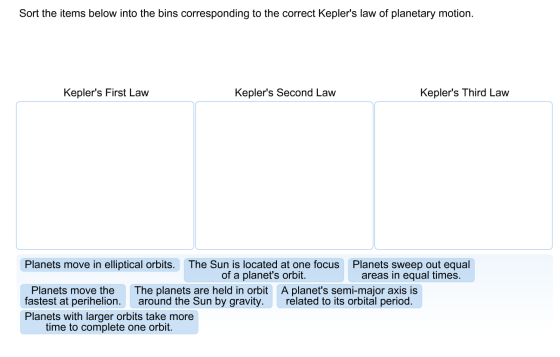
Homework Answers
The concept used to solve this problem is Kepler’s Laws of Planetary Motion.
Initially, use the concept of Kepler’s Laws of Planetary Motion to choose the correct item for Kepler’s First Law.
Then, use the concept of Kepler’s Laws of Planetary motion to choose the correct item for Kepler’s Second Law.
Finally, use the concept of Kepler’s Laws of Planetary Motion to choose the correct item for Kepler’s Third Law.
Kepler’s First Law: It is also termed as the Law of orbits. It explains that all the planets move in an elliptical orbit with the sun at one focus.
Kepler’s Second Law: It is also termed as the Law of Areas. It explains a line that connects a planet to the sun which sweeps out equal areas in equal time.
Kepler’s Third Law: It is also termed as the Law of Periods. It explains the square of the period of any planet that is proportional to the cube of the semi-major axis of its orbits.
From Kepler’s Laws of Planetary motion, the Kepler’s First Law explains that the all the planets move in elliptical orbits with the sun located at one focus of a planet’s orbit.
From the Kepler’s Laws of Planetary motion, the Kepler’s Second Law explains that the planets sweep out equal areas in equal times and the planets are held in orbit around the sun by gravity.
From the Kepler’s Laws of Planetary motion, the Kepler’s Third Law explains that the planets move the fastest at perihelion and planets with larger orbits take more time to complete one orbit. The planet’s semi-major axis is related to its orbital period.
Ans:The correct item for Kepler’s First Law is that the entire planets move in elliptical orbits with the sun located at one focus of a planet’s orbit.
The correct items for Kepler’s Second Law are that the planets sweep out equal areas in equal times and the planets are held in orbit around the sun by gravity.
The correct items for Kepler’s third Law are that the planets move the fastest at perihelion and planets with larger orbits take more time to complete one orbit. The planet’s semi-major axis is related to its orbital period.
Add Answer to:
Sort the items below into the bins corresponding to the correct
Kepler\'s law of planetary motion....
HW: Kepler's Laws of Planetary Motion Instructions: Use Kepler's Laws of Planetary Motion to answer the...
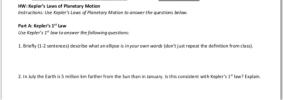 HW: Kepler's Laws of Planetary Motion Instructions: Use Kepler's Laws of Planetary Motion to answer the questions below Part A: Kepler's 1st Law Use Kepler's 1st law to answer the following questions 1. Briefly (1-2 sentences) describe what an ellipse is in your own words (don't just repeat the definition from class) 2. In July the Earth is 5 million km farther from the Sun than in January. Is this consistent with Kepler's 1t law? Explain
1. Kepler's harmonic law of planetary motion (his 3rd law) states that the square of the...
 1. Kepler's harmonic law of planetary motion (his 3rd law) states that the square of the orbital period is proportional to the cube of the characteristic distance of the planet from the sun. Test this by fitting a power law to the data below. Give your answer to 4 decimal places. Data file #period (days), distance (AU) # Data supporting Kepler's third law # distance is measured relative to the earth's mean distance, # which is about 9.26e7 miles and...
Sort the following compound classes into the bins corresponding to the expected ^13C chemical shifts (ppm)....
 Sort the following compound classes into the bins corresponding to the expected ^13C chemical shifts (ppm). Some bins will have more than one compound class.
Sort the following elements as macronutrients or micronutrients Drag the appropriate items to their respective bins....
 Sort the following elements as macronutrients or micronutrients Drag the appropriate items to their respective bins. View Available Hint(s) Reset Help Macronutrients Micronutrients ORL 9 N
Sort the following molecules by their molecular formula. Drag the appropriate items to their respective bins....
 Sort the following molecules by their molecular formula. Drag the appropriate items to their respective bins. ► View Available Hint(s) Reset Help | CH3HC=CHOH H2C=CHOCHZ (H2C=CHCH2OH (1-Propanol Ethyl methyl ether CH3COCH: GH, 0 C3H30 9H, 0 C3H602 9H0 C3H60
1 (10 pts). In 1601 the German astronomer Johannes Kepler became director of the Prague Observatory....
 1 (10 pts). In 1601 the German astronomer Johannes Kepler became director of the Prague Observatory. Kepler had been helping Tycho Brache in collecting 13 years of observations on relative motion of the planet Mars. By 1609, Kepler had formulated his first two laws of planetary motion: i. Each planet moves on an ellipse with the sun at one focus. ii. For each planet, the line from the sun to the planet sweeps out equal areas is equal times. Kepler's...
Practice Exercises Derive the equations of motion, using Newton s second law of motion, for the g...
 Practice Exercises Derive the equations of motion, using Newton s second law of motion, for the given systems below and write these equations in matrix form mt2 m11
Practice Exercises Derive the equations of motion, using Newton s second law of motion, for the given systems below and write these equations in matrix form mt2 m11
Practice Exercises Derive the equations of motion, using Newton s second law of motion, for the given systems below and write these equations in matrix form mt2 m11
How can Kepler’s law of planetary motion be applied to the case of geo-stationary satellite? What are the orbital parameters required to determine a satellite orbit? Name and explain them. Determine...
How can Kepler’s law of planetary motion be applied to the case of geo-stationary satellite? What are the orbital parameters required to determine a satellite orbit? Name and explain them. Determine the maximum and minimum range in kilometer from an earth station to a geo-synchronous satellite. To what round trip propagation times do these correspond? Mention the effect of eclipse on the orbital motion of a satellite. Mention the effect of gravitational force due to sun and moon on the...
Drag the appropriate items to their respective bins. • View Available Hintis) Reset CH2-C2H0 H 2Hg+S...
 Drag the appropriate items to their respective bins. • View Available Hintis) Reset CH2-C2H0 H 2Hg+S Chromiumin Cnos + 2A1-26 + ALO. CH. +202 Co, 240 Warcury Het $ 248 S Aluminum in CO2AL 2Cr +Al: Os Element is addiced Element is reduced
CHOI: Nutrition: Linking Food and Health Focus Figure 1.4: Dietary Reference Intakes (DRIs) Part B- DRI Categories and How They Are Used Review the statements listed below and sort them into the c...
 CHOI: Nutrition: Linking Food and Health Focus Figure 1.4: Dietary Reference Intakes (DRIs) Part B- DRI Categories and How They Are Used Review the statements listed below and sort them into the correct DRI category 2 of3> Drag the appropriate items into their respective bins. to calculate valuesare used when an EAR ore in this category. RDA cannot be provided. needs of only 50% as a of total energy. the ranges indicated by these DRI values can increase the in...
 HW: Kepler's Laws of Planetary Motion Instructions: Use Kepler's Laws of Planetary Motion to answer the questions below Part A: Kepler's 1st Law Use Kepler's 1st law to answer the following questions 1. Briefly (1-2 sentences) describe what an ellipse is in your own words (don't just repeat the definition from class) 2. In July the Earth is 5 million km farther from the Sun than in January. Is this consistent with Kepler's 1t law? Explain
 1. Kepler's harmonic law of planetary motion (his 3rd law) states that the square of the orbital period is proportional to the cube of the characteristic distance of the planet from the sun. Test this by fitting a power law to the data below. Give your answer to 4 decimal places. Data file #period (days), distance (AU) # Data supporting Kepler's third law # distance is measured relative to the earth's mean distance, # which is about 9.26e7 miles and...
 Sort the following compound classes into the bins corresponding to the expected ^13C chemical shifts (ppm). Some bins will have more than one compound class.
 Sort the following elements as macronutrients or micronutrients Drag the appropriate items to their respective bins. View Available Hint(s) Reset Help Macronutrients Micronutrients ORL 9 N
 Sort the following molecules by their molecular formula. Drag the appropriate items to their respective bins. ► View Available Hint(s) Reset Help | CH3HC=CHOH H2C=CHOCHZ (H2C=CHCH2OH (1-Propanol Ethyl methyl ether CH3COCH: GH, 0 C3H30 9H, 0 C3H602 9H0 C3H60
 1 (10 pts). In 1601 the German astronomer Johannes Kepler became director of the Prague Observatory. Kepler had been helping Tycho Brache in collecting 13 years of observations on relative motion of the planet Mars. By 1609, Kepler had formulated his first two laws of planetary motion: i. Each planet moves on an ellipse with the sun at one focus. ii. For each planet, the line from the sun to the planet sweeps out equal areas is equal times. Kepler's...
 Practice Exercises Derive the equations of motion, using Newton s second law of motion, for the given systems below and write these equations in matrix form mt2 m11
Practice Exercises Derive the equations of motion, using Newton s second law of motion, for the given systems below and write these equations in matrix form mt2 m11
Practice Exercises Derive the equations of motion, using Newton s second law of motion, for the given systems below and write these equations in matrix form mt2 m11
 Drag the appropriate items to their respective bins. • View Available Hintis) Reset CH2-C2H0 H 2Hg+S Chromiumin Cnos + 2A1-26 + ALO. CH. +202 Co, 240 Warcury Het $ 248 S Aluminum in CO2AL 2Cr +Al: Os Element is addiced Element is reduced
 CHOI: Nutrition: Linking Food and Health Focus Figure 1.4: Dietary Reference Intakes (DRIs) Part B- DRI Categories and How They Are Used Review the statements listed below and sort them into the correct DRI category 2 of3> Drag the appropriate items into their respective bins. to calculate valuesare used when an EAR ore in this category. RDA cannot be provided. needs of only 50% as a of total energy. the ranges indicated by these DRI values can increase the in...
Most questions answered within 3 hours.
-
Where is the error in this code sequence?
String s1 = "Hello";
String s2 = "ello";...
asked 11 months ago -
Financial data for Joel de Paris, Inc., for last year
follow:
Joel de Paris, Inc.
Balance...
asked 11 months ago -
Consider this reaction:
Al2(SO4)3 (aq)+ BaCl3
(aq) Al2Cl6 (aq)- +
3BaSO4(s) . What is the...
asked 11 months ago -
Suppose that Savneet is considering increasing her
recent random sample from 20 car rentals to 40...
asked 11 months ago -
Trucks arrive at an unloading terminal at an average rate of 120
per hour.
Trucks arrive...
asked 11 months ago -
Why are methanol and ethanol completely soluble in water while
octanol is not very little soluble....
asked 11 months ago -
A facilities manager at a university reads in a research report
that the mean amount of...
asked 11 months ago -
When the CuSO4 is rehydrated by adding water to the anhydrous
compound, is this an endothermic...
asked 11 months ago -
A ray of sunlight is passing from diamond into crown glass; the
angle of incidence is...
asked 11 months ago -
A block of mass 0.249 kg is placed on top of a light, vertical
spring of...
asked 11 months ago -
how do the kidneys compensate in the presences of acidosis
a) trigger hyperventilate
b) reserve acid...
asked 11 months ago -
Question 501 pts
The rental rate of capital to the firm increases. Which of the
following...
asked 11 months ago