McCormick & Company is considering a project that requires an initial investment of $24 million to...
McCormick & Company is considering a project that requires an initial investment of $24 million to build a new plant and purchase equipment. The investment will be depreciated as a modified accelerated cost recovery system (MACRS) seven-year class asset. The new plant will be built on some of the company's land, which has a current, after-tax market value of $4.3 million. The company will produce bulk units at a cost of $130 each and will sell them for $420 each. There are annual fixed costs of $500,000. Unit sales are expected to be $150,000 each year for the next six years, at which time the project will be abandoned. At that time, the plant and equipment is expected to be worth $8 million (before tax) and the land is expected to be worth $5.4 million (after tax). To supplement the production process, the company will need to purchase $1 million worth of inventory. That inventory will be depleted during the final year of the project. The company has $100 million of debt outstanding with a yield to maturity of 8 percent, and has $150 million of equity outstanding with a beta of 0.9. The expected market return is 13 percent, and the risk-free rate is 5 percent. The company's marginal tax rate is 40 percent. Should the project be accepted? questions: 6. Create an after-tax cash flow timeline. (what's the formula?) 7. What are the total expected cash flows at the end of year six? The $4.3 million is an opportunity cost and must be included at date zero as a cash outflow. If the project is accepted, however, the land can be sold in six years for $5.4 million. 8. Find the NPV using the after-tax WACC as the discount rate. 9. Find the IRR. 10. Should the project be accepted? Discuss whether NPV or IRR creates the best decision rule.
Homework Answers
net cash from sale of land in year 6 = $5.4 million - ($5.4 million - $4.3 million) * (40%) = $4,960,000
accumulated depreciation on plant upto end of year 6 = $20,786,400
book value of plant at end of year 6 = $24 million - $20,786,400 = $3,213,600
sale price of plant at end of year 6 = $8 million
net cash from sale of plant = $8 million - ($8 million - $3,213,600)*(40%) = $6,085,440
net cash flow in each year = income after taxes + depreciation
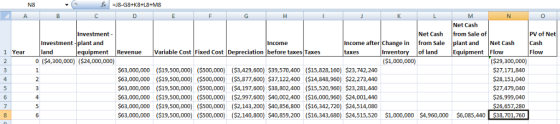
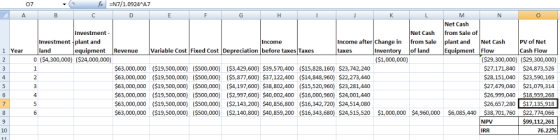
Present value of each net cash flow, discounted at the after-tax WACC discount rate, is the PV of each net cash flow. The sum of the PVs of each net cash flow is the NPV of the project
WACC = (cost of debt * weight of debt) + (cost of equity * weight of equity)
cost of debt = after tax cost of debt = YTM * (1 - tax rate) = 8% * (1 - 40%) = 4.8%
cost of equity = risk free rate + (beta * market risk premium) = 5% + (0.9 * (13% - 5%)) = 12.2%
weight of debt = $100 million / ($100 million + $150 million) = 0.40
weight of equity = $150 million / ($100 million + $150 million) = 0.60
WACC = (4.8% * 0.40) + (12.2% * 0.60) = 9.24%
NPV of the project is $99,112,261
IRR of the project is 76.22%
The project should be accepted as the NPV is positive, and the IRR is higher than the WACC
Add Answer to:
McCormick & Company is considering a project that requires an initial investment of $24 million to...
McCormick & Company is considering a project that requires an initial investment of $24 million to...
McCormick & Company is considering a project that requires an initial investment of $24 million to build a new plant and purchase equipment. The investment will be depreciated as a modified accelerated cost recovery system (MACRS) seven-year class asset. The new plant will be built on some of the company's land, which has a current, after-tax market value of $4.3 million. The company will produce bulk units at a cost of $130 each and will sell them for $420 each....
An investment project requires a net investment of $200 million. The project is expected to generate...
An investment project requires a net investment of $200 million. The project is expected to generate annual net cash flows of $25 million for the next 15 years with a one-time end of project cash flow of $3 million. The firm's cost of capital is 14 percent and marginal tax rate is 40 percent. a) Evaluate the project using the NPV method and state whether or not the project should be accepted. b) Evaluate the project using the IRR method...
A project requires an initial investment of $100,000 and is expected to produce a cash inflow...
 A project requires an initial investment of $100,000 and is expected to produce a cash inflow before tax of $27,500 per year for five years. Company A has substantial accumulated tax losses and is unlikely to pay taxes in the foreseeable future. Company B pays corporate taxes at a rate of 21% and can claim 100% bonus depreciation on the investment. Suppose the opportunity cost of capital is 10%. Ignore inflation. a. Calculate project NPV for each company. (Do not...
Problem 6-15 Project NPV and IRR A project requires an initial investment of $100,000 and is...
 Problem 6-15 Project NPV and IRR A project requires an initial investment of $100,000 and is expected to produce a cash inflow before tax of $26,700 per year for five years. Company A has substantial accumulated tax losses and is unlikely to pay taxes in the foreseeable future. Company B pays corporate taxes at a rate of 21% and can claim 100% bonus depreciation on the investment. Suppose the opportunity cost of capital is 9%. Ignore inflation. a. Calculate project...
FOB Ltd. is considering an investment opportunity. It requires an initial investment of $4 million and...
 FOB Ltd. is considering an investment opportunity. It requires an initial investment of $4 million and is expected to receive after-tax cash flows of $2.2 million at the end otf year 1 and $2.8 million in year 2. This investment is expected to last for two years only. The cost of capital is 12 percent if it is all-equity financed. FOB intends to borrow $1 million at an annual cost of 8 percent. The loan must be repaid in two...
A project requires an initial investment of $100,000 and is expected to produce a cash inflow...
A project requires an initial investment of $100,000 and is expected to produce a cash inflow before tax of $27,200 per year for five years. Company A has substantial accumulated tax losses and is unlikely to pay taxes in the foreseeable future. Company B pays corporate taxes at a rate of 35% and can depreciate the investment for tax purposes using the five-year MACRS tax depreciation schedule. Suppose the opportunity cost of capital is 10%. Ignore inflation. a. Calculate project...
You are considering an investment in a project that requires an initial outlay of $350,000 and...
You are considering an investment in a project that requires an initial outlay of $350,000 and will produce after-tax cash flows of $50,000 per year for the next 10 years. Your firm uses 40 percent debt and 60 percent equity in its financing. The after-tax costs of debt and equity are 6% and 11%, respectively. a. What is the firm’s WACC? b. What is the project NPV? Should the project be accepted?
Dorman Industries has a new project available that requires an initial investment of $5 million. The...
 Dorman Industries has a new project available that requires an initial investment of $5 million. The project will provide unlevered cash flows of $725,000 per year for the next 20 years. The company will finance the project with a debt-to-value ratio of .3. The company's bonds have a YTM of 6.5 percent. The companies with operations comparable to this project have unlevered betas of 1.20, 1.13, 1.35, and 1.30. The risk-free rate is 3.5 percent, and the market risk premium...
A project requires an initial investment of $100,000 and is expected to produce a cash inflow...
A project requires an initial investment of $100,000 and is expected to produce a cash inflow before tax of $27,700 per year for five years. Company A has substantial accumulated tax losses and is unlikely to pay taxes in the foreseeable future. Company B pays corporate taxes at a rate of 21% and can claim 100% bonus depreciation on the investment. Suppose the opportunity cost of capital is 11%. Ignore inflation. a. Calculate project NPV for each company. (Do not...
Fitzgerald Industries has a new project available that requires an initial investment of $4.7 million. The...
 Fitzgerald Industries has a new project available that requires an initial investment of $4.7 million. The project will provide unlevered cash flows of $845,000 per year for the next 20 years. The company will finance the project with a debt-value ratio of .3. The company's bonds have a YTM of 6.6 percent. The companies with operations comparable to this project have unlevered betas of 1.14, 1.07, 1.29, and 1.24. The risk-free rate is 4 percent and the market risk premium...
 A project requires an initial investment of $100,000 and is expected to produce a cash inflow before tax of $27,500 per year for five years. Company A has substantial accumulated tax losses and is unlikely to pay taxes in the foreseeable future. Company B pays corporate taxes at a rate of 21% and can claim 100% bonus depreciation on the investment. Suppose the opportunity cost of capital is 10%. Ignore inflation. a. Calculate project NPV for each company. (Do not...
 Problem 6-15 Project NPV and IRR A project requires an initial investment of $100,000 and is expected to produce a cash inflow before tax of $26,700 per year for five years. Company A has substantial accumulated tax losses and is unlikely to pay taxes in the foreseeable future. Company B pays corporate taxes at a rate of 21% and can claim 100% bonus depreciation on the investment. Suppose the opportunity cost of capital is 9%. Ignore inflation. a. Calculate project...
 FOB Ltd. is considering an investment opportunity. It requires an initial investment of $4 million and is expected to receive after-tax cash flows of $2.2 million at the end otf year 1 and $2.8 million in year 2. This investment is expected to last for two years only. The cost of capital is 12 percent if it is all-equity financed. FOB intends to borrow $1 million at an annual cost of 8 percent. The loan must be repaid in two...
 Dorman Industries has a new project available that requires an initial investment of $5 million. The project will provide unlevered cash flows of $725,000 per year for the next 20 years. The company will finance the project with a debt-to-value ratio of .3. The company's bonds have a YTM of 6.5 percent. The companies with operations comparable to this project have unlevered betas of 1.20, 1.13, 1.35, and 1.30. The risk-free rate is 3.5 percent, and the market risk premium...
 Fitzgerald Industries has a new project available that requires an initial investment of $4.7 million. The project will provide unlevered cash flows of $845,000 per year for the next 20 years. The company will finance the project with a debt-value ratio of .3. The company's bonds have a YTM of 6.6 percent. The companies with operations comparable to this project have unlevered betas of 1.14, 1.07, 1.29, and 1.24. The risk-free rate is 4 percent and the market risk premium...
Most questions answered within 3 hours.
-
Where is the error in this code sequence?
String s1 = "Hello";
String s2 = "ello";...
asked 10 months ago -
Financial data for Joel de Paris, Inc., for last year
follow:
Joel de Paris, Inc.
Balance...
asked 10 months ago -
Consider this reaction:
Al2(SO4)3 (aq)+ BaCl3
(aq) Al2Cl6 (aq)- +
3BaSO4(s) . What is the...
asked 10 months ago -
Suppose that Savneet is considering increasing her
recent random sample from 20 car rentals to 40...
asked 10 months ago -
Trucks arrive at an unloading terminal at an average rate of 120
per hour.
Trucks arrive...
asked 10 months ago -
Why are methanol and ethanol completely soluble in water while
octanol is not very little soluble....
asked 10 months ago -
A facilities manager at a university reads in a research report
that the mean amount of...
asked 10 months ago -
When the CuSO4 is rehydrated by adding water to the anhydrous
compound, is this an endothermic...
asked 10 months ago -
A ray of sunlight is passing from diamond into crown glass; the
angle of incidence is...
asked 10 months ago -
A block of mass 0.249 kg is placed on top of a light, vertical
spring of...
asked 10 months ago -
how do the kidneys compensate in the presences of acidosis
a) trigger hyperventilate
b) reserve acid...
asked 10 months ago -
Question 501 pts
The rental rate of capital to the firm increases. Which of the
following...
asked 10 months ago