Chapter 04, Problem 109 The central ideas in this problem are reviewed in Mutiple-Concept Example 9....
Chapter 04, Problem 109
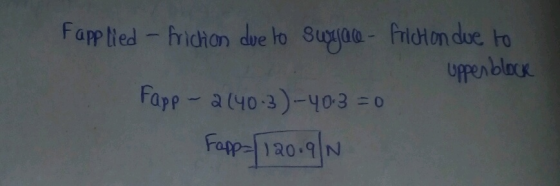
The central ideas in this problem are reviewed in Mutiple-Concept Example 9. One block rests upon a horizontal surface. A second identical block rests upon the first one. The coefficient of static friction between the blocks is the same as the coefficient of static friction between the lower block and the horizontal surface. A horizontal force is applied to the upper block, and its magnitude is slowly increased. When the force reaches 40.3 N, the upper block just begins to slide. The force is then removed from the upper block, and the blocks are returned to their original configuration. What is the magnitude of the horizontal force that should be applied to the lower block, so that it just begins to slide out from under the upper block?
Homework Answers
Add Answer to:
Chapter 04, Problem 109 The central ideas in this problem are reviewed in Mutiple-Concept Example 9....
A block M1 of mass 16.0 kgsits on top of a larger block M2 of mass...
A block M1 of mass 16.0 kgsits on top of a larger block M2 of mass 26.0 kg which sits on a flat surface. The kinetic friction coefficient between the upper and lower block is 0.400. The kinetic friction coefficient between the lower block and the flat surface is 0.100. A horizontal force F = 98 N pushes against the upper block, causing it to slide. The friction force between the blocks then causes the lower block to slide also....
A block of mass M is sitting on a friction-less horizontal surface. A second block of...
A block of mass M is sitting on a friction-less horizontal surface. A second block of mass m is sitting on top of the first block. The (horizontal) interface between the two blocks is characterized by a static friction coefficient µ. The acceleration of gravity is g. Find the max horizontal force F that can be applied to the lower block such that the upper block does not slide off it.
Two blocks are pushed along a frictionless surface. The static coefficient of friction between the blocks...
 Two blocks are pushed along a frictionless surface. The static coefficient of friction between the blocks is .70 mm is the maximum force F that can be applied to the lower block (as shown on the diagram) Such that the upper block does not slide
A block of mass m1 sits on top of a larger block of mass2 which sits on a flat surface. The coefficient of kinetic frict...
A block of mass m1 sits on top of a larger block of mass2 which sits on a flat surface. The coefficient of kinetic friction between the upper and the lower blocks is u1, and that between the lower block and the flat surface is u2. A horizontal force F pushes against the upper block, causing it to slide; the friciton force between the blocks then cause the lower block to slide also. Find the acceleration of the upper block...
Problem 9. You push on a 30kg object with a force of 200 N, but it...
 Problem 9. You push on a 30kg object with a force of 200 N, but it refuses to move. The coefficient of static friction between the object and the floor is 0.80, what is the magnitude of the friction force on the object? Solution El = 200 N Problem 10 A flatbed truck slowly tilts its bed upward to dispose of a 95 kg box. When the tilt angle just exceeds 23°, the crate begins to slide. What is the...
Please try to make the answers accurate. Also please make the final answers clear. Chapter 6,...
 Please try to make the answers accurate. Also please make the
final answers clear.
Chapter 6, Problem 6/002 The 55-kg block rests on the horizontal surface, and a force P-607 N, whose direction can be varied, is applied to the block. (a) If the block begins to slip when ? is reduced to 370, calculate the coefficient of static friction ?: between the block and the surface. (b) ItP is applied with ? 470, calculate the friction force F. The...
Please try to make the answers accurate. Also please make the
final answers clear.
Chapter 6, Problem 6/002 The 55-kg block rests on the horizontal surface, and a force P-607 N, whose direction can be varied, is applied to the block. (a) If the block begins to slip when ? is reduced to 370, calculate the coefficient of static friction ?: between the block and the surface. (b) ItP is applied with ? 470, calculate the friction force F. The...
High school physics problem
You are lowering two boxes, one on top of the other, down a ramp by pulling on a rope parallel to the surface of the ramp. Both blocks move with constant velocity of 15 ?/?. The coefficient of kinetic friction between the ramp and the lower box is 0.444 and the coefficient of static friction between the two boxes is 0.800. What is the magnitude and direction of the frictional force on the upper box? Magnitue of the applied force?...
Consult Multiple-Concept Example 9 to explore a model for solving this problem. A person pushes on...
Consult Multiple-Concept Example 9 to explore a model for solving this problem. A person pushes on a 55-kg refrigerator with a horizontal force of -260 N; the minus sign indicates that the force points in the -x direction. The coefficient of static friction is 0.64. (a) If the refrigerator does not move, what are the magnitude and direction of the static frictional force that the floor exerts on the refrigerator? (b) What is the magnitude of the largest pushing force...
The figure below shows two masses my=5.9 kg and m2=3.6 kg. The lower surface is frictionless...
 The figure below shows two masses my=5.9 kg and m2=3.6 kg. The lower surface is frictionless but the surface between the blocks has an unknown coefficient of static friction us. If a horizontal force of magnitude F=41 N acts on the top block and the bottom block moves along with the top block, what is the magnitude of the static friction force which acts between the two blocks? m2 mi U = 0 х
The figure below shows two masses m1=5.9 kg and m2=3.3 kg. The lower surface is frictionless...
 The figure below shows two masses m1=5.9 kg and m2=3.3 kg. The
lower surface is frictionless but the surface between the blocks
has an unknown coefficient of static friction µs. If a horizontal
force of magnitude F=57 N acts on the top block and the bottom
block moves along with the top block, what is the magnitude of the
static friction force which acts between the two blocks?
X () = ni tw mi F4
The figure below shows two masses m1=5.9 kg and m2=3.3 kg. The
lower surface is frictionless but the surface between the blocks
has an unknown coefficient of static friction µs. If a horizontal
force of magnitude F=57 N acts on the top block and the bottom
block moves along with the top block, what is the magnitude of the
static friction force which acts between the two blocks?
X () = ni tw mi F4
 Two blocks are pushed along a frictionless surface. The static coefficient of friction between the blocks is .70 mm is the maximum force F that can be applied to the lower block (as shown on the diagram) Such that the upper block does not slide
 Problem 9. You push on a 30kg object with a force of 200 N, but it refuses to move. The coefficient of static friction between the object and the floor is 0.80, what is the magnitude of the friction force on the object? Solution El = 200 N Problem 10 A flatbed truck slowly tilts its bed upward to dispose of a 95 kg box. When the tilt angle just exceeds 23°, the crate begins to slide. What is the...
 Please try to make the answers accurate. Also please make the
final answers clear.
Chapter 6, Problem 6/002 The 55-kg block rests on the horizontal surface, and a force P-607 N, whose direction can be varied, is applied to the block. (a) If the block begins to slip when ? is reduced to 370, calculate the coefficient of static friction ?: between the block and the surface. (b) ItP is applied with ? 470, calculate the friction force F. The...
Please try to make the answers accurate. Also please make the
final answers clear.
Chapter 6, Problem 6/002 The 55-kg block rests on the horizontal surface, and a force P-607 N, whose direction can be varied, is applied to the block. (a) If the block begins to slip when ? is reduced to 370, calculate the coefficient of static friction ?: between the block and the surface. (b) ItP is applied with ? 470, calculate the friction force F. The...
 The figure below shows two masses my=5.9 kg and m2=3.6 kg. The lower surface is frictionless but the surface between the blocks has an unknown coefficient of static friction us. If a horizontal force of magnitude F=41 N acts on the top block and the bottom block moves along with the top block, what is the magnitude of the static friction force which acts between the two blocks? m2 mi U = 0 х
 The figure below shows two masses m1=5.9 kg and m2=3.3 kg. The
lower surface is frictionless but the surface between the blocks
has an unknown coefficient of static friction µs. If a horizontal
force of magnitude F=57 N acts on the top block and the bottom
block moves along with the top block, what is the magnitude of the
static friction force which acts between the two blocks?
X () = ni tw mi F4
The figure below shows two masses m1=5.9 kg and m2=3.3 kg. The
lower surface is frictionless but the surface between the blocks
has an unknown coefficient of static friction µs. If a horizontal
force of magnitude F=57 N acts on the top block and the bottom
block moves along with the top block, what is the magnitude of the
static friction force which acts between the two blocks?
X () = ni tw mi F4
Most questions answered within 3 hours.
-
Where is the error in this code sequence?
String s1 = "Hello";
String s2 = "ello";...
asked 10 months ago -
Financial data for Joel de Paris, Inc., for last year
follow:
Joel de Paris, Inc.
Balance...
asked 10 months ago -
Consider this reaction:
Al2(SO4)3 (aq)+ BaCl3
(aq) Al2Cl6 (aq)- +
3BaSO4(s) . What is the...
asked 10 months ago -
Suppose that Savneet is considering increasing her
recent random sample from 20 car rentals to 40...
asked 10 months ago -
Trucks arrive at an unloading terminal at an average rate of 120
per hour.
Trucks arrive...
asked 10 months ago -
Why are methanol and ethanol completely soluble in water while
octanol is not very little soluble....
asked 10 months ago -
A facilities manager at a university reads in a research report
that the mean amount of...
asked 10 months ago -
When the CuSO4 is rehydrated by adding water to the anhydrous
compound, is this an endothermic...
asked 10 months ago -
A ray of sunlight is passing from diamond into crown glass; the
angle of incidence is...
asked 10 months ago -
A block of mass 0.249 kg is placed on top of a light, vertical
spring of...
asked 10 months ago -
how do the kidneys compensate in the presences of acidosis
a) trigger hyperventilate
b) reserve acid...
asked 10 months ago -
Question 501 pts
The rental rate of capital to the firm increases. Which of the
following...
asked 10 months ago