The sun orbits the center of the Milky Way galaxy (see figure) in a period of...
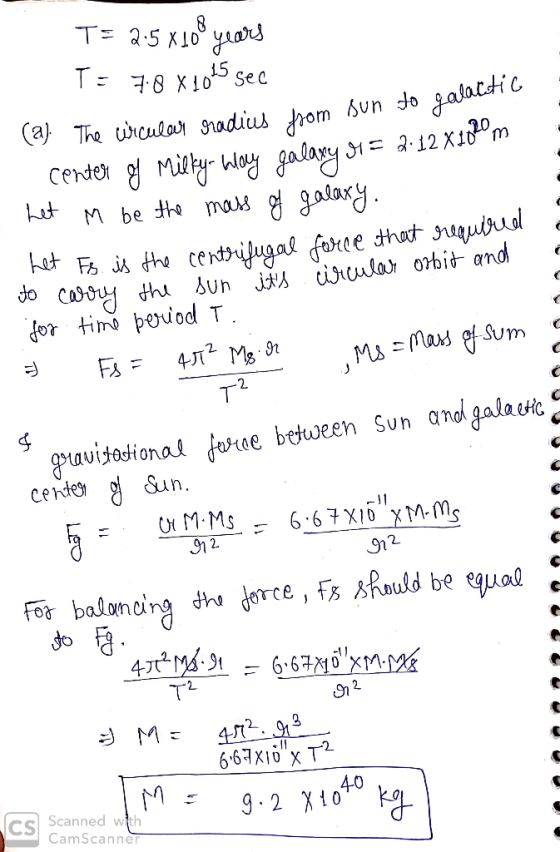
The sun orbits the center of the Milky Way galaxy (see figure) in a period of 2.5 108 years.
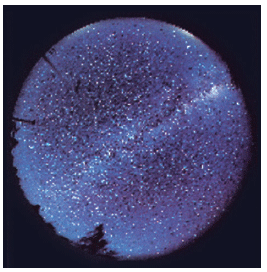
(a) Assuming a circular orbit of radius 2.12 1020 m, compute the mass of the Milky Way.
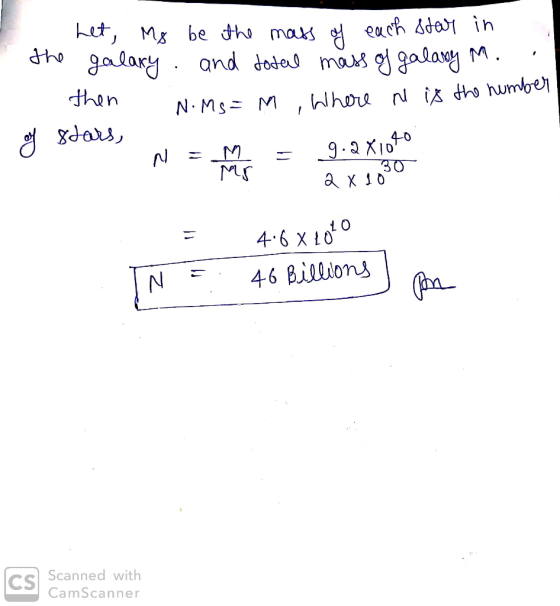
(b) Estimate the number of stars in the Milky Way, assuming the average star mass equals the mass of the sun—2.0 1030 kg. units
Homework Answers


Add Answer to:
The sun orbits the center of the Milky Way galaxy (see figure) in a period of...
Astronomers have observed a small, massive object at the center of our Milky Way galaxy. A...
Astronomers have observed a small, massive object at the center of our Milky Way galaxy. A ring of material orbits this massive object; the ring has a diameter of about 10 light years and an orbital speed of about 210 km/s . A) Determine the mass of the massive object at the center of the Milky Way galaxy. Give your answer in kilograms. B) Give your answer in solar masses (one solar mass is the mass of the sun). C)...
It is said that at the center of every galaxy is a supermassive black hole (the...
 It is said that at the center of every galaxy is a supermassive black hole (the picture below shows a picture towards the center of the Milky Way from the Keck Observatory). By observing the orbits of nearby stars, you can get a crude estimate of the mass of this black hole by assuming the stars have a circular orbit. Consider the star SO-2, which has an orbital period of 16.3 years. Its average distance from the black hole is...
The Large Magellanic Cloud is a small galaxy that orbits the Milky Way. It is currently...
The Large Magellanic Cloud is a small galaxy that orbits the Milky Way. It is currently orbiting the Milky Way at a distance of roughly 160000 light-years from the galactic center at a velocity of about 300 km/s. Use these values in the orbital velocity law to get an estimate of the Milky Way's mass within 160000 light-years from the center. (The value you obtain is a fairly rough estimate because the orbit of the Large Magellanic Cloud is not...
Astronomers have observed a small, massive object at the center of our Milky Way Galaxy. A...
Astronomers have observed a small, massive object at the center of our Milky Way Galaxy. A ring of material orbits this massive object; the ring has a diameter of about 14 light-years and an orbital speed of about 100 km/s. A. Determine the mass M of the massive object at the center of the Milky Way Galaxy. Give your answer in kilograms. B. Give your answer in solar masses (one solar mass is the mass of the sun) C. Many...
A. The Sun travels in a circular orbit at a velocity of 220 km/second at a...
A. The Sun travels in a circular orbit at a velocity of 220 km/second at a distance of 8.0 kiloparsecs from the center of the Galaxy (note that these numbers are slightly different from those in your book). Calculate the number of years it takes the Sun to complete an orbit (i.e., the circumference of a circle with an 8.0 kiloparsec radius) around the center of the Galaxy. (There are 3.1 x 10¹³ kilometers/parsec and 3.2 x 10⁷ seconds/year.) B....
3. In this problem, we are going to examine the supermassive black hole in the center...
 3. In this problem, we are going to examine the supermassive black hole in the center of our galaxy, Sagittarius A.. (a) (15 points) We can calculate its mass using the orbits of stars gravitationally bound to it in the same way that you can use the Earth's orbit to calculate the mass of the Sun). The orbit of a star, S2, has been fully mapped out. Its period is 15.24 yr and semi-major axis length is 980 AU. Using...
Andromeda Galaxy, M31, is considered a sister galaxy to Milky Way galaxy. One similarirty is their...
Andromeda Galaxy, M31, is considered a sister galaxy to Milky Way galaxy. One similarirty is their masses (a) Astronomers have used orbiting satellite galaxies to calculate the mass. At a distance of 190 kpc from the center of M31, the circular velocity of these objects is 150 km/s. Using the measurements and tools that astronomers use, calculate the total mass of M31 in units of the mass of the Sun, M. Watch your units in your calculations! Here are few...
Astronomical observations of our Milky Way galaxy indicate that it center. (For your calculations, assume that...
 Astronomical observations of our Milky Way galaxy indicate that it center. (For your calculations, assume that the galaxy's mass is concentrated near its center.) has a mass of about 8 × Ό11 solar masses. A star orbiting near the galaxy S periphery. S ,, e İ-lit ears or ts (a) What should the orbital period of that star be? yr If its period is 6.7 x ǐ07 years instead, what is the mass of the galaxy? Such calculations are used...
Astronomers have observed a small, massive object at the center of our Milky Way Galaxy. A...
Astronomers have observed a small, massive object at the center of our Milky Way Galaxy. A ring of material orbits this massive object; the ring has a diameter of about 12 light-years. If this massive object at the center has a mass of 2.75 x 1037 kg, what is the material orbital speed? Give your answer in km/h.
A star near the visible edge of a galaxy travels in a uniform circular orbit. It...
A star near the visible edge of a galaxy travels in a uniform circular orbit. It is 42,700 ly (light-years) from the galactic center and has a speed of 275 km/s. Estimate the total mass of the galaxy based on the motion of the star. Gravitational constant is 6.674×10⁻¹¹ m3/(kg·s2) and mass of the Sun Ms=1.99 × 1030 kg. The total visible mass (i.e., matter we can detect via electromagnetic radiation) of the galaxy is 1011 solar masses. What fraction...
 It is said that at the center of every galaxy is a supermassive black hole (the picture below shows a picture towards the center of the Milky Way from the Keck Observatory). By observing the orbits of nearby stars, you can get a crude estimate of the mass of this black hole by assuming the stars have a circular orbit. Consider the star SO-2, which has an orbital period of 16.3 years. Its average distance from the black hole is...
 3. In this problem, we are going to examine the supermassive black hole in the center of our galaxy, Sagittarius A.. (a) (15 points) We can calculate its mass using the orbits of stars gravitationally bound to it in the same way that you can use the Earth's orbit to calculate the mass of the Sun). The orbit of a star, S2, has been fully mapped out. Its period is 15.24 yr and semi-major axis length is 980 AU. Using...
 Astronomical observations of our Milky Way galaxy indicate that it center. (For your calculations, assume that the galaxy's mass is concentrated near its center.) has a mass of about 8 × Ό11 solar masses. A star orbiting near the galaxy S periphery. S ,, e İ-lit ears or ts (a) What should the orbital period of that star be? yr If its period is 6.7 x ǐ07 years instead, what is the mass of the galaxy? Such calculations are used...
Most questions answered within 3 hours.
-
Where is the error in this code sequence?
String s1 = "Hello";
String s2 = "ello";...
asked 11 months ago -
Financial data for Joel de Paris, Inc., for last year
follow:
Joel de Paris, Inc.
Balance...
asked 11 months ago -
Consider this reaction:
Al2(SO4)3 (aq)+ BaCl3
(aq) Al2Cl6 (aq)- +
3BaSO4(s) . What is the...
asked 11 months ago -
Suppose that Savneet is considering increasing her
recent random sample from 20 car rentals to 40...
asked 11 months ago -
Trucks arrive at an unloading terminal at an average rate of 120
per hour.
Trucks arrive...
asked 11 months ago -
Why are methanol and ethanol completely soluble in water while
octanol is not very little soluble....
asked 11 months ago -
A facilities manager at a university reads in a research report
that the mean amount of...
asked 11 months ago -
When the CuSO4 is rehydrated by adding water to the anhydrous
compound, is this an endothermic...
asked 11 months ago -
A ray of sunlight is passing from diamond into crown glass; the
angle of incidence is...
asked 11 months ago -
A block of mass 0.249 kg is placed on top of a light, vertical
spring of...
asked 11 months ago -
how do the kidneys compensate in the presences of acidosis
a) trigger hyperventilate
b) reserve acid...
asked 11 months ago -
Question 501 pts
The rental rate of capital to the firm increases. Which of the
following...
asked 11 months ago