Exercise 1.6. Using definition (1.2.5) of the symmetric difference, prove that, for any sets A and...
Exercise 1.6. Using definition (1.2.5) of the symmetric difference, prove that, for any sets A and B, A (delta sign) B = (A ∪ B) \ (A ∩ B).
Homework Answers

Add Answer to:
Exercise 1.6. Using definition (1.2.5) of the symmetric difference, prove that, for any sets A and...
Exercise 1.5. Prove that if A and B are sets satisfying the property that A \...
Exercise 1.5. Prove that if A and B are sets satisfying the property that A \ B = B \ A, then it must be the case that A = B. Exercise 1.6. Using definition (1.2.5) of the symmetric difference, prove that, for any sets A and B, A4B = (A ∪ B) \ (A ∩ B). Exercise 1.7. Verify the second assertion of Theorem 1.3.4, that for any collection of sets {Ai}i∈I, \ i∈I Ai !c = [ i∈I...
I really need someone to solve and explain the last two questions. Thank you! Exercise 1.5....
 I really need someone to solve and explain the last two
questions. Thank you!
Exercise 1.5. Prove that if A and B are sets satisfying the property that then it must be the case that A - B. Exercise 1.6. Using definition (1.2.5) of the symmetric difference, prove that, for any sets A and B, AAB - (AUB)I(AnB). Exercise 1.7. Verify the second assertion of Theorem 1.3.4, that for any collection of sets {Asher Ai iET iET Exercise 1.8. Prove...
I really need someone to solve and explain the last two
questions. Thank you!
Exercise 1.5. Prove that if A and B are sets satisfying the property that then it must be the case that A - B. Exercise 1.6. Using definition (1.2.5) of the symmetric difference, prove that, for any sets A and B, AAB - (AUB)I(AnB). Exercise 1.7. Verify the second assertion of Theorem 1.3.4, that for any collection of sets {Asher Ai iET iET Exercise 1.8. Prove...
Exercise 1.8. Prove that, for any sets A and B, the set A ∪ B can...
Exercise 1.8. Prove that, for any sets A and B, the set A ∪ B can be written as a disjoint union in the form A ∪ B = (A \ (A ∩ B)) ∪˙ (B \ (A ∩ B)) ∪˙ (A ∩ B). Exercise 1.9. Prove that, for any two finite sets A and B, |A ∪ B| = |A| + |B| − |A ∩ B|. This is a special case of the inclusion-exclusion principle. Exercise 1.10. Prove for...
Exercise 1.9. Prove that, for any two finite sets A and B, |A ∪ B| =...
Exercise 1.9. Prove that, for any two finite sets A and B, |A ∪ B| = |A| + |B| − |A ∩ B|. This is a special case of the inclusion-exclusion principle.
Recall the following definition: For two sets A and B, the difference set A \ B...
Recall the following definition: For two sets A and B, the difference set A \ B is the set consisting of those objects that are members of A but not members of B: A \ B = {x ∈ A : x is NOT ∈ B}. Please provide a thorough answer to the following questions. (a) Prove or disprove: For all sets A, B, C, if A \ C = B \ C, then A = B. (b) Prove or...
Prove or disprove by using Definition 2.1.3 for any n E N. Then {ann is a...
 Prove or disprove by using Definition 2.1.3
for any n E N. Then {ann is a convergent (g) Let an = sequence. (h) Let an sequence." for any n E N. Then {an} is a convergent
Prove or disprove by using Definition 2.1.3
for any n E N. Then {ann is a convergent (g) Let an = sequence. (h) Let an sequence." for any n E N. Then {an} is a convergent
1.9.1 Definition. The rth elementary symmetric function Ef(xi,2,.. ,.xn) is the sum of all possib...
 1.9.1 Definition. The rth elementary symmetric function Ef(xi,2,.. ,.xn) is the sum of all possible products of r elements chosen from fxi,*2, .. . *n) with- out replacement where order doesn't matter. Prove these three facts about elementary symmetric functions for any ai, a2, and any nonnegative integer r. . an, (b): Er(-a1 ,-a2 ,-an)-(-1 )EXa1 ,a2, ,an).
1.9.1 Definition. The rth elementary symmetric function Ef(xi,2,.. ,.xn) is the sum of all possible products of r elements chosen from fxi,*2,...
1.9.1 Definition. The rth elementary symmetric function Ef(xi,2,.. ,.xn) is the sum of all possible products of r elements chosen from fxi,*2, .. . *n) with- out replacement where order doesn't matter. Prove these three facts about elementary symmetric functions for any ai, a2, and any nonnegative integer r. . an, (b): Er(-a1 ,-a2 ,-an)-(-1 )EXa1 ,a2, ,an).
1.9.1 Definition. The rth elementary symmetric function Ef(xi,2,.. ,.xn) is the sum of all possible products of r elements chosen from fxi,*2,...
Define the symmetric difference of two sets to be S * T = (S ∪ T)...
Define the symmetric difference of two sets to be S * T = (S ∪ T) \ (S ∩ T). Show that the power set P(S) is a vector space over Z2 with addition given by *.
these are my tries and other ppl's tries. Prove these statements for any sets A &...
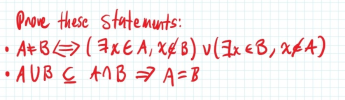 these are my tries and other ppl's tries.
Prove these statements for any sets A & B. Prove
using set definitions, or set equality property.
the question is in red, other information is my
attempts.
these are my tries and other ppl's tries.
Prove these statements for any sets A & B. Prove
using set definitions, or set equality property.
the question is in red, other information is my
attempts.
3) Complete the following to prove lim (4x – 3)= 5 using the epsilon-delta definition of...
 3) Complete the following to prove lim (4x – 3)= 5 using the epsilon-delta definition of a limit. x2 Part 1: Analysis (i.e. "guess” a 8) For every we need to if then (Complete these steps as you want in order to find delta.) This suggests that we should choose Part 2: Proof: (show that this choice of satisfies the definition of a limit). Given choose If then Thus, if , then Therefore, by Q.E.D.
 I really need someone to solve and explain the last two
questions. Thank you!
Exercise 1.5. Prove that if A and B are sets satisfying the property that then it must be the case that A - B. Exercise 1.6. Using definition (1.2.5) of the symmetric difference, prove that, for any sets A and B, AAB - (AUB)I(AnB). Exercise 1.7. Verify the second assertion of Theorem 1.3.4, that for any collection of sets {Asher Ai iET iET Exercise 1.8. Prove...
I really need someone to solve and explain the last two
questions. Thank you!
Exercise 1.5. Prove that if A and B are sets satisfying the property that then it must be the case that A - B. Exercise 1.6. Using definition (1.2.5) of the symmetric difference, prove that, for any sets A and B, AAB - (AUB)I(AnB). Exercise 1.7. Verify the second assertion of Theorem 1.3.4, that for any collection of sets {Asher Ai iET iET Exercise 1.8. Prove...
 Prove or disprove by using Definition 2.1.3
for any n E N. Then {ann is a convergent (g) Let an = sequence. (h) Let an sequence." for any n E N. Then {an} is a convergent
Prove or disprove by using Definition 2.1.3
for any n E N. Then {ann is a convergent (g) Let an = sequence. (h) Let an sequence." for any n E N. Then {an} is a convergent
 1.9.1 Definition. The rth elementary symmetric function Ef(xi,2,.. ,.xn) is the sum of all possible products of r elements chosen from fxi,*2, .. . *n) with- out replacement where order doesn't matter. Prove these three facts about elementary symmetric functions for any ai, a2, and any nonnegative integer r. . an, (b): Er(-a1 ,-a2 ,-an)-(-1 )EXa1 ,a2, ,an).
1.9.1 Definition. The rth elementary symmetric function Ef(xi,2,.. ,.xn) is the sum of all possible products of r elements chosen from fxi,*2,...
1.9.1 Definition. The rth elementary symmetric function Ef(xi,2,.. ,.xn) is the sum of all possible products of r elements chosen from fxi,*2, .. . *n) with- out replacement where order doesn't matter. Prove these three facts about elementary symmetric functions for any ai, a2, and any nonnegative integer r. . an, (b): Er(-a1 ,-a2 ,-an)-(-1 )EXa1 ,a2, ,an).
1.9.1 Definition. The rth elementary symmetric function Ef(xi,2,.. ,.xn) is the sum of all possible products of r elements chosen from fxi,*2,...
 these are my tries and other ppl's tries.
Prove these statements for any sets A & B. Prove
using set definitions, or set equality property.
the question is in red, other information is my
attempts.
these are my tries and other ppl's tries.
Prove these statements for any sets A & B. Prove
using set definitions, or set equality property.
the question is in red, other information is my
attempts.
 3) Complete the following to prove lim (4x – 3)= 5 using the epsilon-delta definition of a limit. x2 Part 1: Analysis (i.e. "guess” a 8) For every we need to if then (Complete these steps as you want in order to find delta.) This suggests that we should choose Part 2: Proof: (show that this choice of satisfies the definition of a limit). Given choose If then Thus, if , then Therefore, by Q.E.D.
Most questions answered within 3 hours.
-
Where is the error in this code sequence?
String s1 = "Hello";
String s2 = "ello";...
asked 10 months ago -
Financial data for Joel de Paris, Inc., for last year
follow:
Joel de Paris, Inc.
Balance...
asked 10 months ago -
Consider this reaction:
Al2(SO4)3 (aq)+ BaCl3
(aq) Al2Cl6 (aq)- +
3BaSO4(s) . What is the...
asked 10 months ago -
Suppose that Savneet is considering increasing her
recent random sample from 20 car rentals to 40...
asked 10 months ago -
Trucks arrive at an unloading terminal at an average rate of 120
per hour.
Trucks arrive...
asked 10 months ago -
Why are methanol and ethanol completely soluble in water while
octanol is not very little soluble....
asked 10 months ago -
A facilities manager at a university reads in a research report
that the mean amount of...
asked 10 months ago -
When the CuSO4 is rehydrated by adding water to the anhydrous
compound, is this an endothermic...
asked 10 months ago -
A ray of sunlight is passing from diamond into crown glass; the
angle of incidence is...
asked 10 months ago -
A block of mass 0.249 kg is placed on top of a light, vertical
spring of...
asked 10 months ago -
how do the kidneys compensate in the presences of acidosis
a) trigger hyperventilate
b) reserve acid...
asked 10 months ago -
Question 501 pts
The rental rate of capital to the firm increases. Which of the
following...
asked 10 months ago