
Homework Answers
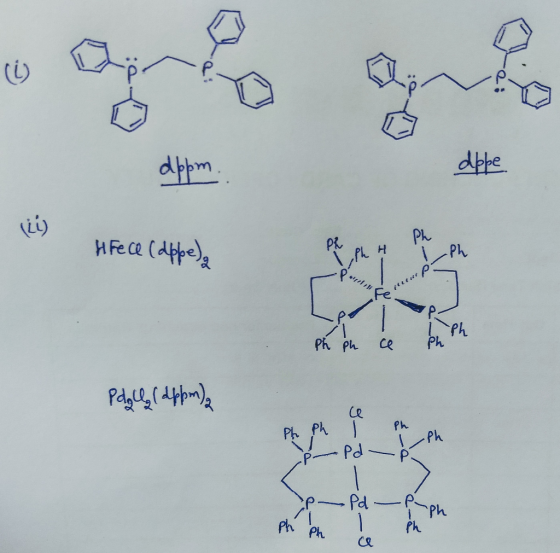
(iii) dppe complexes are more common because dppe is bidentate ligand , if forms five membered ring with the metal center. While dppm forms four membered ring, which is unstable due to excess strain. dppm can act as monodentate in some complexes , which are not stabilized chelation effect. dppm generally forms multi metallic complexes, to form five membered ring as shown in the above picture.
Add Answer to:
Complexes with chelating ligands such as dppe 1,2-bis(diphenylphosphino)e thane are more common than complexes with dppm...
xplain why chelating ligands give more stable complexes than monodentate ligands; use a balanced chemical equation...
 xplain why chelating ligands give more stable complexes than monodentate ligands; use a balanced chemical equation in your explanation. Explain why macrocyclic ligands give more stable complexes than chelating ligands.
1. For each pair of complexes given below (a-e), predict which complex will be more prone...
 1. For each pair of complexes given below (a-e), predict which complex will be more prone to decomposition by reductive elimination. Briefly give your reasoning. a) PdMean2-dppe)] or [PtMe2(n2-dppe)] b) [PdMe2(n2-dppe)] or [PdMe2(n2-depe)] c) trans-[PdMe2(PPhs)2] or cis-[PdMe2(PPhs)2] d) [AuMe4)'or cis-TrMe2(PMe3)2]. e) [PdBr(?-dppe)] or [PdH(Me)(?2-dppe)] dppe-1 ,2-bis(diphenylphosphino)ethane depe 1,2-bis(dicyclohexylphosphino)ethane
2. (3 points) In lab, you will form complexes using different ligands. Use your lab manual to identify and draw the str...
 2. (3 points) In lab, you will form complexes using different ligands. Use your lab manual to identify and draw the structural formula (lewis formula) for the following: a. A charged monodentate ligand (answer cannot be a halide ion) b. A polydentate ligand c. The CO ligand, not used in the laboratory. Is it likely CO can form a coordinate covalent bond from more than one atom? Explain. NC CN Ni Geometry of Coordination Compounds A compounds geometry (i.e., how...
From the following list of metal ions and ligands, construct metal complexes with properties which match...
 From the following list of metal ions and ligands, construct metal complexes with properties which match that described in each part of the question and provide a brief explanation. (Only one example is required for each part of the question, e.g. [Fe(H20)6]21). Metal ions Ligands (in order of increasing ligand field strength) [ < Br< <C1° <NO3 <OH <ox?- <H2O< Ti(IV), V(III), V(IV), Cr(II), Cr(III), Mn(II), NH3 <en <bpy < PPh3< CN=CO Mn(III), Mn(IV), Fe(II), Fe(III), Co(II), Co(III), en =...
1. Answer all parts to this question. From the following list of metal ions and ligands,...
 1. Answer all parts to this question. From the following list of metal ions and ligands, construct metal complexes with properties which match that described in each part of the question and provide a brief explanation (Only one example is required for each part of the question, eg [Fe(H:01) Metal ions Ligands in order of increasing ligand field strength) I <Br <C<NO, <OHOXH.0 Ti(IV), V(III), V(IV), CHIT), CHIIT), Min(II). NH<em<bry<PPh<N =CÓ Mn(III). Mn(IV), Fe(II) Fe(III). CoII), COIIT) en = ethylenediamine...
3. Of course, there is much more to the Cope rearrangement than I let on. Typical,...
 3. Of course, there is much more to the Cope rearrangement than I let on. Typical, right? Notice the differences in alkene geometry below. Provide a detailed explanation for how the alkene geometry is determined for each system. Use words and drawings to support your answer. TIP: Hardest question on this PW! Be brave! Me, Me: Me (E) heat heat 2. 32 ) Me Me Me Me Me (E) (E)
Please take your time to answer all questions clearly and correctly... More Nomenclature and Symmetry Learning...
 Please take your time to answer all questions clearly and
correctly...
More Nomenclature and Symmetry Learning Objectives: 1, Determine the rules for naming coordination compounds including special orientation of ligands 2. Use the rules to determine structures and formula from names and vice versa. 1. Isomerism in metal complex nomenclature: For the remainder of this assignment you can reference Figure 1 which contains a collection of metal complex structures with their chemical names and chemical compositions. Answer questions a -e....
Please take your time to answer all questions clearly and
correctly...
More Nomenclature and Symmetry Learning Objectives: 1, Determine the rules for naming coordination compounds including special orientation of ligands 2. Use the rules to determine structures and formula from names and vice versa. 1. Isomerism in metal complex nomenclature: For the remainder of this assignment you can reference Figure 1 which contains a collection of metal complex structures with their chemical names and chemical compositions. Answer questions a -e....
1. What is a structure based explanation for why acetamide is more stable than acetone. I'm...
 1. What is a structure based explanation for why acetamide is
more stable than acetone. I'm pretty sure it has to do with
resonance.
2. also for question F im fairly sure it has to do with
resonance again but I not sure exactly why. could someone answer
and explain?
F. Draw the conjugate base for each compound below and draw the appropriate structures to explain the difference in N-H acidity pKa~9.5 pKa 16 N-H N-H
1. What is a structure based explanation for why acetamide is
more stable than acetone. I'm pretty sure it has to do with
resonance.
2. also for question F im fairly sure it has to do with
resonance again but I not sure exactly why. could someone answer
and explain?
F. Draw the conjugate base for each compound below and draw the appropriate structures to explain the difference in N-H acidity pKa~9.5 pKa 16 N-H N-H
Please help me with the following questions. Provide me with explinations and more than just "this...
 Please help me with the following questions. Provide me
with explinations and more than just "this is the answer" Thank you
for your help!!
Determine whether or not each of
the following molecules is polar. For those that are, draw an arrow
indicating the direction of the net dipole moment. (See attached
image for the 4 different molecules it's asking about)
Which of the following iNOT an
acceptable resonance contributor for the o-nitrophenoxide ion?
Explain your answer. (See attached image...
Please help me with the following questions. Provide me
with explinations and more than just "this is the answer" Thank you
for your help!!
Determine whether or not each of
the following molecules is polar. For those that are, draw an arrow
indicating the direction of the net dipole moment. (See attached
image for the 4 different molecules it's asking about)
Which of the following iNOT an
acceptable resonance contributor for the o-nitrophenoxide ion?
Explain your answer. (See attached image...
What is the coordination number for each of the following complexes or compounds? [Co(NH3)4Cl2]+ [Ca(EDTA)]2− [Pt(NH3)4]2+...
 What is the coordination number for each of the following
complexes or compounds?
[Co(NH3)4Cl2]+
[Ca(EDTA)]2−
[Pt(NH3)4]2+
Na[Ag(CN)2]
Enter the coordination numbers, in the order that the complexes
are listed, as four integers separated by commas (e.g.,
1,2,3,4).
What is the charge on each of the following complex ions?
hexaaquairon(II), [Fe(H2O)6]?
tris(carbonato)aluminate(III), [Al(CO3)3]?
amminepentachloroplatinate(IV), [Pt(NH3)Cl5]?
Express the charges numerically, in the order that the complexes
are listed, separated by commas. For a nonzero charge, be sure to
include the sign (e.g.,...
What is the coordination number for each of the following
complexes or compounds?
[Co(NH3)4Cl2]+
[Ca(EDTA)]2−
[Pt(NH3)4]2+
Na[Ag(CN)2]
Enter the coordination numbers, in the order that the complexes
are listed, as four integers separated by commas (e.g.,
1,2,3,4).
What is the charge on each of the following complex ions?
hexaaquairon(II), [Fe(H2O)6]?
tris(carbonato)aluminate(III), [Al(CO3)3]?
amminepentachloroplatinate(IV), [Pt(NH3)Cl5]?
Express the charges numerically, in the order that the complexes
are listed, separated by commas. For a nonzero charge, be sure to
include the sign (e.g.,...
 xplain why chelating ligands give more stable complexes than monodentate ligands; use a balanced chemical equation in your explanation. Explain why macrocyclic ligands give more stable complexes than chelating ligands.
 1. For each pair of complexes given below (a-e), predict which complex will be more prone to decomposition by reductive elimination. Briefly give your reasoning. a) PdMean2-dppe)] or [PtMe2(n2-dppe)] b) [PdMe2(n2-dppe)] or [PdMe2(n2-depe)] c) trans-[PdMe2(PPhs)2] or cis-[PdMe2(PPhs)2] d) [AuMe4)'or cis-TrMe2(PMe3)2]. e) [PdBr(?-dppe)] or [PdH(Me)(?2-dppe)] dppe-1 ,2-bis(diphenylphosphino)ethane depe 1,2-bis(dicyclohexylphosphino)ethane
 2. (3 points) In lab, you will form complexes using different ligands. Use your lab manual to identify and draw the structural formula (lewis formula) for the following: a. A charged monodentate ligand (answer cannot be a halide ion) b. A polydentate ligand c. The CO ligand, not used in the laboratory. Is it likely CO can form a coordinate covalent bond from more than one atom? Explain. NC CN Ni Geometry of Coordination Compounds A compounds geometry (i.e., how...
 From the following list of metal ions and ligands, construct metal complexes with properties which match that described in each part of the question and provide a brief explanation. (Only one example is required for each part of the question, e.g. [Fe(H20)6]21). Metal ions Ligands (in order of increasing ligand field strength) [ < Br< <C1° <NO3 <OH <ox?- <H2O< Ti(IV), V(III), V(IV), Cr(II), Cr(III), Mn(II), NH3 <en <bpy < PPh3< CN=CO Mn(III), Mn(IV), Fe(II), Fe(III), Co(II), Co(III), en =...
 1. Answer all parts to this question. From the following list of metal ions and ligands, construct metal complexes with properties which match that described in each part of the question and provide a brief explanation (Only one example is required for each part of the question, eg [Fe(H:01) Metal ions Ligands in order of increasing ligand field strength) I <Br <C<NO, <OHOXH.0 Ti(IV), V(III), V(IV), CHIT), CHIIT), Min(II). NH<em<bry<PPh<N =CÓ Mn(III). Mn(IV), Fe(II) Fe(III). CoII), COIIT) en = ethylenediamine...
 3. Of course, there is much more to the Cope rearrangement than I let on. Typical, right? Notice the differences in alkene geometry below. Provide a detailed explanation for how the alkene geometry is determined for each system. Use words and drawings to support your answer. TIP: Hardest question on this PW! Be brave! Me, Me: Me (E) heat heat 2. 32 ) Me Me Me Me Me (E) (E)
 Please take your time to answer all questions clearly and
correctly...
More Nomenclature and Symmetry Learning Objectives: 1, Determine the rules for naming coordination compounds including special orientation of ligands 2. Use the rules to determine structures and formula from names and vice versa. 1. Isomerism in metal complex nomenclature: For the remainder of this assignment you can reference Figure 1 which contains a collection of metal complex structures with their chemical names and chemical compositions. Answer questions a -e....
Please take your time to answer all questions clearly and
correctly...
More Nomenclature and Symmetry Learning Objectives: 1, Determine the rules for naming coordination compounds including special orientation of ligands 2. Use the rules to determine structures and formula from names and vice versa. 1. Isomerism in metal complex nomenclature: For the remainder of this assignment you can reference Figure 1 which contains a collection of metal complex structures with their chemical names and chemical compositions. Answer questions a -e....
 1. What is a structure based explanation for why acetamide is
more stable than acetone. I'm pretty sure it has to do with
resonance.
2. also for question F im fairly sure it has to do with
resonance again but I not sure exactly why. could someone answer
and explain?
F. Draw the conjugate base for each compound below and draw the appropriate structures to explain the difference in N-H acidity pKa~9.5 pKa 16 N-H N-H
1. What is a structure based explanation for why acetamide is
more stable than acetone. I'm pretty sure it has to do with
resonance.
2. also for question F im fairly sure it has to do with
resonance again but I not sure exactly why. could someone answer
and explain?
F. Draw the conjugate base for each compound below and draw the appropriate structures to explain the difference in N-H acidity pKa~9.5 pKa 16 N-H N-H
 Please help me with the following questions. Provide me
with explinations and more than just "this is the answer" Thank you
for your help!!
Determine whether or not each of
the following molecules is polar. For those that are, draw an arrow
indicating the direction of the net dipole moment. (See attached
image for the 4 different molecules it's asking about)
Which of the following iNOT an
acceptable resonance contributor for the o-nitrophenoxide ion?
Explain your answer. (See attached image...
Please help me with the following questions. Provide me
with explinations and more than just "this is the answer" Thank you
for your help!!
Determine whether or not each of
the following molecules is polar. For those that are, draw an arrow
indicating the direction of the net dipole moment. (See attached
image for the 4 different molecules it's asking about)
Which of the following iNOT an
acceptable resonance contributor for the o-nitrophenoxide ion?
Explain your answer. (See attached image...
 What is the coordination number for each of the following
complexes or compounds?
[Co(NH3)4Cl2]+
[Ca(EDTA)]2−
[Pt(NH3)4]2+
Na[Ag(CN)2]
Enter the coordination numbers, in the order that the complexes
are listed, as four integers separated by commas (e.g.,
1,2,3,4).
What is the charge on each of the following complex ions?
hexaaquairon(II), [Fe(H2O)6]?
tris(carbonato)aluminate(III), [Al(CO3)3]?
amminepentachloroplatinate(IV), [Pt(NH3)Cl5]?
Express the charges numerically, in the order that the complexes
are listed, separated by commas. For a nonzero charge, be sure to
include the sign (e.g.,...
What is the coordination number for each of the following
complexes or compounds?
[Co(NH3)4Cl2]+
[Ca(EDTA)]2−
[Pt(NH3)4]2+
Na[Ag(CN)2]
Enter the coordination numbers, in the order that the complexes
are listed, as four integers separated by commas (e.g.,
1,2,3,4).
What is the charge on each of the following complex ions?
hexaaquairon(II), [Fe(H2O)6]?
tris(carbonato)aluminate(III), [Al(CO3)3]?
amminepentachloroplatinate(IV), [Pt(NH3)Cl5]?
Express the charges numerically, in the order that the complexes
are listed, separated by commas. For a nonzero charge, be sure to
include the sign (e.g.,...
Most questions answered within 3 hours.
-
Where is the error in this code sequence?
String s1 = "Hello";
String s2 = "ello";...
asked 10 months ago -
Financial data for Joel de Paris, Inc., for last year
follow:
Joel de Paris, Inc.
Balance...
asked 10 months ago -
Consider this reaction:
Al2(SO4)3 (aq)+ BaCl3
(aq) Al2Cl6 (aq)- +
3BaSO4(s) . What is the...
asked 10 months ago -
Suppose that Savneet is considering increasing her
recent random sample from 20 car rentals to 40...
asked 10 months ago -
Trucks arrive at an unloading terminal at an average rate of 120
per hour.
Trucks arrive...
asked 10 months ago -
Why are methanol and ethanol completely soluble in water while
octanol is not very little soluble....
asked 10 months ago -
A facilities manager at a university reads in a research report
that the mean amount of...
asked 10 months ago -
When the CuSO4 is rehydrated by adding water to the anhydrous
compound, is this an endothermic...
asked 10 months ago -
A ray of sunlight is passing from diamond into crown glass; the
angle of incidence is...
asked 10 months ago -
A block of mass 0.249 kg is placed on top of a light, vertical
spring of...
asked 10 months ago -
how do the kidneys compensate in the presences of acidosis
a) trigger hyperventilate
b) reserve acid...
asked 10 months ago -
Question 501 pts
The rental rate of capital to the firm increases. Which of the
following...
asked 10 months ago