A mutual fund is managing a portfolio of $100 million, and estimates its returns are normally...
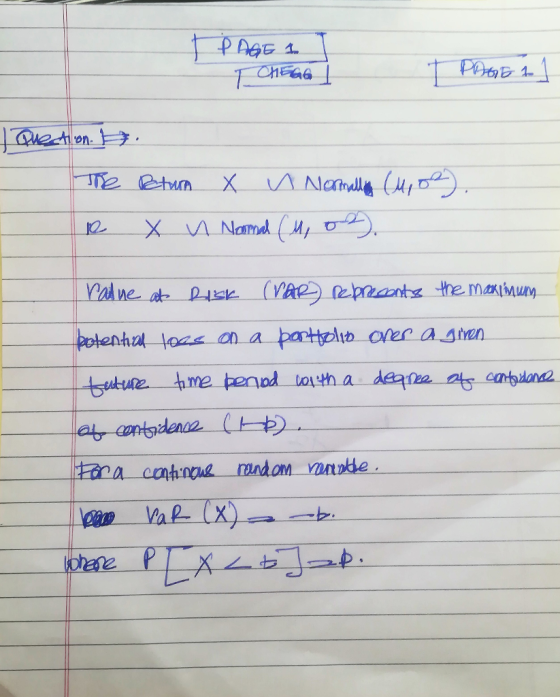
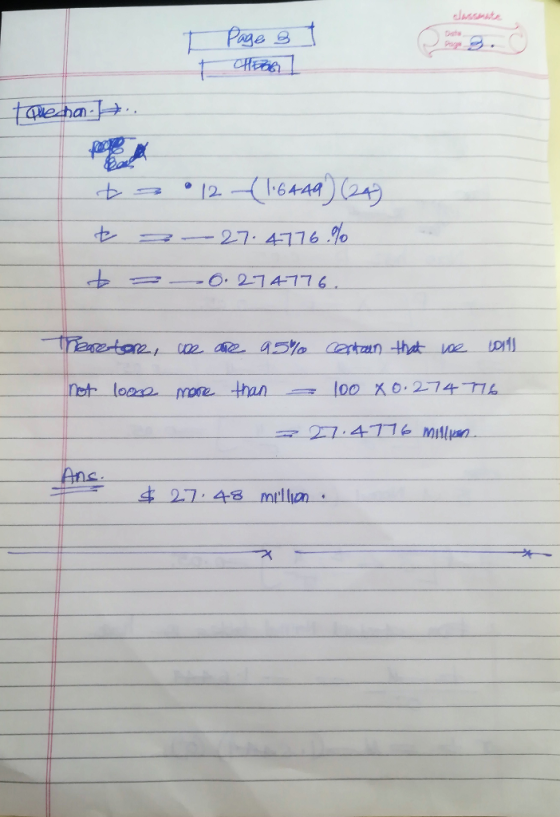
A mutual fund is managing a portfolio of $100 million, and estimates its returns are normally distributed with a mean of 12 % and a standard deviation of 24 %. What is the 5% Value at Risk for the fund?
Enter answer in millions, accurate to two decimal places.
Homework Answers

Add Answer to:
A mutual fund is managing a portfolio of $100 million, and estimates its returns are normally...
Suppose a mutual fund has yearly returns that are normally distributed and has a mean yearly...
Suppose a mutual fund has yearly returns that are normally distributed and has a mean yearly return of 9% with standard deviation of 4%. What is the cutoff for the lowest 2.5% of yearly returns with this mutual fund? Round to the nearest tenth of a percent.
Suppose the returns of a particular group of mutual funds are normally distributed with a mean...
Suppose the returns of a particular group of mutual funds are normally distributed with a mean of 10.9% and a standard deviation of 4.6%. If the manager of a particular fund wants his fund to be in the top 10% of funds with the highest return, what return must his fund have? (please round your answer to 2 decimal places)
Subject: PORTFOLIO BETA A mutual fund manager has a $20 million portfolio with a beta of...
Subject: PORTFOLIO BETA A mutual fund manager has a $20 million portfolio with a beta of 0.75. The risk-free rate is 4.00%, and the market risk premium is 5.0%. The manager expects to receive an additional $5 million, which she plans to invest in a number of stocks. After investing the additional funds, she wants the fund's required return to be 19%. What should be the average beta of the new stocks added to the portfolio? Do not round intermediate...
PORTFOLIO BETA A mutual fund manager has a $20 million portfolio with a beta of 2.00....
PORTFOLIO BETA A mutual fund manager has a $20 million portfolio with a beta of 2.00. The risk-free rate is 7.50%, and the market risk premium is 6.5%. The manager expects to receive an additional $5 million, which she plans to invest in a number of stocks. After investing the additional funds, she wants the fund's required return to be 19%. What should be the average beta of the new stocks added to the portfolio? Do not round intermediate calculations....
A pension fund manager is considering three mutual funds. The first is a stock fund, the...
 A pension fund manager is considering three mutual funds. The first is a stock fund, the second is a long-term government and corporate bond fund, and the third is a T-bill money market fund that yields a rate of 8%. The probability distribution of the risky funds is as follows: Expected Return 24% 12 Standard Deviation 30% 19 Stock fund (S) Bond fund (B) The correlation between the fund returns is 0.13. a-1. What are the investment proportions in the...
You collect a small sample of 20 fund returns, which turns out to have a sample...
You collect a small sample of 20 fund returns, which turns out to have a sample mean of 6 % and a sample standard deviation of 6 %. Assuming fund returns are normally distributed, what is the lower bound of the 95% confidence interval for fund returns? Enter answer in percents, accurate to two decimal places. I need it to be done on excel, Please SHOW the steps.
A mutual fund manager has a $20 million portfolio with a beta of 2.00. The risk-free...
A mutual fund manager has a $20 million portfolio with a beta of 2.00. The risk-free rate is 6.75%, and the market risk premium is 5.0%. The manager expects to receive an additional $5 million, which she plans to invest in a number of stocks. After investing the additional funds, she wants the fund's required return to be 18%. What should be the average beta of the new stocks added to the portfolio? Do not round intermediate calculations. Round your...
A. The return on treasury bills is 4%. The return on a mutual fund is normally...
 A. The return on treasury bills is 4%. The return on a mutual fund is normally distributed with a mean of 10% and a standard deviation of 20%. An investor forms a portfolio, P, by putting 70% of his money into the mutual fund and the remainder into treasury bills. Find the expected return on the investor's portfolio. B. Find the equation of the combination line. Find the standard deviation of the investor's portfolio. Find the standard normal deviate, Zº,...
The return on a portfolio is normally distributed with a mean of 10% and a standard...
 The return on a portfolio is normally distributed with a mean of 10% and a standard deviation of 25%. Find the following: A. Prob(Rp <0) B. Prob(R, > 25%) c. Prob(0% <R, <20%) A. The return on treasury bills is 4%. The return on a mutual fund is normally distributed with a mean of 10% and a standard deviation of 20%. An investor forms a portfolio, P. by putting 70% of his money into the mutual fund and the remainder...
A pension fund manager is considering three mutual funds. The first is a stock fund, the...
A pension fund manager is considering three mutual funds. The first is a stock fund, the second is a long-term government and corporate bond fund, and the third is a T-bill money market fund that yields a rate of 8%. The probability distribution of the risky funds is as follows: Expected Return Standard Deviation Stock fund (S) 24 % 30 % Bond fund (B) 12 19 The correlation between the fund returns is 0.13. a-1. What are the investment proportions...
 A pension fund manager is considering three mutual funds. The first is a stock fund, the second is a long-term government and corporate bond fund, and the third is a T-bill money market fund that yields a rate of 8%. The probability distribution of the risky funds is as follows: Expected Return 24% 12 Standard Deviation 30% 19 Stock fund (S) Bond fund (B) The correlation between the fund returns is 0.13. a-1. What are the investment proportions in the...
 A. The return on treasury bills is 4%. The return on a mutual fund is normally distributed with a mean of 10% and a standard deviation of 20%. An investor forms a portfolio, P, by putting 70% of his money into the mutual fund and the remainder into treasury bills. Find the expected return on the investor's portfolio. B. Find the equation of the combination line. Find the standard deviation of the investor's portfolio. Find the standard normal deviate, Zº,...
 The return on a portfolio is normally distributed with a mean of 10% and a standard deviation of 25%. Find the following: A. Prob(Rp <0) B. Prob(R, > 25%) c. Prob(0% <R, <20%) A. The return on treasury bills is 4%. The return on a mutual fund is normally distributed with a mean of 10% and a standard deviation of 20%. An investor forms a portfolio, P. by putting 70% of his money into the mutual fund and the remainder...
Most questions answered within 3 hours.
-
Where is the error in this code sequence?
String s1 = "Hello";
String s2 = "ello";...
asked 11 months ago -
Financial data for Joel de Paris, Inc., for last year
follow:
Joel de Paris, Inc.
Balance...
asked 11 months ago -
Consider this reaction:
Al2(SO4)3 (aq)+ BaCl3
(aq) Al2Cl6 (aq)- +
3BaSO4(s) . What is the...
asked 11 months ago -
Suppose that Savneet is considering increasing her
recent random sample from 20 car rentals to 40...
asked 11 months ago -
Trucks arrive at an unloading terminal at an average rate of 120
per hour.
Trucks arrive...
asked 11 months ago -
Why are methanol and ethanol completely soluble in water while
octanol is not very little soluble....
asked 11 months ago -
A facilities manager at a university reads in a research report
that the mean amount of...
asked 11 months ago -
When the CuSO4 is rehydrated by adding water to the anhydrous
compound, is this an endothermic...
asked 11 months ago -
A ray of sunlight is passing from diamond into crown glass; the
angle of incidence is...
asked 11 months ago -
A block of mass 0.249 kg is placed on top of a light, vertical
spring of...
asked 11 months ago -
how do the kidneys compensate in the presences of acidosis
a) trigger hyperventilate
b) reserve acid...
asked 11 months ago -
Question 501 pts
The rental rate of capital to the firm increases. Which of the
following...
asked 11 months ago