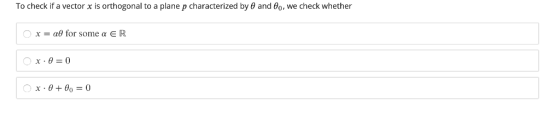
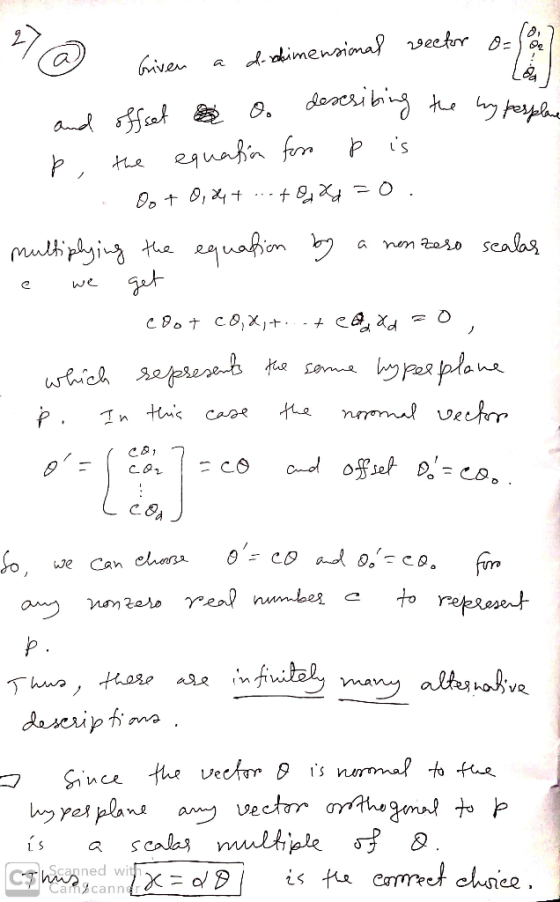
To check if a vector x is orthogonal to a plane p characterized by 0 and 00, we check whether x = ae for some a E R Ox0 0 x0 = 0
Homework Answers
Add Answer to:
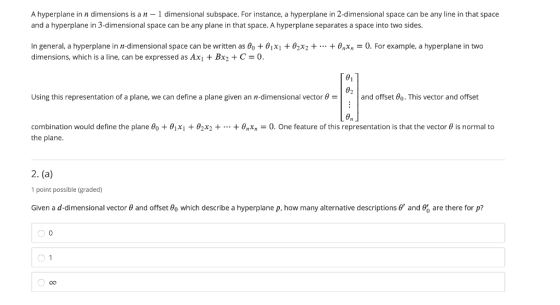
A hyperplane in n dimensions is a n - 1 dimensional subspace. For instance, a hyperplane...
Consider the three-dimensional subspace of function space defined by the span of 1, r, and a2 the...
 Consider the three-dimensional subspace of function space defined by the span of 1, r, and a2 the first three orthogonal polynomials on -1,1. Let f(x) 21, and consider the subset G-{g(z) | 〈f,g〉 0), the set of functions orthogonal to f using the L inner product on, (This can be thought of as the plane normal to f(x) in the three-dimensional function space.) Let h(z) 2-1. Find the function g(x) є G in the plane which is closest to h(x)....
Hello, can you please help me understand this problem? Thank you! 3. Let V be finite...
 Hello, can you please help me understand this problem? Thank
you!
3. Let V be finite dimensional vector space. T is a linear transformation from V into W and E is a subspace of V and F is a subspace of W. Define T-(F) = {u € V|T(u) € F} and T(E) = {WE Ww= T(u) for someu e E}. (a) Prove that T-(F) is a subspace of V and dim(T-(F)) = dim(Ker(T)) + dim(F n Im(T)) (b) Prove that...
Hello, can you please help me understand this problem? Thank
you!
3. Let V be finite dimensional vector space. T is a linear transformation from V into W and E is a subspace of V and F is a subspace of W. Define T-(F) = {u € V|T(u) € F} and T(E) = {WE Ww= T(u) for someu e E}. (a) Prove that T-(F) is a subspace of V and dim(T-(F)) = dim(Ker(T)) + dim(F n Im(T)) (b) Prove that...
Exercise 6 (6.4.35, p.452) Let A e Cnxn, and let S be a k-dimensional subspace of...
 Exercise 6 (6.4.35, p.452) Let A e Cnxn, and let S be a k-dimensional subspace of C". Then a vector ve S is called a Ritz vector of A from S if and only if there is a pie C such that the Rayleigh-Ritz-Galerkin condition Av – uv Is holds, that is, (Av – uv, s) = 0 for all s E S. The scalar u is called the Ritz value of A associated with v. Let 91, ...,qk be...
Question 1. Let V be a finite dimensional vector space over a field F and let...
 Question 1. Let V be a finite dimensional vector space over a field F and let W be a subspace of Prove that the quotient space V/W is finite dimensional and dimr(V/IV) = dimF(V) _ dimF(W). Hint l. Start with a basis A = {wi, . . . , w,n} for W and extend it to a basis B = {wi , . . . , wm, V1 , . . . , va) for V. Hint 2. Our goal...
2. Let V be an n-dimensional vector space over C. Classify, up to similarity, all JE C(V), where2...
 linear algebra please help on both questions
2. Let V be an n-dimensional vector space over C. Classify, up to similarity, all JE C(V), where2-Idy 3. Recall in assignment 2, no. 7, you showed UoM-lv where U, M E C(V), V-Fİrl,Ms Mr maps p to ap, and U maps 1 to 0 and a to for nEN a. Show that 0 E σ(M). b. Show 0 is not an eigenvalue of M. c. Define an inner product on V: Flr]...
linear algebra please help on both questions
2. Let V be an n-dimensional vector space over C. Classify, up to similarity, all JE C(V), where2-Idy 3. Recall in assignment 2, no. 7, you showed UoM-lv where U, M E C(V), V-Fİrl,Ms Mr maps p to ap, and U maps 1 to 0 and a to for nEN a. Show that 0 E σ(M). b. Show 0 is not an eigenvalue of M. c. Define an inner product on V: Flr]...
12. (True/False) (a) Let AE Rm*n . Then R(A) (b) Let AERm*n. Then N(A) is isomorphic to N(AT) (c) We define < A. B > = Tr (BTA ) where A, B E Rnxn . is isomorphic to R(A Then 〈 . , . 〉 is an...
 12. (True/False) (a) Let AE Rm*n . Then R(A) (b) Let AERm*n. Then N(A) is isomorphic to N(AT) (c) We define < A. B > = Tr (BTA ) where A, B E Rnxn . is isomorphic to R(A Then 〈 . , . 〉 is an inner product on Rmxn. (d) Consider a periodic-function space V with period of 1 sec. Define an inner product on V by <f,a>= f(t )a (t ) dt. Then cos 2 π t...
Let V be a finite-dimensional vector space and let T L(V) be an operator. In this problem you sh...
Let V be a finite-dimensional vector space and let T L(V) be an operator. In this problem you show that there is a nonzero polynomial such that p(T) = 0. (a) What is 0 in this context? A polynomial? A linear map? An element of V? (b) Define by . Prove that is a linear map. (c) Prove that if where V is infinite-dimensional and W is finite-dimensional, then S cannot be injective. (d) Use the preceding parts to prove...
(1 point) Determine whether the given set S is a subspace of the vector space V....
 (1 point) Determine whether the given set S is a subspace of the vector space V. A. V = R", and S is the set of solutions to the homogeneous linear system Ax = 0 where A is a fixed mxn matrix. B. V is the vector space of all real-valued functions defined on the interval (-oo, oo), and S is the subset of V consisting of those functions satisfying f(0) 0 C. V Mn (R), and S is the...
Let V = R3[x] be the vector space of all polynomials with real coefficients and degress not exceeding 3. Let V-R3r] be t...
 Let V = R3[x] be the vector
space of all polynomials with real coefficients and degress not
exceeding 3.
Let V-R3r] be the vector space of all polynomials with real coefficients and degress not exceeding 3. For 0Sn 3, define the maps dn p(x)HP(x) do where we adopt the convention thatp(x). Also define f V -V to be the linear map dro (a) Show that for O S n 3, T, is in the dual space V (b) LetTOs Show...
Let V = R3[x] be the vector
space of all polynomials with real coefficients and degress not
exceeding 3.
Let V-R3r] be the vector space of all polynomials with real coefficients and degress not exceeding 3. For 0Sn 3, define the maps dn p(x)HP(x) do where we adopt the convention thatp(x). Also define f V -V to be the linear map dro (a) Show that for O S n 3, T, is in the dual space V (b) LetTOs Show...
5. For t ER, define the evaluation map evt : Pn(R) + R given by evt(p(x))...
 5. For t ER, define the evaluation map evt : Pn(R) + R given by evt(p(x)) = p(t). Here we consider R as the vector space R1. (a) Prove evt is a linear map. (b) For part (b), let n= 4. Write down a polynomial p e ker(ev3). (c) For any t, the set of polynomials Ut = {p E Pn(R) : p(t) = 0} is a subspace. What is the dimension of Ut (in terms of n)? Justify your...
 Consider the three-dimensional subspace of function space defined by the span of 1, r, and a2 the first three orthogonal polynomials on -1,1. Let f(x) 21, and consider the subset G-{g(z) | 〈f,g〉 0), the set of functions orthogonal to f using the L inner product on, (This can be thought of as the plane normal to f(x) in the three-dimensional function space.) Let h(z) 2-1. Find the function g(x) є G in the plane which is closest to h(x)....
 Hello, can you please help me understand this problem? Thank
you!
3. Let V be finite dimensional vector space. T is a linear transformation from V into W and E is a subspace of V and F is a subspace of W. Define T-(F) = {u € V|T(u) € F} and T(E) = {WE Ww= T(u) for someu e E}. (a) Prove that T-(F) is a subspace of V and dim(T-(F)) = dim(Ker(T)) + dim(F n Im(T)) (b) Prove that...
Hello, can you please help me understand this problem? Thank
you!
3. Let V be finite dimensional vector space. T is a linear transformation from V into W and E is a subspace of V and F is a subspace of W. Define T-(F) = {u € V|T(u) € F} and T(E) = {WE Ww= T(u) for someu e E}. (a) Prove that T-(F) is a subspace of V and dim(T-(F)) = dim(Ker(T)) + dim(F n Im(T)) (b) Prove that...
 Exercise 6 (6.4.35, p.452) Let A e Cnxn, and let S be a k-dimensional subspace of C". Then a vector ve S is called a Ritz vector of A from S if and only if there is a pie C such that the Rayleigh-Ritz-Galerkin condition Av – uv Is holds, that is, (Av – uv, s) = 0 for all s E S. The scalar u is called the Ritz value of A associated with v. Let 91, ...,qk be...
 Question 1. Let V be a finite dimensional vector space over a field F and let W be a subspace of Prove that the quotient space V/W is finite dimensional and dimr(V/IV) = dimF(V) _ dimF(W). Hint l. Start with a basis A = {wi, . . . , w,n} for W and extend it to a basis B = {wi , . . . , wm, V1 , . . . , va) for V. Hint 2. Our goal...
 linear algebra please help on both questions
2. Let V be an n-dimensional vector space over C. Classify, up to similarity, all JE C(V), where2-Idy 3. Recall in assignment 2, no. 7, you showed UoM-lv where U, M E C(V), V-Fİrl,Ms Mr maps p to ap, and U maps 1 to 0 and a to for nEN a. Show that 0 E σ(M). b. Show 0 is not an eigenvalue of M. c. Define an inner product on V: Flr]...
linear algebra please help on both questions
2. Let V be an n-dimensional vector space over C. Classify, up to similarity, all JE C(V), where2-Idy 3. Recall in assignment 2, no. 7, you showed UoM-lv where U, M E C(V), V-Fİrl,Ms Mr maps p to ap, and U maps 1 to 0 and a to for nEN a. Show that 0 E σ(M). b. Show 0 is not an eigenvalue of M. c. Define an inner product on V: Flr]...
 12. (True/False) (a) Let AE Rm*n . Then R(A) (b) Let AERm*n. Then N(A) is isomorphic to N(AT) (c) We define < A. B > = Tr (BTA ) where A, B E Rnxn . is isomorphic to R(A Then 〈 . , . 〉 is an inner product on Rmxn. (d) Consider a periodic-function space V with period of 1 sec. Define an inner product on V by <f,a>= f(t )a (t ) dt. Then cos 2 π t...
 (1 point) Determine whether the given set S is a subspace of the vector space V. A. V = R", and S is the set of solutions to the homogeneous linear system Ax = 0 where A is a fixed mxn matrix. B. V is the vector space of all real-valued functions defined on the interval (-oo, oo), and S is the subset of V consisting of those functions satisfying f(0) 0 C. V Mn (R), and S is the...
 Let V = R3[x] be the vector
space of all polynomials with real coefficients and degress not
exceeding 3.
Let V-R3r] be the vector space of all polynomials with real coefficients and degress not exceeding 3. For 0Sn 3, define the maps dn p(x)HP(x) do where we adopt the convention thatp(x). Also define f V -V to be the linear map dro (a) Show that for O S n 3, T, is in the dual space V (b) LetTOs Show...
Let V = R3[x] be the vector
space of all polynomials with real coefficients and degress not
exceeding 3.
Let V-R3r] be the vector space of all polynomials with real coefficients and degress not exceeding 3. For 0Sn 3, define the maps dn p(x)HP(x) do where we adopt the convention thatp(x). Also define f V -V to be the linear map dro (a) Show that for O S n 3, T, is in the dual space V (b) LetTOs Show...
 5. For t ER, define the evaluation map evt : Pn(R) + R given by evt(p(x)) = p(t). Here we consider R as the vector space R1. (a) Prove evt is a linear map. (b) For part (b), let n= 4. Write down a polynomial p e ker(ev3). (c) For any t, the set of polynomials Ut = {p E Pn(R) : p(t) = 0} is a subspace. What is the dimension of Ut (in terms of n)? Justify your...
Most questions answered within 3 hours.
-
Where is the error in this code sequence?
String s1 = "Hello";
String s2 = "ello";...
asked 10 months ago -
Financial data for Joel de Paris, Inc., for last year
follow:
Joel de Paris, Inc.
Balance...
asked 10 months ago -
Consider this reaction:
Al2(SO4)3 (aq)+ BaCl3
(aq) Al2Cl6 (aq)- +
3BaSO4(s) . What is the...
asked 10 months ago -
Suppose that Savneet is considering increasing her
recent random sample from 20 car rentals to 40...
asked 10 months ago -
Trucks arrive at an unloading terminal at an average rate of 120
per hour.
Trucks arrive...
asked 10 months ago -
Why are methanol and ethanol completely soluble in water while
octanol is not very little soluble....
asked 10 months ago -
A facilities manager at a university reads in a research report
that the mean amount of...
asked 10 months ago -
When the CuSO4 is rehydrated by adding water to the anhydrous
compound, is this an endothermic...
asked 10 months ago -
A ray of sunlight is passing from diamond into crown glass; the
angle of incidence is...
asked 10 months ago -
A block of mass 0.249 kg is placed on top of a light, vertical
spring of...
asked 10 months ago -
how do the kidneys compensate in the presences of acidosis
a) trigger hyperventilate
b) reserve acid...
asked 10 months ago -
Question 501 pts
The rental rate of capital to the firm increases. Which of the
following...
asked 10 months ago