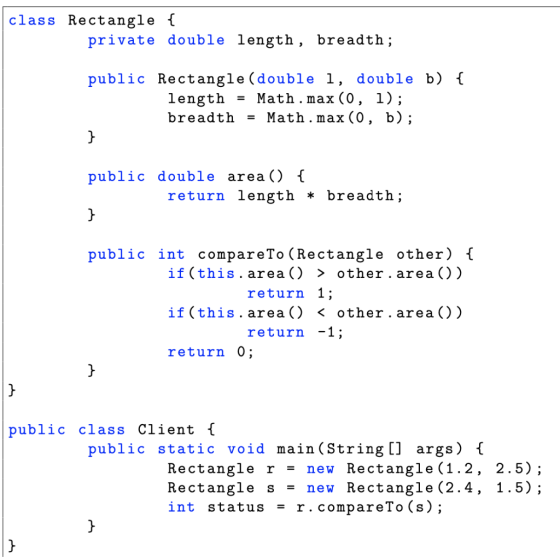
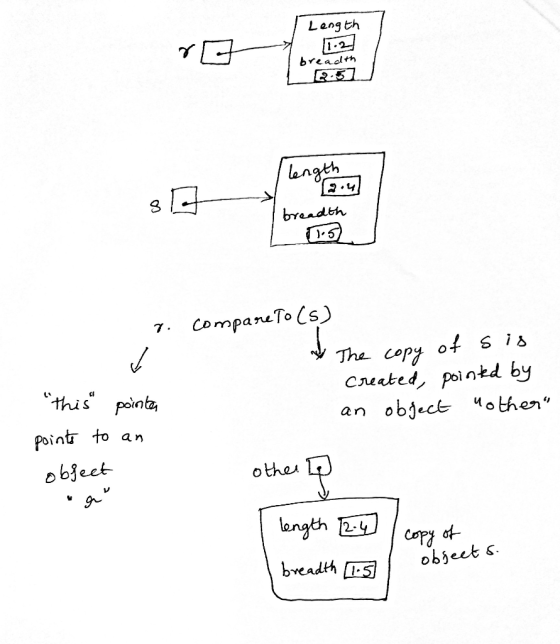
a. Draw a memory diagram to illustrate the passing of parameters with respect to the method call r.compareTo(s) in the following code. More specifically, illustrate how the calling object and parameter object are referenced during the execution of the method r.compareTo(s).
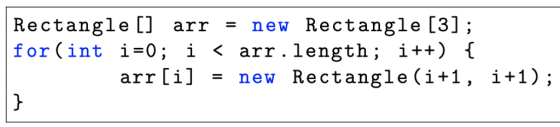
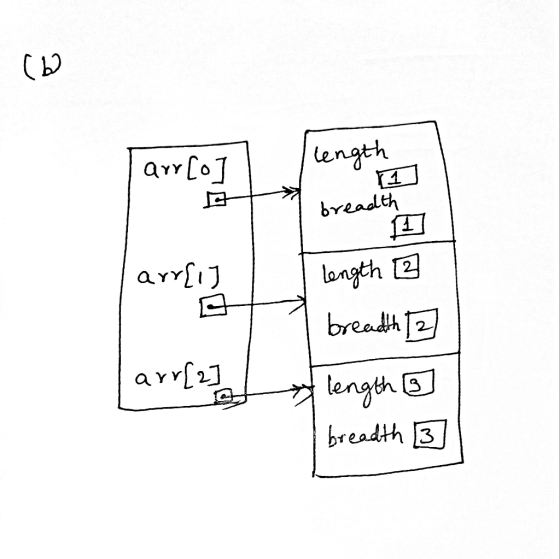
b. For the same definition for class Rectangle as part c., draw the memory diagram that illustrates the storage of array and objects when the following code executes:
Homework Answers
Add Answer to:
a. Draw a memory diagram to illustrate the passing of parameters with respect to the method...
a. Draw a memory diagram to illustrate the passing of parameters with respect to the method...
 a. Draw a memory diagram to illustrate the passing of parameters
with respect to the method call r.compareTo(s) in the following
code. More specifically, illustrate how the calling object and
parameter object are referenced during the execution of the method
r.compareTo(s).
b. For the same definition for class Rectangle as part a., draw
the memory diagram that illustrates the storage of array and
objects when the following code executes:
class Rectangle { private double length, breadth; public Rectangle(double 1, double...
a. Draw a memory diagram to illustrate the passing of parameters
with respect to the method call r.compareTo(s) in the following
code. More specifically, illustrate how the calling object and
parameter object are referenced during the execution of the method
r.compareTo(s).
b. For the same definition for class Rectangle as part a., draw
the memory diagram that illustrates the storage of array and
objects when the following code executes:
class Rectangle { private double length, breadth; public Rectangle(double 1, double...
Draw a memory diagram to illustrate the passing of parameters with respect to the method call...
 Draw a memory diagram to illustrate the passing of parameters
with respect to the method call r.resize(1.1) on line 18 of the
following code.
Rectangle { private class double length , breadth public Rectangle(double l, double b) { (0, 1) (0, b); Math.mах length = Math.max breadth = } resize (double factor) { public void = this.length this.length factor; this.breadth * factor; this.breadth } } Client public class main (String [] args) { public static void Rectangle (1. 2, 2.5);...
Draw a memory diagram to illustrate the passing of parameters
with respect to the method call r.resize(1.1) on line 18 of the
following code.
Rectangle { private class double length , breadth public Rectangle(double l, double b) { (0, 1) (0, b); Math.mах length = Math.max breadth = } resize (double factor) { public void = this.length this.length factor; this.breadth * factor; this.breadth } } Client public class main (String [] args) { public static void Rectangle (1. 2, 2.5);...
A general shape class is shown below. Shape has a dimension. It also defines constructors, getters,...
A general shape class is shown below. Shape has a dimension. It also defines constructors, getters, setters and a toString method. class Shape{ int dimension; public Shape(){} public Shape(int newDimension){ dimension = newDimension; } public int getDimension(){ return dimension; } public void setDimension(int newDimension){ dimension = newDimension; } public String toString(){ return "Shape has dimension "+dimension; } } a. Define classes Circle and Square, which inherit from Shape class. b. Both classes must have two constructors similar to Shape class....
Draw memory diagrams for all variables and objects created using during the execution of main method...
Draw memory diagrams for all variables and objects created using during the execution of main method below: class Singleton { private int value; Singleton( int value ) { this.value = value; } } class Pair { private Object first; private Object second; Pair( Object first, Object second ) { this.first = first; this.second = second; } } public class Quiz { public static void main( String[] args ) { Singleton s; Pair p1, p2; s = new Singleton( 99 );...
Question 1- part-1) Provide complete UML class diagrams for the Polygon and Rectangle classes, including access...
Question 1- part-1) Provide complete UML class diagrams for the Polygon and Rectangle classes, including access specifiers, parameters, and data/return types. Include the relationship between these two classes in the diagram. And then, Question 1-part-2) Given the following reference variable declaration and object assignment: Polygon poly = new Rectangle(); What would happen given each of the following two lines of code? Briefly explain your answer. System.out.println(poly); double area = poly.getArea(); Then tell me what is the major difference between abstract...
Why are obj1 and obj2 printing the same areas? I'm trying to learn about Comparable interface....
Why are obj1 and obj2 printing the same areas? I'm trying to learn about Comparable interface. Couldn't figure it out. the compare to method should print 0, 1, or -1 import java.util.*; public class RectangleMain { public static void main(String [] args) throws CloneNotSupportedException { /*ComparableRectangleAlsoCloneable obj1 = new ComparableRectangleAlsoCloneable(4, 5); ComparableRectangleAlsoCloneable obj2 = (ComparableRectangleAlsoCloneable)obj1.clone(); System.out.println(obj1.toString()); System.out.println(obj1 == obj2); //false System.out.println(obj2.toString());*/ Scanner...
this is for java programming Please Use Comments I am not 100% sure if my code...
this is for java programming Please Use Comments I am not 100% sure if my code needs work, this code is for the geometric if you feel like you need to edit it please do :) Problem Description: Modify the GeometricObject class to implement the Comparable interface and define a static max method in the GeometricObject class for finding the larger (in area) of two GeometricObject objects. Draw the UML and implement the new GeometricObject class and its two subclasses...
JAVA Modify the code to create a class called box, wherein you find the area. I...
JAVA Modify the code to create a class called box, wherein you find the area. I have the code in rectangle and needs to change it to box. Here is my code. Rectangle.java public class Rectangle { private int length; private int width; public void setRectangle(int length, int width) { this.length = length; this.width = width; } public int area() { return this.length * this.width; } } // CONSOLE / MAIN import java.awt.Rectangle; import java.util.Scanner; public class Console...
(Need to complete the methods and pass a Junit test i can email them to you.)...
(Need to complete the methods and pass a Junit test i can email them to you.) public class Triangle implements Comparable { /** * Stores the number of objects instantiated from the {@code Triangle} class */ private static int numTriangles; /** * The shortest side of the triangle */ private final double a; /** * The side of medium length of the triangle */ private final double b;...
write a completed program (included the main) for the Q: add an equals method to each...
 write a completed program (included the main) for the Q: add an
equals method to each of the Rectangle circle and triangle classes
introduced in this chapter. two shapes are considered equal if
their fields have equivalent values. based on
public class Circle implements Shape f private double radius; // Constructs a new circle with the given radius. public Circle (double radius) f this.radius - radius; // Returns the area of this circle. public double getArea) return Math.PI *radius *...
write a completed program (included the main) for the Q: add an
equals method to each of the Rectangle circle and triangle classes
introduced in this chapter. two shapes are considered equal if
their fields have equivalent values. based on
public class Circle implements Shape f private double radius; // Constructs a new circle with the given radius. public Circle (double radius) f this.radius - radius; // Returns the area of this circle. public double getArea) return Math.PI *radius *...
 a. Draw a memory diagram to illustrate the passing of parameters
with respect to the method call r.compareTo(s) in the following
code. More specifically, illustrate how the calling object and
parameter object are referenced during the execution of the method
r.compareTo(s).
b. For the same definition for class Rectangle as part a., draw
the memory diagram that illustrates the storage of array and
objects when the following code executes:
class Rectangle { private double length, breadth; public Rectangle(double 1, double...
a. Draw a memory diagram to illustrate the passing of parameters
with respect to the method call r.compareTo(s) in the following
code. More specifically, illustrate how the calling object and
parameter object are referenced during the execution of the method
r.compareTo(s).
b. For the same definition for class Rectangle as part a., draw
the memory diagram that illustrates the storage of array and
objects when the following code executes:
class Rectangle { private double length, breadth; public Rectangle(double 1, double...
 Draw a memory diagram to illustrate the passing of parameters
with respect to the method call r.resize(1.1) on line 18 of the
following code.
Rectangle { private class double length , breadth public Rectangle(double l, double b) { (0, 1) (0, b); Math.mах length = Math.max breadth = } resize (double factor) { public void = this.length this.length factor; this.breadth * factor; this.breadth } } Client public class main (String [] args) { public static void Rectangle (1. 2, 2.5);...
Draw a memory diagram to illustrate the passing of parameters
with respect to the method call r.resize(1.1) on line 18 of the
following code.
Rectangle { private class double length , breadth public Rectangle(double l, double b) { (0, 1) (0, b); Math.mах length = Math.max breadth = } resize (double factor) { public void = this.length this.length factor; this.breadth * factor; this.breadth } } Client public class main (String [] args) { public static void Rectangle (1. 2, 2.5);...
 write a completed program (included the main) for the Q: add an
equals method to each of the Rectangle circle and triangle classes
introduced in this chapter. two shapes are considered equal if
their fields have equivalent values. based on
public class Circle implements Shape f private double radius; // Constructs a new circle with the given radius. public Circle (double radius) f this.radius - radius; // Returns the area of this circle. public double getArea) return Math.PI *radius *...
write a completed program (included the main) for the Q: add an
equals method to each of the Rectangle circle and triangle classes
introduced in this chapter. two shapes are considered equal if
their fields have equivalent values. based on
public class Circle implements Shape f private double radius; // Constructs a new circle with the given radius. public Circle (double radius) f this.radius - radius; // Returns the area of this circle. public double getArea) return Math.PI *radius *...
Most questions answered within 3 hours.
-
Where is the error in this code sequence?
String s1 = "Hello";
String s2 = "ello";...
asked 10 months ago -
Financial data for Joel de Paris, Inc., for last year
follow:
Joel de Paris, Inc.
Balance...
asked 10 months ago -
Consider this reaction:
Al2(SO4)3 (aq)+ BaCl3
(aq) Al2Cl6 (aq)- +
3BaSO4(s) . What is the...
asked 10 months ago -
Suppose that Savneet is considering increasing her
recent random sample from 20 car rentals to 40...
asked 10 months ago -
Trucks arrive at an unloading terminal at an average rate of 120
per hour.
Trucks arrive...
asked 10 months ago -
Why are methanol and ethanol completely soluble in water while
octanol is not very little soluble....
asked 10 months ago -
A facilities manager at a university reads in a research report
that the mean amount of...
asked 10 months ago -
When the CuSO4 is rehydrated by adding water to the anhydrous
compound, is this an endothermic...
asked 10 months ago -
A ray of sunlight is passing from diamond into crown glass; the
angle of incidence is...
asked 10 months ago -
A block of mass 0.249 kg is placed on top of a light, vertical
spring of...
asked 10 months ago -
how do the kidneys compensate in the presences of acidosis
a) trigger hyperventilate
b) reserve acid...
asked 10 months ago -
Question 501 pts
The rental rate of capital to the firm increases. Which of the
following...
asked 10 months ago