
Homework Answers
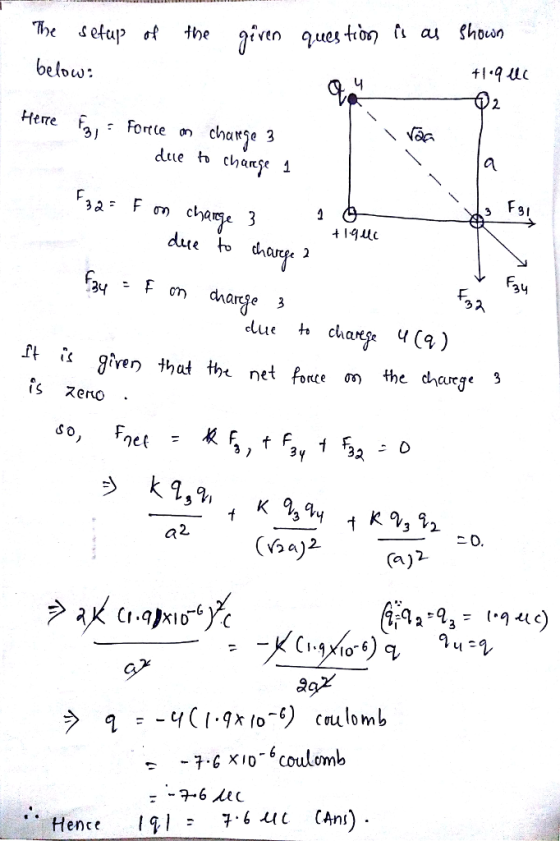
We can solve this question by calculating all the forces acting on the charge opposite to the negative charge, and then equating it with zero.
It's important to note that the distance between diagonally opposite charge is √2 times the length if the side of the square
Add Answer to:
identical point charges of +1.9 JC are fixed to three of the four corners of a...
Identical point charges of +1.3 µC are fixed to three of the four corners of a...
Identical point charges of +1.3 µC are fixed to three of the four corners of a square. What is the magnitude of the negative point charge that must be fixed to the fourth corner, so that the charge at the diagonally opposite corner experiences a net force of zero?
A square with sides of length LL has a point charge at each of its four...
A square with sides of length LL has a point charge at each of its four corners. Two corners that are diagonally opposite have charges equal to 3.10 μCμC the other two diagonal corners have charges Q. Find the magnitude and sign of the charges Q such that each of the 3.10 μCμC charges experiences zero net force.
Four point charges are located at the corners of a square, 1.00 m by 1.00 m....
Four point charges are located at the corners of a square, 1.00 m by 1.00 m. On each of two diagonally opposite corners are 1.00 µC charges. On each of the other two corners are -1.00 µC charges. What is the direction of the force on each charge? positive and negative charges both away from the center of the square positive and negative charges both toward the center of the square no direction (net force = 0) positive charges away...
Chapter 19, Problem 28 GO identical point charges of +1.3 μC are fixed to diagonally opposite...
 Chapter 19, Problem 28 GO identical point charges of +1.3 μC are fixed to diagonally opposite corners of a square. A third charge is then fixed at the center of the square, such that it causes the potentials at the empty corners to change signs without changing magnitudes. Find the sign and magnitude of the third charge Number Units
Revieww Part A A square with sides of length L has a point charge at each...
 Revieww Part A A square with sides of length L has a point charge at each of its four corners. Two corners that are diagonally opposite have charges equal to 3.25 HC the other two diagonal corners have charges Q Find the magnitude and sign of the charges Q such that each of the 3.25 μC charges experiences zero net force. AC
Four point charges are fixed on the corners of a square asshown. The square has...
 Four point charges are fixed on the corners of a square as
shown. The square has sides of length 2l, with l= 0.05 m. The bottom two charges are equal in magnitude but
opposite in sign, Q1 and –Q1, with
Q1 = 1.2 microCoulombs, and the top two are equal in
magnitude but opposite in sign, Q2 and –Q2 as
shown, where Q2 = 2 Q1.If a charge of magnitude Q = 0.6 microCoulombs is placed in the
center of...
Four point charges are fixed on the corners of a square as
shown. The square has sides of length 2l, with l= 0.05 m. The bottom two charges are equal in magnitude but
opposite in sign, Q1 and –Q1, with
Q1 = 1.2 microCoulombs, and the top two are equal in
magnitude but opposite in sign, Q2 and –Q2 as
shown, where Q2 = 2 Q1.If a charge of magnitude Q = 0.6 microCoulombs is placed in the
center of...
Three charges, each of magnitude 3 nC, are at the corners of a square of side...
Three charges, each of magnitude 3 nC, are at the corners of a square of side 5 cm. The two charges at the opposite corners are positive and the other is negative. Find the force exerted by these charges on a fourth charge q = 3 nC at the remaining corner.
7. Four charges of equal magnitude but different signs are fixed at the corners of a...
 7. Four charges of equal magnitude but different signs are fixed at the corners of a square, as shown. What is the direction of the net electric force on the charge on the bottom right corner? A) 1 B) 2 C) 3 D) 4
1) Three charges, each of magnitude 3 nC, are at the corners of a square of...
 1) Three charges, each of magnitude 3 nC, are at the corners of a square of side 5 cm. The two charges at the opposite corners are positive and the other is negative. Find the force exerted by these charges on a fourth charge q = 3 nC at the remaining corner.
Three equal positive point charges of magnitude Q = 10.00μ C are located at three corners...
Three equal positive point charges of magnitude Q = 10.00μ C are located at three corners of a square of edge length d = 9.1 cm. A negative charge -30.00μ C is placed on the fourth corner. At the position of the negative charge, what is the magnitude of the electric field due to the three positive charges? What is the magnitude of the attractive force on the negative charge?
 Chapter 19, Problem 28 GO identical point charges of +1.3 μC are fixed to diagonally opposite corners of a square. A third charge is then fixed at the center of the square, such that it causes the potentials at the empty corners to change signs without changing magnitudes. Find the sign and magnitude of the third charge Number Units
 Revieww Part A A square with sides of length L has a point charge at each of its four corners. Two corners that are diagonally opposite have charges equal to 3.25 HC the other two diagonal corners have charges Q Find the magnitude and sign of the charges Q such that each of the 3.25 μC charges experiences zero net force. AC
 Four point charges are fixed on the corners of a square as
shown. The square has sides of length 2l, with l= 0.05 m. The bottom two charges are equal in magnitude but
opposite in sign, Q1 and –Q1, with
Q1 = 1.2 microCoulombs, and the top two are equal in
magnitude but opposite in sign, Q2 and –Q2 as
shown, where Q2 = 2 Q1.If a charge of magnitude Q = 0.6 microCoulombs is placed in the
center of...
Four point charges are fixed on the corners of a square as
shown. The square has sides of length 2l, with l= 0.05 m. The bottom two charges are equal in magnitude but
opposite in sign, Q1 and –Q1, with
Q1 = 1.2 microCoulombs, and the top two are equal in
magnitude but opposite in sign, Q2 and –Q2 as
shown, where Q2 = 2 Q1.If a charge of magnitude Q = 0.6 microCoulombs is placed in the
center of...
 7. Four charges of equal magnitude but different signs are fixed at the corners of a square, as shown. What is the direction of the net electric force on the charge on the bottom right corner? A) 1 B) 2 C) 3 D) 4
 1) Three charges, each of magnitude 3 nC, are at the corners of a square of side 5 cm. The two charges at the opposite corners are positive and the other is negative. Find the force exerted by these charges on a fourth charge q = 3 nC at the remaining corner.
Most questions answered within 3 hours.
-
Where is the error in this code sequence?
String s1 = "Hello";
String s2 = "ello";...
asked 11 months ago -
Financial data for Joel de Paris, Inc., for last year
follow:
Joel de Paris, Inc.
Balance...
asked 11 months ago -
Consider this reaction:
Al2(SO4)3 (aq)+ BaCl3
(aq) Al2Cl6 (aq)- +
3BaSO4(s) . What is the...
asked 11 months ago -
Suppose that Savneet is considering increasing her
recent random sample from 20 car rentals to 40...
asked 11 months ago -
Trucks arrive at an unloading terminal at an average rate of 120
per hour.
Trucks arrive...
asked 11 months ago -
Why are methanol and ethanol completely soluble in water while
octanol is not very little soluble....
asked 11 months ago -
A facilities manager at a university reads in a research report
that the mean amount of...
asked 11 months ago -
When the CuSO4 is rehydrated by adding water to the anhydrous
compound, is this an endothermic...
asked 11 months ago -
A ray of sunlight is passing from diamond into crown glass; the
angle of incidence is...
asked 11 months ago -
A block of mass 0.249 kg is placed on top of a light, vertical
spring of...
asked 11 months ago -
how do the kidneys compensate in the presences of acidosis
a) trigger hyperventilate
b) reserve acid...
asked 11 months ago -
Question 501 pts
The rental rate of capital to the firm increases. Which of the
following...
asked 11 months ago