A Stirling-engine is used in the heat-pump mode to heat a house. The engine maintains a...
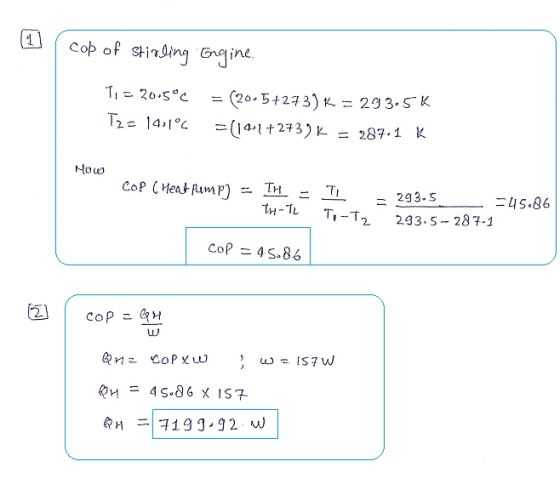
A Stirling-engine is used in the heat-pump mode to heat a house. The engine maintains a temperature of 20.5 °C inside the house. The temperature of the Earth loop is 14.1 °C. (The Earth loop buried deep under the ground is the cold reservoir of this heat pump.) What is the coefficient of performance of this heat pump?
| Tries 0/12 |
If the power of the electric motor driving the heat pump is 157 W, then what is the rate at which heat is delivered to the house?
Homework Answers
Please rate
if any mistake in this answer please comment i will clarify your
doubt . thank you
Add Answer to:
A Stirling-engine is used in the heat-pump mode to heat a house. The engine maintains a...
SP3. A Carnot engine operating in reverse as a heat pump moves heat from a cold...
 SP3. A Carnot engine operating in reverse as a heat pump moves heat from a cold reservoir at 7°C to a warmer one at 22°C. a) What is the efficiency of a Carnot engine operating between these two temperatures? b) If the Carnot heat pump releases 250 J of heat into the higher-temperature reservoir e co in each cycle, how much work must be provided in each cycle? c) How much heat is removed from the 7°C reservoir in each...
#10: A heat pump requires 430 W of electrical power to deliver heat to your house...
#10: A heat pump requires 430 W of electrical power to deliver heat to your house at a rate of 2390 J per second. How many joules of energy are extracted from the cold air outside each second? #11: The coefficient of performance for a heat pump is defined as the ratio of the heat delivered to the warmer system to the work required. If a heat pump requires an input of 360 W of electrical energy and has a...
earning Goal: To understand that a heat engine run backward is a heat pump that can be used as a refrigerator....
earning Goal: To understand that a heat engine run backward is a heat pump that can be used as a refrigerator. By now you should be familiar with heat engines--devices, theoretical or actual, designed to convert heat into work. You should understand the following: Heat engines must be cyclical; that is, they must return to their original state some time after having absorbed some heat and done some work). Heat engines cannot convert heat into work without generating some waste...
Find the maximum possible coefficient of performance for a heat pump used to heat a house...
Find the maximum possible coefficient of performance for a heat pump used to heat a house in a northerly climate in winter. The inside is kept at 21 ∘C while the outside is -25 ∘C. COPmax = ??
The water in a deep underground well is used as the cold reservoir of a Carnot...
The water in a deep underground well is used as the cold reservoir of a Carnot heat pump that maintains the temperature of a house at 291 K. To deposit 14260 J of heat in the house, the heat pump requires 811 J of work. Determine the temperature of the well water. Give answer in K. Do not enter unit.
The water in a deep underground well is used as the cold reservoir of a Carnot...
The water in a deep underground well is used as the cold reservoir of a Carnot heat pump that maintains the temperature of a house at 301 K. To deposit 14370 J of heat in the house, the heat pump requires 791 J of work. Determine the temperature of the well water. Give answer in K. Do not enter unit
A heat pump is to be used to heat a house in winter and then reversed...
 A heat pump is to be used to heat a house in winter and then
reversed to cool the house in summer. The interior space is to be
maintained at 20oC. Heat transfer through walls and roof is
estimated to be χ = 0.525 kJ/sec per degree difference in
temperature between inside and outside. (6a) (8p) In winter if the
outside temperature is 5oC, what is the minimum power required to
drive the heat pump? (6b) (12p) For the same...
A heat pump is to be used to heat a house in winter and then
reversed to cool the house in summer. The interior space is to be
maintained at 20oC. Heat transfer through walls and roof is
estimated to be χ = 0.525 kJ/sec per degree difference in
temperature between inside and outside. (6a) (8p) In winter if the
outside temperature is 5oC, what is the minimum power required to
drive the heat pump? (6b) (12p) For the same...
5, (25 points) A Carnot heat pump is used to maintain a house at 20 °C...
 5, (25 points) A Carnot heat pump is used to maintain a house at 20 °C in winter and consumes 8 kW of power (electricity) when operating. On a day temperature outside the house is -3 °C, the house is estimated to lose heat at an average rate of 80,000 kJ/h. (Sa). (2p) Please identify the hot reservoir and the cool reservoir of this heat pump. (5b). (2p) Please draw of schematic diagram of this heat pump-house heating system with...
A heat pump maintains temperature of house at 4 C by removing heat 360Kj/min. if the...
A heat pump maintains temperature of house at 4 C by removing heat 360Kj/min. if the required power input is 2 KW. Determine COP for Heat Pump
Operating in series are two reversible heat pumps. Heat transfer gives energy to the first cycle...
 Operating in series are two reversible heat pumps. Heat transfer
gives energy to the first cycle from a cold reservoir at 105 K and
rejects energy by heat transfer to a reservoir at an intermediate
temperature T greater than 105 K. The second cycle receives energy
by heat transfer from the reservoir at T and rejects energy by heat
transfer to a higher-temperature reservoir at 1200 K. If the heat
pump cycles have the same co-efficient of performance, calculate:
Low...
Operating in series are two reversible heat pumps. Heat transfer
gives energy to the first cycle from a cold reservoir at 105 K and
rejects energy by heat transfer to a reservoir at an intermediate
temperature T greater than 105 K. The second cycle receives energy
by heat transfer from the reservoir at T and rejects energy by heat
transfer to a higher-temperature reservoir at 1200 K. If the heat
pump cycles have the same co-efficient of performance, calculate:
Low...
 SP3. A Carnot engine operating in reverse as a heat pump moves heat from a cold reservoir at 7°C to a warmer one at 22°C. a) What is the efficiency of a Carnot engine operating between these two temperatures? b) If the Carnot heat pump releases 250 J of heat into the higher-temperature reservoir e co in each cycle, how much work must be provided in each cycle? c) How much heat is removed from the 7°C reservoir in each...
 A heat pump is to be used to heat a house in winter and then
reversed to cool the house in summer. The interior space is to be
maintained at 20oC. Heat transfer through walls and roof is
estimated to be χ = 0.525 kJ/sec per degree difference in
temperature between inside and outside. (6a) (8p) In winter if the
outside temperature is 5oC, what is the minimum power required to
drive the heat pump? (6b) (12p) For the same...
A heat pump is to be used to heat a house in winter and then
reversed to cool the house in summer. The interior space is to be
maintained at 20oC. Heat transfer through walls and roof is
estimated to be χ = 0.525 kJ/sec per degree difference in
temperature between inside and outside. (6a) (8p) In winter if the
outside temperature is 5oC, what is the minimum power required to
drive the heat pump? (6b) (12p) For the same...
 5, (25 points) A Carnot heat pump is used to maintain a house at 20 °C in winter and consumes 8 kW of power (electricity) when operating. On a day temperature outside the house is -3 °C, the house is estimated to lose heat at an average rate of 80,000 kJ/h. (Sa). (2p) Please identify the hot reservoir and the cool reservoir of this heat pump. (5b). (2p) Please draw of schematic diagram of this heat pump-house heating system with...
 Operating in series are two reversible heat pumps. Heat transfer
gives energy to the first cycle from a cold reservoir at 105 K and
rejects energy by heat transfer to a reservoir at an intermediate
temperature T greater than 105 K. The second cycle receives energy
by heat transfer from the reservoir at T and rejects energy by heat
transfer to a higher-temperature reservoir at 1200 K. If the heat
pump cycles have the same co-efficient of performance, calculate:
Low...
Operating in series are two reversible heat pumps. Heat transfer
gives energy to the first cycle from a cold reservoir at 105 K and
rejects energy by heat transfer to a reservoir at an intermediate
temperature T greater than 105 K. The second cycle receives energy
by heat transfer from the reservoir at T and rejects energy by heat
transfer to a higher-temperature reservoir at 1200 K. If the heat
pump cycles have the same co-efficient of performance, calculate:
Low...
Most questions answered within 3 hours.
-
Where is the error in this code sequence?
String s1 = "Hello";
String s2 = "ello";...
asked 10 months ago -
Financial data for Joel de Paris, Inc., for last year
follow:
Joel de Paris, Inc.
Balance...
asked 10 months ago -
Consider this reaction:
Al2(SO4)3 (aq)+ BaCl3
(aq) Al2Cl6 (aq)- +
3BaSO4(s) . What is the...
asked 10 months ago -
Suppose that Savneet is considering increasing her
recent random sample from 20 car rentals to 40...
asked 10 months ago -
Trucks arrive at an unloading terminal at an average rate of 120
per hour.
Trucks arrive...
asked 10 months ago -
Why are methanol and ethanol completely soluble in water while
octanol is not very little soluble....
asked 10 months ago -
A facilities manager at a university reads in a research report
that the mean amount of...
asked 10 months ago -
When the CuSO4 is rehydrated by adding water to the anhydrous
compound, is this an endothermic...
asked 10 months ago -
A ray of sunlight is passing from diamond into crown glass; the
angle of incidence is...
asked 10 months ago -
A block of mass 0.249 kg is placed on top of a light, vertical
spring of...
asked 10 months ago -
how do the kidneys compensate in the presences of acidosis
a) trigger hyperventilate
b) reserve acid...
asked 10 months ago -
Question 501 pts
The rental rate of capital to the firm increases. Which of the
following...
asked 10 months ago