
Homework Answers

Add Answer to:
What is the magnitude of the dampening constant (in kg/s) required to create a critically damped...
Please solve with steps What is the magnitude of the dampening constant (in kg/s) required to...
 Please solve with steps
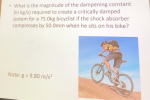
What is the magnitude of the dampening constant (in kg/s) required to create a critically damped system for a 75.0kg bicyclist if the shock absorber compresses by 50.0mm when he sits on his bike? Note: g 9.80 m/s2
Please solve with steps
What is the magnitude of the dampening constant (in kg/s) required to create a critically damped system for a 75.0kg bicyclist if the shock absorber compresses by 50.0mm when he sits on his bike? Note: g 9.80 m/s2
PROBLEMS 89 3-30. A system composed of a mass of S kg and an elastic member having a modulus of 4...
 Please answer 3-34 and 3-35. Please provide all steps so I can
follow along.
PROBLEMS 89 3-30. A system composed of a mass of S kg and an elastic member having a modulus of 45 N/m is less than critically damped. When the mass is givén an initial displacement and released from rest, the overshoot (the displacement attained past the equilibrium position) is 25% Determine the dam ping factor and the damping constant. 3-31. A mass-spring system is critically damped....
Please answer 3-34 and 3-35. Please provide all steps so I can
follow along.
PROBLEMS 89 3-30. A system composed of a mass of S kg and an elastic member having a modulus of 45 N/m is less than critically damped. When the mass is givén an initial displacement and released from rest, the overshoot (the displacement attained past the equilibrium position) is 25% Determine the dam ping factor and the damping constant. 3-31. A mass-spring system is critically damped....
just need answers no explanation required. Question 23 1 pts At what Kelvin temperature does the...
 just
need answers no explanation required.
Question 23 1 pts At what Kelvin temperature does the rms speed of the oxygen (O2) molecules in the air near the surface of the earth become equal to the escape speed from the earth? (R-8.31 /mol K;molar mass of O, gas is 32 g/mol; radius of the earth Re - 6.37 x 10ºm; the escape speed from the earth is 11.2 km/s) 1.6 x 10K 8.0 x 10K 1.1 x 10K 3.6 x...
just
need answers no explanation required.
Question 23 1 pts At what Kelvin temperature does the rms speed of the oxygen (O2) molecules in the air near the surface of the earth become equal to the escape speed from the earth? (R-8.31 /mol K;molar mass of O, gas is 32 g/mol; radius of the earth Re - 6.37 x 10ºm; the escape speed from the earth is 11.2 km/s) 1.6 x 10K 8.0 x 10K 1.1 x 10K 3.6 x...
A 32-kg boy sits initially still on a wheeled 17-kg office chair, holding a fire extinguisher...
 A 32-kg boy sits initially still on a wheeled 17-kg office chair, holding a fire extinguisher (9 kg when empty). He points the discharge horn to the right and ejects 6 kg of carbon dioxide at 18 m/s. What is his velocity after the fire extinguisher is emptied (assuming friction is negligible)? Answer in units of m/s and round to one decimal place. Note that velocity is a vector and the sign matters. Hints: This is a recoil problem for...
A student sits on a freely rotating stool holding two weights, each of mass 4 kg.. When his arms are extended horizonta...
A student sits on a freely rotating stool holding two weights, each of mass 4 kg.. When his arms are extended horizontally, the weights are 1.1 m from the axis of rotation and he rotates with an angular speed of 0.9 rad/s. The moment of inertia of the student plus stool is 3.0 kg-m2 and is assumed to be constant. The student pulls the weights inward horizontally to a position 0.4 m from the rotation axis. Find the new angular...
A 288-kg mass, when attached to the end of a spring hanging vertically, stretches the spring...
 A 288-kg mass, when attached to the end of a spring hanging vertically, stretches the spring 8 m. The mass is in a medium that exerts a viscous resistance of 576 N when the mass has a velocity of 4 m/sec. Assume the mass is given an initial velocity of 18 m/s from the equilibrium position. a) Determine the spring constant k. Use g = 10 m/sec. k b) Determine the damping coeffient 7. 7= c) If the initial value...
A 189-kg mass, when attached to the end of a spring hanging vertically, stretches the spring...
 A 189-kg mass, when attached to the end of a spring hanging vertically, stretches the spring 9 m. The mass is in a medium that exerts a viscous resistance of 3024 N when the mass has a velocity of 4 m/sec. Assume the mass is given an initial velocity of 14 m/s from the equilibrium position. a) Determine the spring constant k. Use g = 10 m/sec. k b) Determine the damping coeffient 7. 7 c) If the initial value...
A student sits on a freely rotating stool holding two dumbbells, each of mass 2.98 kg...
A student sits on a freely rotating stool holding two dumbbells, each of mass 2.98 kg . When his arms are extended horizontally , the dumbbells are 0.96 m from the axis of rotation and the student rotates with an angular speed of 0.747 rad/s. The moment of inertia of the student plus stool is 2.62 kg · m2 and is assumed to be constant. The student pulls the dumbbells inward horizontally to a position 0.305 m from the rotation...
A student sits on a freely rotating stool holding two weights, each of mass 3.08 kg....
A student sits on a freely rotating stool holding two weights, each of mass 3.08 kg. When his arms are extended horizontally, the weights are 0.91 m from the axis of rotation and he rotates with an angular speed of 0.755 rad/s. The moment of inertia of the student plus stool is 3.08 kg·m2 and is assumed to be constant. The student pulls the weights inward horizontally to a position 0.294 m from the rotation axis. (a) Find the new...
A student sits on a freely rotating stool holding two dumbbells, each of mass 2.99 kg...
 A student sits on a freely rotating stool holding two dumbbells, each of mass 2.99 kg (see figure below). When his arms are extended horizontally (Figure a), the dumbbells are 1.09 m from the axis of rotation and the student rotates with an angular speed of 0.752 rad/s. The moment of inertia of the student plus stool is 2.80 kg . m and is assumed to be constant. The student pulls the dumbbells inward horizontally to a position 0.293 m...
 Please solve with steps
What is the magnitude of the dampening constant (in kg/s) required to create a critically damped system for a 75.0kg bicyclist if the shock absorber compresses by 50.0mm when he sits on his bike? Note: g 9.80 m/s2
Please solve with steps
What is the magnitude of the dampening constant (in kg/s) required to create a critically damped system for a 75.0kg bicyclist if the shock absorber compresses by 50.0mm when he sits on his bike? Note: g 9.80 m/s2
 Please answer 3-34 and 3-35. Please provide all steps so I can
follow along.
PROBLEMS 89 3-30. A system composed of a mass of S kg and an elastic member having a modulus of 45 N/m is less than critically damped. When the mass is givén an initial displacement and released from rest, the overshoot (the displacement attained past the equilibrium position) is 25% Determine the dam ping factor and the damping constant. 3-31. A mass-spring system is critically damped....
Please answer 3-34 and 3-35. Please provide all steps so I can
follow along.
PROBLEMS 89 3-30. A system composed of a mass of S kg and an elastic member having a modulus of 45 N/m is less than critically damped. When the mass is givén an initial displacement and released from rest, the overshoot (the displacement attained past the equilibrium position) is 25% Determine the dam ping factor and the damping constant. 3-31. A mass-spring system is critically damped....
 just
need answers no explanation required.
Question 23 1 pts At what Kelvin temperature does the rms speed of the oxygen (O2) molecules in the air near the surface of the earth become equal to the escape speed from the earth? (R-8.31 /mol K;molar mass of O, gas is 32 g/mol; radius of the earth Re - 6.37 x 10ºm; the escape speed from the earth is 11.2 km/s) 1.6 x 10K 8.0 x 10K 1.1 x 10K 3.6 x...
just
need answers no explanation required.
Question 23 1 pts At what Kelvin temperature does the rms speed of the oxygen (O2) molecules in the air near the surface of the earth become equal to the escape speed from the earth? (R-8.31 /mol K;molar mass of O, gas is 32 g/mol; radius of the earth Re - 6.37 x 10ºm; the escape speed from the earth is 11.2 km/s) 1.6 x 10K 8.0 x 10K 1.1 x 10K 3.6 x...
 A 32-kg boy sits initially still on a wheeled 17-kg office chair, holding a fire extinguisher (9 kg when empty). He points the discharge horn to the right and ejects 6 kg of carbon dioxide at 18 m/s. What is his velocity after the fire extinguisher is emptied (assuming friction is negligible)? Answer in units of m/s and round to one decimal place. Note that velocity is a vector and the sign matters. Hints: This is a recoil problem for...
 A 288-kg mass, when attached to the end of a spring hanging vertically, stretches the spring 8 m. The mass is in a medium that exerts a viscous resistance of 576 N when the mass has a velocity of 4 m/sec. Assume the mass is given an initial velocity of 18 m/s from the equilibrium position. a) Determine the spring constant k. Use g = 10 m/sec. k b) Determine the damping coeffient 7. 7= c) If the initial value...
 A 189-kg mass, when attached to the end of a spring hanging vertically, stretches the spring 9 m. The mass is in a medium that exerts a viscous resistance of 3024 N when the mass has a velocity of 4 m/sec. Assume the mass is given an initial velocity of 14 m/s from the equilibrium position. a) Determine the spring constant k. Use g = 10 m/sec. k b) Determine the damping coeffient 7. 7 c) If the initial value...
 A student sits on a freely rotating stool holding two dumbbells, each of mass 2.99 kg (see figure below). When his arms are extended horizontally (Figure a), the dumbbells are 1.09 m from the axis of rotation and the student rotates with an angular speed of 0.752 rad/s. The moment of inertia of the student plus stool is 2.80 kg . m and is assumed to be constant. The student pulls the dumbbells inward horizontally to a position 0.293 m...
Most questions answered within 3 hours.
-
Where is the error in this code sequence?
String s1 = "Hello";
String s2 = "ello";...
asked 11 months ago -
Financial data for Joel de Paris, Inc., for last year
follow:
Joel de Paris, Inc.
Balance...
asked 11 months ago -
Consider this reaction:
Al2(SO4)3 (aq)+ BaCl3
(aq) Al2Cl6 (aq)- +
3BaSO4(s) . What is the...
asked 11 months ago -
Suppose that Savneet is considering increasing her
recent random sample from 20 car rentals to 40...
asked 11 months ago -
Trucks arrive at an unloading terminal at an average rate of 120
per hour.
Trucks arrive...
asked 11 months ago -
Why are methanol and ethanol completely soluble in water while
octanol is not very little soluble....
asked 11 months ago -
A facilities manager at a university reads in a research report
that the mean amount of...
asked 11 months ago -
When the CuSO4 is rehydrated by adding water to the anhydrous
compound, is this an endothermic...
asked 11 months ago -
A ray of sunlight is passing from diamond into crown glass; the
angle of incidence is...
asked 11 months ago -
A block of mass 0.249 kg is placed on top of a light, vertical
spring of...
asked 11 months ago -
how do the kidneys compensate in the presences of acidosis
a) trigger hyperventilate
b) reserve acid...
asked 11 months ago -
Question 501 pts
The rental rate of capital to the firm increases. Which of the
following...
asked 11 months ago