Homework Answers

Add Answer to:
1.a) What type of motion does an electron initially moving at 1.5x10^6m/s parallel to the 2...
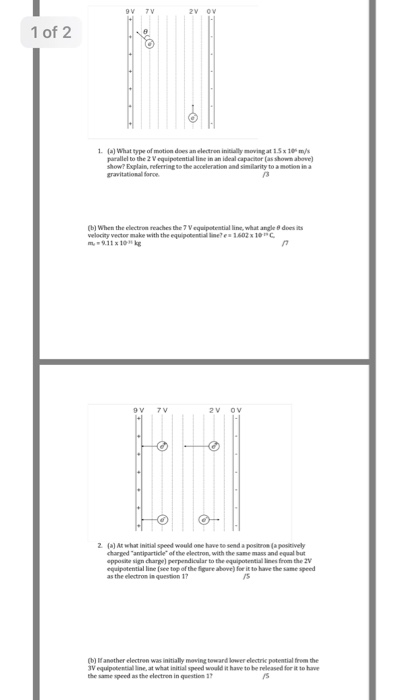
1 of 2 1 (a) What type of motion does an electron initially moving at 15...
 1 of 2 1 (a) What type of motion does an electron initially moving at 15 x 10 m/s parallel to the 2 Vequipotential line in an ideal capacitor (as shown abowe how? Explain, referring to the acceleration and similarity to a metion in a gravitationall force (b) When the electron reaches the 7 Vequipotential line, what angle 8 does its velacity vector make with the equipobential inees 1602 10 c 9.11 x 10 kg 2. (a) At what initial...
2. (i) The governing equation of motion for a single electron of mass m and charge -e moving with velocity y in uniform time-independent magnetic and electric fields is given by mayx B where B- (B, 0...
 2. (i) The governing equation of motion for a single electron of mass m and charge -e moving with velocity y in uniform time-independent magnetic and electric fields is given by mayx B where B- (B, 0,0) di dr (a) Suppose the electron initially moves with velocity y (0,vo 0) in an electric field parallel to the magnetic field E-E-(E,00) By taking vf)-v +vi, where y i0, obtain v, and show that the speed vis constant. Describe (in words) the...
In the figure a charged particle (either an electron or a proton) is moving rightward between...
In the figure a charged particle (either an electron or a proton) is moving rightward between two parallel charged plates separated by distance d = 1.50 mm. The plate potentials are V1 = –67.0 V and V2 = –55.0 V. The particle is slowing from an initial speed of 86.0 km/s at the left plate. (a) Is the particle an electron or a proton? (b) What is its speed just as it reaches plate 2? (a) Choose the answer for...
Question 1 2 pts In the figure below, a charged particle (either an electron or a...
 Question 1 2 pts In the figure below, a charged particle (either an electron or a proton) is moving rightward between two parallel charged plates separated by distance d-1.25mm. The plate potentials are V=-65V and V2=-40V. The particle is slowing from an initial speed of 90.0 km/s at the left plate. What is its speed just as it reaches plate 2? Express the speed in units of km/s i.e. 10 m/s, and up to one decimal place.
39.2 A beta^+ particle is moving at 19 500 m s^-1 parallel to the ground and...
 39.2
A beta^+ particle is moving at 19 500 m s^-1 parallel to the ground and due east through a region of space in which there is a uniform 0.05 T magnetic field. If the magnetic field lines point upwards in the vertical direction, what is the direction and magnitude of the magnetic force on the beta^+ particle? In a region of space there is a uniform magnetic field of magnitude 0.25 m T pointing vertically straight down. If an...
39.2
A beta^+ particle is moving at 19 500 m s^-1 parallel to the ground and due east through a region of space in which there is a uniform 0.05 T magnetic field. If the magnetic field lines point upwards in the vertical direction, what is the direction and magnitude of the magnetic force on the beta^+ particle? In a region of space there is a uniform magnetic field of magnitude 0.25 m T pointing vertically straight down. If an...
7) What is a "gauss" and how does it compare to the tesla? 8) If a...
 7) What is a "gauss" and how does it compare to the tesla? 8) If a charged particle moves in a straight line through some region of space, can you say that the magnetic field in that region is necessarily zero? Can you set a resting electron in motion with a magnetic field? Explain. 9) 10) What is the direction of the magnetic force on a positive charge that moves as shown in each of the six cases shown in...
The energy of motion is called: Kinetic energy. potential energy, inertial energy. Power. In an inelastic...
 The energy of motion is called: Kinetic energy. potential energy, inertial energy. Power. In an inelastic collision: momentum is conserved. kinetic energy is conserved, both (a) and (b). If the velocity of a moving object is doubled and its mass is cut in half, the kinetic energy of the object is; remains the same, doubled quadrupled, cut in half. When the net work done on an object is speed of the object is me on an object is zero; the...
1. A block is initially moving at 1.80 m/s. It then experiences a uniform acceleration for...
1. A block is initially moving at 1.80 m/s. It then experiences a uniform acceleration for 1.25 seconds until it reaches a final speed of 8.92 m/s. Assume the block is moving in a straight line, in the same direction for the entire acceleration. Find the magnitude of the acceleration. 2. Two masses move directly toward each other, colliding and bouncing off each other after the collision with no deformation or damage. Which of the following statements is correct? a....
2. A 106-kg object is initially moving in a straight line with a speed of 51.3...
 2. A 106-kg object is initially moving in a straight line with a speed of 51.3 m/s. (a) If it is brought to a stop with a decelera- tion of 1.97 m/s2, what force is required, what distance does the object travel, and how much work is done by the force? (b) An- swer the same questions if the object's deceleration is 4.82 m/s?. 3. To push a 25-kg crate up a 27° incline, a worker exerts a force of...
U potential energy=k q1 q2r=V1 (voltage)*q2 ; Ekin = (1/2) m v2 1) How much energy...
U potential energy=k q1 q2r=V1 (voltage)*q2 ; Ekin = (1/2) m v2 1) How much energy must a single electron have as it leaves a 1.5 V potential assuming it started from rest? (an approximation of the batteries in lab) 2) How fast must that electron be moving as a result? 3) How much energy can that electron release before it comes to a stop, and why? 4) If current (I) is correlated to the speed of electron motion, then...
 1 of 2 1 (a) What type of motion does an electron initially moving at 15 x 10 m/s parallel to the 2 Vequipotential line in an ideal capacitor (as shown abowe how? Explain, referring to the acceleration and similarity to a metion in a gravitationall force (b) When the electron reaches the 7 Vequipotential line, what angle 8 does its velacity vector make with the equipobential inees 1602 10 c 9.11 x 10 kg 2. (a) At what initial...
 2. (i) The governing equation of motion for a single electron of mass m and charge -e moving with velocity y in uniform time-independent magnetic and electric fields is given by mayx B where B- (B, 0,0) di dr (a) Suppose the electron initially moves with velocity y (0,vo 0) in an electric field parallel to the magnetic field E-E-(E,00) By taking vf)-v +vi, where y i0, obtain v, and show that the speed vis constant. Describe (in words) the...
 Question 1 2 pts In the figure below, a charged particle (either an electron or a proton) is moving rightward between two parallel charged plates separated by distance d-1.25mm. The plate potentials are V=-65V and V2=-40V. The particle is slowing from an initial speed of 90.0 km/s at the left plate. What is its speed just as it reaches plate 2? Express the speed in units of km/s i.e. 10 m/s, and up to one decimal place.
 39.2
A beta^+ particle is moving at 19 500 m s^-1 parallel to the ground and due east through a region of space in which there is a uniform 0.05 T magnetic field. If the magnetic field lines point upwards in the vertical direction, what is the direction and magnitude of the magnetic force on the beta^+ particle? In a region of space there is a uniform magnetic field of magnitude 0.25 m T pointing vertically straight down. If an...
39.2
A beta^+ particle is moving at 19 500 m s^-1 parallel to the ground and due east through a region of space in which there is a uniform 0.05 T magnetic field. If the magnetic field lines point upwards in the vertical direction, what is the direction and magnitude of the magnetic force on the beta^+ particle? In a region of space there is a uniform magnetic field of magnitude 0.25 m T pointing vertically straight down. If an...
 7) What is a "gauss" and how does it compare to the tesla? 8) If a charged particle moves in a straight line through some region of space, can you say that the magnetic field in that region is necessarily zero? Can you set a resting electron in motion with a magnetic field? Explain. 9) 10) What is the direction of the magnetic force on a positive charge that moves as shown in each of the six cases shown in...
 The energy of motion is called: Kinetic energy. potential energy, inertial energy. Power. In an inelastic collision: momentum is conserved. kinetic energy is conserved, both (a) and (b). If the velocity of a moving object is doubled and its mass is cut in half, the kinetic energy of the object is; remains the same, doubled quadrupled, cut in half. When the net work done on an object is speed of the object is me on an object is zero; the...
 2. A 106-kg object is initially moving in a straight line with a speed of 51.3 m/s. (a) If it is brought to a stop with a decelera- tion of 1.97 m/s2, what force is required, what distance does the object travel, and how much work is done by the force? (b) An- swer the same questions if the object's deceleration is 4.82 m/s?. 3. To push a 25-kg crate up a 27° incline, a worker exerts a force of...
Most questions answered within 3 hours.
-
Where is the error in this code sequence?
String s1 = "Hello";
String s2 = "ello";...
asked 11 months ago -
Financial data for Joel de Paris, Inc., for last year
follow:
Joel de Paris, Inc.
Balance...
asked 11 months ago -
Consider this reaction:
Al2(SO4)3 (aq)+ BaCl3
(aq) Al2Cl6 (aq)- +
3BaSO4(s) . What is the...
asked 11 months ago -
Suppose that Savneet is considering increasing her
recent random sample from 20 car rentals to 40...
asked 11 months ago -
Trucks arrive at an unloading terminal at an average rate of 120
per hour.
Trucks arrive...
asked 11 months ago -
Why are methanol and ethanol completely soluble in water while
octanol is not very little soluble....
asked 11 months ago -
A facilities manager at a university reads in a research report
that the mean amount of...
asked 11 months ago -
When the CuSO4 is rehydrated by adding water to the anhydrous
compound, is this an endothermic...
asked 11 months ago -
A ray of sunlight is passing from diamond into crown glass; the
angle of incidence is...
asked 11 months ago -
A block of mass 0.249 kg is placed on top of a light, vertical
spring of...
asked 11 months ago -
how do the kidneys compensate in the presences of acidosis
a) trigger hyperventilate
b) reserve acid...
asked 11 months ago -
Question 501 pts
The rental rate of capital to the firm increases. Which of the
following...
asked 11 months ago