1. When a 4.00 g sample of RbBr is dissolved in water in a calorimeter that...
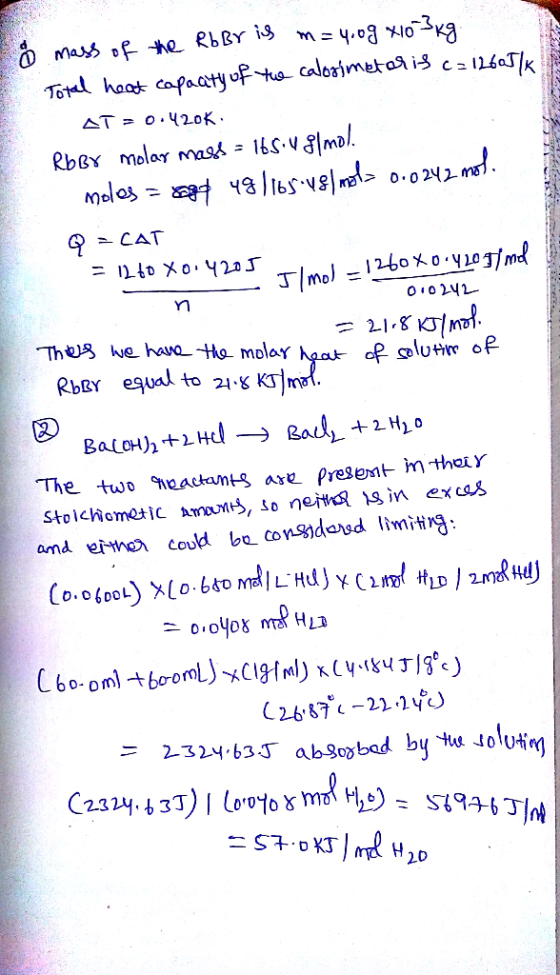
1. When a 4.00 g sample of RbBr is dissolved in water in a calorimeter that has a total heat capacity of 1.26 kJ⋅K−1, the temperature decreases by 0.420 K. Calculate the molar heat of solution of RbBr.
ΔHsoln=
2. In a constant‑pressure calorimeter, 60.0 mL of 0.340 M Ba(OH)2 was added to 60.0 mL of 0.680 M HCl.
The reaction caused the temperature of the solution to rise from 22.24 ∘C to 26.87 ∘C. If the solution has the same density and specific heat as water (1.00 g/mL and 4.184J/g⋅°C,) respectively), what is ΔH for this reaction (per mole H2O produced)? Assume that the total volume is the sum of the individual volumes.
ΔH=
Homework Answers
Add Answer to:
1. When a 4.00 g sample of RbBr is dissolved in water in a calorimeter that...
When a 4.00 g sample of RbBr is dissolved in water in a calorimeter that has...
When a 4.00 g sample of RbBr is dissolved in water in a calorimeter that has a total heat capacity of 2.65 kJ ⋅ K − 1 , the temperature decreases by 0.200 K . Calculate the molar heat of solution of RbBr .
When a 2.00 g sample of RbBr is dissolved in water in a calorimeter that has...
 When a 2.00 g sample of RbBr is dissolved in water in a calorimeter that has a total heat capacity of 0.552 kJK-!, the temperature decreases by 0.480 K. Calculate the molar heat of solution of RbBr. ΔΗολη = kJ/mol
In a constant-pressure calorimeter, 50.0 mL of 0.340 M Ba(OH), was added to 50.0 mL of...
 In a constant-pressure calorimeter, 50.0 mL of 0.340 M Ba(OH), was added to 50.0 mL of 0.680 M HCI. The reaction caused the temperature of the solution to rise from 22.91 °C to 27.54 °C. If the solution has the same density and specific heat as water (1.00 g/mL and 4.184J/g • °C,) respectively), what is AH for this reaction (per mole H,O produced)? Assume that the total volume is the sum of the individual volumes.
In a constant-pressure calorimeter, 70.0 mL of 0.340 M Ba(OH), was added to 70.0 ml of...
 In a constant-pressure calorimeter, 70.0 mL of 0.340 M Ba(OH), was added to 70.0 ml of 0.680 M HCL. The reaction caused the temperature of the solution to rise from 22.99°C to 27.6°C. If the solution has the same density and specific heat as water (1.00 g/mL and 4.184J/g. "C) respectively), what is AH for this reaction (per mole H, produced)? Assume that the total volume is the sum of the individual volumes. AH - kJ/mol H,O
When a 4.00-g sample of KSCN is dissolved in water in a calorimeter that has a...
 When a 4.00-g sample of KSCN is dissolved in water in a calorimeter that has a total heat capacity of 2.930 kJ K-1 the temperature decreases by 0.340 K. Calculate the molar heat of solution of KSCN. Number k.J/mol seln
In a constant‑pressure calorimeter, 60.0 mL of 0.330 M Ba(OH)2 was added to 60.0 mL of...
In a constant‑pressure calorimeter, 60.0 mL of 0.330 M Ba(OH)2 was added to 60.0 mL of 0.660 M HCl. The reaction caused the temperature of the solution to rise from 23.74 ∘C to 28.24 ∘C. If the solution has the same density and specific heat as water ( 1.00 g/mL and 4.184J/g⋅K,) respectively), what is Δ? for this reaction (per mole H2O produced)? Assume that the total volume is the sum of the individual volumes.
When a 3.00 g sample of KCN is dissolved in water in a calorimeter that has...
When a 3.00 g sample of KCN is dissolved in water in a calorimeter that has a total heat capacity of 1.28 kJ⋅K−1, the temperature decreases by 0.420 K. Calculate the molar heat of solution of KCN.
, the When a 4.00 g sample of KBr is dissolved in water in a calorimeter...
 , the When a 4.00 g sample of KBr is dissolved in water in a calorimeter that has a total heat capacity of 1.49 kJ · K temperature decreases by 0.450 K. Calculate the molar heat of solution of KBr. AH soln = kJ/mol
When a 4.00 g sample of KSCN is dissolved in water in a calorimeter that has...
 When a 4.00 g sample of KSCN is dissolved in water in a calorimeter that has a total heat capacity of 3.56 kJ · K-!, the temperature decreases by 0.280 K. Calculate the molar heat of solution of KSCN.
In a constant-pressure calorimeter, 50.0mL of 0.340 M Ba(OH)2 was added to 50.0 mL of 0.680...
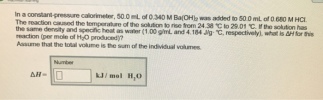 In a constant-pressure calorimeter, 50.0mL of 0.340 M Ba(OH)2 was added to 50.0 mL of 0.680 M HCı The reaction caused the temperature of the solution to the same density and specific heat as water (1.00 g/mL and 4.184 J g ℃ respectively), what is dH for this reaction (per mole of H20 produced)? Assume that the total volume is the sum of the individual volumes. Number kJ/ mol H,O
 When a 2.00 g sample of RbBr is dissolved in water in a calorimeter that has a total heat capacity of 0.552 kJK-!, the temperature decreases by 0.480 K. Calculate the molar heat of solution of RbBr. ΔΗολη = kJ/mol
 In a constant-pressure calorimeter, 50.0 mL of 0.340 M Ba(OH), was added to 50.0 mL of 0.680 M HCI. The reaction caused the temperature of the solution to rise from 22.91 °C to 27.54 °C. If the solution has the same density and specific heat as water (1.00 g/mL and 4.184J/g • °C,) respectively), what is AH for this reaction (per mole H,O produced)? Assume that the total volume is the sum of the individual volumes.
 In a constant-pressure calorimeter, 70.0 mL of 0.340 M Ba(OH), was added to 70.0 ml of 0.680 M HCL. The reaction caused the temperature of the solution to rise from 22.99°C to 27.6°C. If the solution has the same density and specific heat as water (1.00 g/mL and 4.184J/g. "C) respectively), what is AH for this reaction (per mole H, produced)? Assume that the total volume is the sum of the individual volumes. AH - kJ/mol H,O
 When a 4.00-g sample of KSCN is dissolved in water in a calorimeter that has a total heat capacity of 2.930 kJ K-1 the temperature decreases by 0.340 K. Calculate the molar heat of solution of KSCN. Number k.J/mol seln
 , the When a 4.00 g sample of KBr is dissolved in water in a calorimeter that has a total heat capacity of 1.49 kJ · K temperature decreases by 0.450 K. Calculate the molar heat of solution of KBr. AH soln = kJ/mol
 When a 4.00 g sample of KSCN is dissolved in water in a calorimeter that has a total heat capacity of 3.56 kJ · K-!, the temperature decreases by 0.280 K. Calculate the molar heat of solution of KSCN.
 In a constant-pressure calorimeter, 50.0mL of 0.340 M Ba(OH)2 was added to 50.0 mL of 0.680 M HCı The reaction caused the temperature of the solution to the same density and specific heat as water (1.00 g/mL and 4.184 J g ℃ respectively), what is dH for this reaction (per mole of H20 produced)? Assume that the total volume is the sum of the individual volumes. Number kJ/ mol H,O
Most questions answered within 3 hours.
-
Where is the error in this code sequence?
String s1 = "Hello";
String s2 = "ello";...
asked 10 months ago -
Financial data for Joel de Paris, Inc., for last year
follow:
Joel de Paris, Inc.
Balance...
asked 10 months ago -
Consider this reaction:
Al2(SO4)3 (aq)+ BaCl3
(aq) Al2Cl6 (aq)- +
3BaSO4(s) . What is the...
asked 10 months ago -
Suppose that Savneet is considering increasing her
recent random sample from 20 car rentals to 40...
asked 10 months ago -
Trucks arrive at an unloading terminal at an average rate of 120
per hour.
Trucks arrive...
asked 10 months ago -
Why are methanol and ethanol completely soluble in water while
octanol is not very little soluble....
asked 10 months ago -
A facilities manager at a university reads in a research report
that the mean amount of...
asked 10 months ago -
When the CuSO4 is rehydrated by adding water to the anhydrous
compound, is this an endothermic...
asked 10 months ago -
A ray of sunlight is passing from diamond into crown glass; the
angle of incidence is...
asked 10 months ago -
A block of mass 0.249 kg is placed on top of a light, vertical
spring of...
asked 10 months ago -
how do the kidneys compensate in the presences of acidosis
a) trigger hyperventilate
b) reserve acid...
asked 10 months ago -
Question 501 pts
The rental rate of capital to the firm increases. Which of the
following...
asked 10 months ago