
Homework Answers
Add Answer to:
The drag force F acting on a spherical particle of diameter D falling slowly through a...
The drag force Fp on a smooth sphere falling in water depends on the sphere speed...
 The drag force Fp on a smooth sphere falling in water depends on
the sphere speed V, the sphere density P. the density p and dynamic
viscosity of water, the sphere diameter Dand the gravitational
acceleration g. Using dimensional analysis with p. V and D as
repeating variables, determine suitable dimensionless groups to
obtain a reneral relationship between the drag force and the other
variables. If the same sphere were to fall through air, determine
the ratio of the drag...
The drag force Fp on a smooth sphere falling in water depends on
the sphere speed V, the sphere density P. the density p and dynamic
viscosity of water, the sphere diameter Dand the gravitational
acceleration g. Using dimensional analysis with p. V and D as
repeating variables, determine suitable dimensionless groups to
obtain a reneral relationship between the drag force and the other
variables. If the same sphere were to fall through air, determine
the ratio of the drag...
The aerodynamic drag acting on a cylinder at a very low Reynolds number (Stokes flow or...
 The aerodynamic drag acting on a cylinder at a very low Reynolds number (Stokes flow or creeping motion) is a function of dynamic viscosity of fluid (u), diameter of cylinder (D) and freestream velocity (U). Find a non-dimensional parameter using dimensional analysis.
The aerodynamic drag acting on a cylinder at a very low Reynolds number (Stokes flow or...
 The aerodynamic drag acting on a cylinder at a very low Reynolds number (Stokes flow or creeping motion) is a function of dynamic viscosity of fluid (u), diameter of cylinder (D) and freestream velocity (U). Find a non-dimensional parameter using dimensional analysis.
The aerodynamic drag acting on a cylinder at a very low Reynolds number (Stokes flow or...
The aerodynamic drag acting on a cylinder at a very low Reynolds number (Stokes flow or creeping motion) is a function of dynamic viscosity of fluid (µ), diameter of cylinder (D) and freestream velocity (U). Find a non-dimensional parameter using dimensional analysis.
please show all work The aerodynamic drag acting on a cylinder at a very low Reynolds...
 please show all work
The aerodynamic drag acting on a cylinder at a very low Reynolds number (Stokes flow or creeping motion) is a function of dynamic viscosity of fluid (u), diameter of cylinder (D) and freestream velocity (U). Find a non-dimensional parameter using dimensional analysis.
please show all work
The aerodynamic drag acting on a cylinder at a very low Reynolds number (Stokes flow or creeping motion) is a function of dynamic viscosity of fluid (u), diameter of cylinder (D) and freestream velocity (U). Find a non-dimensional parameter using dimensional analysis.
2. A small spherical particle (diameter = 75x10-6 m) is falling through air from a high...
 2. A small spherical particle (diameter = 75x10-6 m) is falling through air from a high elevation. Density of air is 0.85 kg/m3 and viscosity is 1.47 x 10⁻⁵ kg/m.s. Density of particle is 1,500 kg/m3. Determine the terminal velocity of the particle. (10%)
6a. The aerodynamic drag acting on a cylinder at a very low Reynolds number (Stokes flow...
 6a. The aerodynamic drag acting on a cylinder at a very low Reynolds number (Stokes flow or creeping motion) is a function of dynamic viscosity of fluid (u), diameter of cylinder (D) and freestream velocity (U). Find a non-dimensional parameter using dimensional analysis. 6b. A model test is to be conducted in a water tunnel using a 1: 20 model of a submarine, which is to travel at a speed of 12 km/h deep under sea surface. The water temperature...
Consider the viscous pipe flow. The relevant variables for the problem are summarized as follows: P...
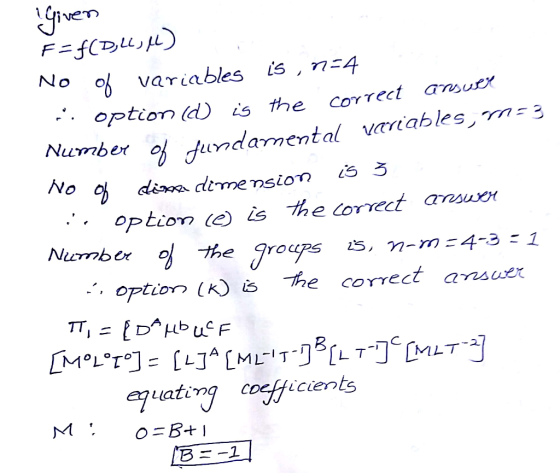
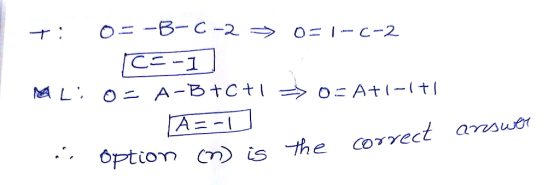
 Consider the viscous pipe flow. The relevant variables for the problem are summarized as follows: P (pressure drop) f (p density, U = velocity, D diameter, viscosity in kg/m.s, E= roughness, L length). You need to determine Number of variables is a. (5) b. (6) ) с. (7) Number of the dimensions is d. (3) e. (4) 5 Number of the groups is g. (3) h. (4) i. (5) If the first group is represented as: n1- Lpa vo DC...
1.) Find the terminal velocity (in m/s) of a spherical bacterium (diameter 1.94 µm) falling in...
1.) Find the terminal velocity (in m/s) of a spherical bacterium (diameter 1.94 µm) falling in water. You will first need to note that the drag force is equal to the weight at terminal velocity. Take the density of the bacterium to be 1.10 ✕ 103 kg/m3. (Assume the viscosity of water is 1.002 ✕ 10−3 kg/(m · s).
The drag F on a sphere of volume V moving slowly with speed u in a...
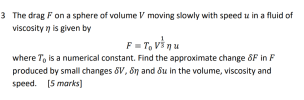 The drag F on a sphere of volume V moving slowly with speed u in a fluid of viscosity η is l:iven by 3 wiie.reSXİ) s ia nurricTICial «x»nsiant.. Firnd i Inc, appr'«ixilii iai? (:lliintyc, e57 n P produced by small changes δν, δη and δυ in the volume, viscosity and speed. [5 marks]
 The drag force Fp on a smooth sphere falling in water depends on
the sphere speed V, the sphere density P. the density p and dynamic
viscosity of water, the sphere diameter Dand the gravitational
acceleration g. Using dimensional analysis with p. V and D as
repeating variables, determine suitable dimensionless groups to
obtain a reneral relationship between the drag force and the other
variables. If the same sphere were to fall through air, determine
the ratio of the drag...
The drag force Fp on a smooth sphere falling in water depends on
the sphere speed V, the sphere density P. the density p and dynamic
viscosity of water, the sphere diameter Dand the gravitational
acceleration g. Using dimensional analysis with p. V and D as
repeating variables, determine suitable dimensionless groups to
obtain a reneral relationship between the drag force and the other
variables. If the same sphere were to fall through air, determine
the ratio of the drag...
 The aerodynamic drag acting on a cylinder at a very low Reynolds number (Stokes flow or creeping motion) is a function of dynamic viscosity of fluid (u), diameter of cylinder (D) and freestream velocity (U). Find a non-dimensional parameter using dimensional analysis.
 The aerodynamic drag acting on a cylinder at a very low Reynolds number (Stokes flow or creeping motion) is a function of dynamic viscosity of fluid (u), diameter of cylinder (D) and freestream velocity (U). Find a non-dimensional parameter using dimensional analysis.
 please show all work
The aerodynamic drag acting on a cylinder at a very low Reynolds number (Stokes flow or creeping motion) is a function of dynamic viscosity of fluid (u), diameter of cylinder (D) and freestream velocity (U). Find a non-dimensional parameter using dimensional analysis.
please show all work
The aerodynamic drag acting on a cylinder at a very low Reynolds number (Stokes flow or creeping motion) is a function of dynamic viscosity of fluid (u), diameter of cylinder (D) and freestream velocity (U). Find a non-dimensional parameter using dimensional analysis.
 2. A small spherical particle (diameter = 75x10-6 m) is falling through air from a high elevation. Density of air is 0.85 kg/m3 and viscosity is 1.47 x 10⁻⁵ kg/m.s. Density of particle is 1,500 kg/m3. Determine the terminal velocity of the particle. (10%)
 6a. The aerodynamic drag acting on a cylinder at a very low Reynolds number (Stokes flow or creeping motion) is a function of dynamic viscosity of fluid (u), diameter of cylinder (D) and freestream velocity (U). Find a non-dimensional parameter using dimensional analysis. 6b. A model test is to be conducted in a water tunnel using a 1: 20 model of a submarine, which is to travel at a speed of 12 km/h deep under sea surface. The water temperature...
 Consider the viscous pipe flow. The relevant variables for the problem are summarized as follows: P (pressure drop) f (p density, U = velocity, D diameter, viscosity in kg/m.s, E= roughness, L length). You need to determine Number of variables is a. (5) b. (6) ) с. (7) Number of the dimensions is d. (3) e. (4) 5 Number of the groups is g. (3) h. (4) i. (5) If the first group is represented as: n1- Lpa vo DC...
 The drag F on a sphere of volume V moving slowly with speed u in a fluid of viscosity η is l:iven by 3 wiie.reSXİ) s ia nurricTICial «x»nsiant.. Firnd i Inc, appr'«ixilii iai? (:lliintyc, e57 n P produced by small changes δν, δη and δυ in the volume, viscosity and speed. [5 marks]
Most questions answered within 3 hours.
-
Where is the error in this code sequence?
String s1 = "Hello";
String s2 = "ello";...
asked 10 months ago -
Financial data for Joel de Paris, Inc., for last year
follow:
Joel de Paris, Inc.
Balance...
asked 10 months ago -
Consider this reaction:
Al2(SO4)3 (aq)+ BaCl3
(aq) Al2Cl6 (aq)- +
3BaSO4(s) . What is the...
asked 10 months ago -
Suppose that Savneet is considering increasing her
recent random sample from 20 car rentals to 40...
asked 10 months ago -
Trucks arrive at an unloading terminal at an average rate of 120
per hour.
Trucks arrive...
asked 10 months ago -
Why are methanol and ethanol completely soluble in water while
octanol is not very little soluble....
asked 10 months ago -
A facilities manager at a university reads in a research report
that the mean amount of...
asked 10 months ago -
When the CuSO4 is rehydrated by adding water to the anhydrous
compound, is this an endothermic...
asked 10 months ago -
A ray of sunlight is passing from diamond into crown glass; the
angle of incidence is...
asked 10 months ago -
A block of mass 0.249 kg is placed on top of a light, vertical
spring of...
asked 10 months ago -
how do the kidneys compensate in the presences of acidosis
a) trigger hyperventilate
b) reserve acid...
asked 10 months ago -
Question 501 pts
The rental rate of capital to the firm increases. Which of the
following...
asked 10 months ago