example is the 2nd pic.
plzz help!!
Homework Answers
a)
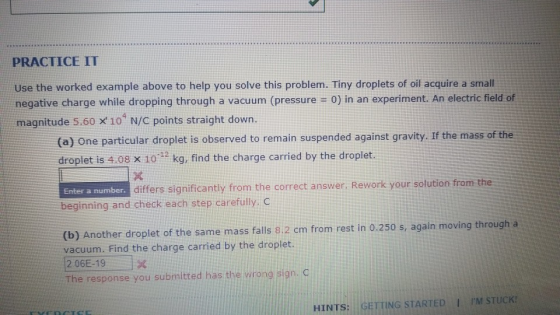
E = electric field in the region = 5.6 x 10⁴ N/C
m = mass of the droplet = 4.08 x 10⁻¹² kg
q = charge on the droplet = ?
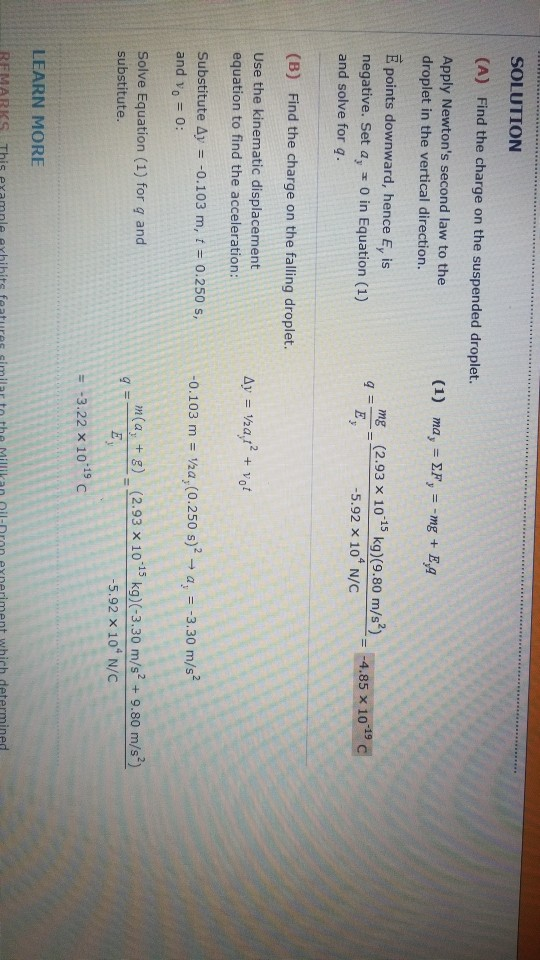
the electric force on the droplet in upward direction balances the weight of the droplet in downward direction
Electric force = weight
qE = mg
q ( 5.6 x 10⁴) = (4.08 x 10⁻¹²) (9.8)
q = 7.14 x 10⁻¹⁶ C
b)
d = distance fallen = 8.2 cm = 0.082 m
vo = initial velocity = 0 m/s
t = time of fall = 0.250 s
a = acceleration
using the kinematics equation
d = vo t + (0.5) a t2
0.082 = (0) (0.250) + (0.5) a (0.250)2
a = 2.624 m/s2
m = mass of droplet = 4.08 x 10⁻¹² kg
q = charge on the droplet
Fe = electric force on the droplet in upward direction = q E
Fg = weight of droplet in downward direction = mg
force equation for the motion of the droplet is given as
Fg - Fe = ma
mg - q E = ma
( 4.08 x 10⁻¹² ) (9.8) - q (5.6 x 10⁴) = (4.08 x 10⁻¹²) (2.624)
q = 5.23 x 10⁻¹⁶ C
Add Answer to:
example is the 2nd pic. plzz help!! PRACTICE IT Use the worked example above to help...
PRACTICE IT Use the worked ex negative charge while dropping through a vacuum (pressure 0) in...
 PRACTICE IT Use the worked ex negative charge while dropping through a vacuum (pressure 0) in an experimentr An electric field of magnitude 6.3s x 104 N/c points straight down. ample above to help you solve this problem. Tiny droplets of oll acquire a small (a) One particular droplet is observed to remain suspended against gravity If the mass of the droplet is 4.11 x 10⁻¹² kg, find the charge carried by the droplet. (b) Another droplet of the same...
worked examples is the 2nd photo. plzz help!!! Use the worked example above to help you...
 worked examples is the 2nd photo.
plzz help!!!
Use the worked example above to help you solve this problem. The electron and proton of a hydrogen atom are separated by a distance of about 5.62 X 10¹¹ m at some instant. (a) Find the magnitudes of the electric force and the gravitational force that each particle exerts on the other, and the ratio of the electric force, F., to the gravitational force, F F -70E0-8 The response you submitted has...
worked examples is the 2nd photo.
plzz help!!!
Use the worked example above to help you solve this problem. The electron and proton of a hydrogen atom are separated by a distance of about 5.62 X 10¹¹ m at some instant. (a) Find the magnitudes of the electric force and the gravitational force that each particle exerts on the other, and the ratio of the electric force, F., to the gravitational force, F F -70E0-8 The response you submitted has...
PRACTICE IT Use the worked example above to help you solve this problem. A patient receives...
 PRACTICE IT Use the worked example above to help you solve this problem. A patient receives a blood transfusion through a needle of radius 0.25 mm and length 2.1 cm, The density of blood is 1,050 kg/m3. The bottle supplying the blood is 0.500 m above the patient's arm. What is the rate of flow through the needle? m2/s EXERCISE GETTING STARTED I I'M STUCK! HINTS: A pipe carrying water from a tank 19.5 m tall must cross 3.20 x...
PRACTICE IT Use the worked example above to help you solve this problem. Charge 91-685 μc...
 PRACTICE IT Use the worked example above to help you solve this problem. Charge 91-685 μc is at the origin, and charge q 2 -4.80 μC is on the x-axis, 0.300 m from the origin (see figure). (a) Find the magnitude and direction of the electric field at point P, which has coordinates (o 0.400) m 384884.37 magnitude Your response differs from the correct answer by more than 10%. Double check your calculations. N/C direction o counterclockwise from the tx-axis...
PRACTICE IT Use the worked example above to help you solve this problem. Charge q1 7.40...
 PRACTICE IT Use the worked example above to help you solve this problem. Charge q1 7.40 C is at the origin, and charge q 2--4.9。pC is on the x-axis, 0.300 m from the origin (see figure). (a) Find the magnitude and direction of the electric field at point P, which has coordinates (0, 0.400) m. magnitude directiorn N/C o counterclockwise from the +x-axis (b) Find the force on a charge of 2.00 x 10⁸ C placed at P EXERCISE HINTS:...
PRACTICE IT Use the worked example above to help you solve this problem. A patient receives...
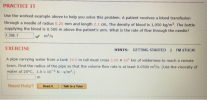 PRACTICE IT Use the worked example above to help you solve this problem. A patient receives a blood transfusion through a needle of radius 0.25 mm and length 2.1 cm, The density of blood is 1,050 kg/m3. The bottle supplying the blood is 0.500 m above the patient's arm. What is the rate of flow through the needle? 1.39E-7 m2/s EXERCISE I I'M STUCK! HINTS: GETTING STARTED A pipe carrying water from a tank 19.5 m tall must cross 3.20...
PRACTICE IT Use the worked example above to help you solve this problem. Charge q1 6.90...
 PRACTICE IT Use the worked example above to help you solve this problem. Charge q1 6.90 uC is at the origin, and charge 92 =-4.90 pC is on the x-axis, 0.300 m from the origin (see figure). (a) Find the magnitude and direction of the electric field at point P, which has coordinates (O, 0.400) m. 2.53e5 magnitude Your response is within 10% of the correct value. This may be due to roundoff error, or you could have a mistake...
PRACTICE IT Use the worked example above to help you solve this problem. A ball is...
 PRACTICE IT Use the worked example above to help you solve this problem. A ball is thrown upward from the top of a building at an angle of 30.00 to the horizontal and with an initial speed of 19.0 m/s. The point of release is h 46.0 m above the ground. (a) How long does it take for the ball to hit the ground? 4.18 b) Find the ball's speed at impact 35.5 m/s (c) Find the horizontal range of...
PRACTICE IT Use the worked example above to help you solve this problem. A patient receives...
 PRACTICE IT
Use the worked example above to help you solve this problem. A
patient receives a blood transfusion through a needle of radius
0.24 mm and length 1.8 cm, The density of blood is 1,050
kg/m3. The bottle supplying the blood is 0.500 m above
the patient's arm. What is the rate of flow through the
needle?
m3/s
EXERCISEHINTS: GETTING
STARTED | I'M STUCK!
A pipe carrying water from a tank 19.0 m tall must cross 3.05
102 km of wilderness to...
PRACTICE IT
Use the worked example above to help you solve this problem. A
patient receives a blood transfusion through a needle of radius
0.24 mm and length 1.8 cm, The density of blood is 1,050
kg/m3. The bottle supplying the blood is 0.500 m above
the patient's arm. What is the rate of flow through the
needle?
m3/s
EXERCISEHINTS: GETTING
STARTED | I'M STUCK!
A pipe carrying water from a tank 19.0 m tall must cross 3.05
102 km of wilderness to...
PRACTICE IT Use the worked example above to help you solve this problenm A ball is...
 PRACTICE IT Use the worked example above to help you solve this problenm A ball is thrown upward from the top of a building at an angle of 30.0° to the horizontal and with an initial speed of 22.0 m/s. The point of release is h 41.0 m above the ground (a) How long does it take for the ball to hit the ground? 3.103 Your response differs from the correct answer by more than 10%. Double check your calculations....
 PRACTICE IT Use the worked ex negative charge while dropping through a vacuum (pressure 0) in an experimentr An electric field of magnitude 6.3s x 104 N/c points straight down. ample above to help you solve this problem. Tiny droplets of oll acquire a small (a) One particular droplet is observed to remain suspended against gravity If the mass of the droplet is 4.11 x 10⁻¹² kg, find the charge carried by the droplet. (b) Another droplet of the same...
 worked examples is the 2nd photo.
plzz help!!!
Use the worked example above to help you solve this problem. The electron and proton of a hydrogen atom are separated by a distance of about 5.62 X 10¹¹ m at some instant. (a) Find the magnitudes of the electric force and the gravitational force that each particle exerts on the other, and the ratio of the electric force, F., to the gravitational force, F F -70E0-8 The response you submitted has...
worked examples is the 2nd photo.
plzz help!!!
Use the worked example above to help you solve this problem. The electron and proton of a hydrogen atom are separated by a distance of about 5.62 X 10¹¹ m at some instant. (a) Find the magnitudes of the electric force and the gravitational force that each particle exerts on the other, and the ratio of the electric force, F., to the gravitational force, F F -70E0-8 The response you submitted has...
 PRACTICE IT Use the worked example above to help you solve this problem. A patient receives a blood transfusion through a needle of radius 0.25 mm and length 2.1 cm, The density of blood is 1,050 kg/m3. The bottle supplying the blood is 0.500 m above the patient's arm. What is the rate of flow through the needle? m2/s EXERCISE GETTING STARTED I I'M STUCK! HINTS: A pipe carrying water from a tank 19.5 m tall must cross 3.20 x...
 PRACTICE IT Use the worked example above to help you solve this problem. Charge 91-685 μc is at the origin, and charge q 2 -4.80 μC is on the x-axis, 0.300 m from the origin (see figure). (a) Find the magnitude and direction of the electric field at point P, which has coordinates (o 0.400) m 384884.37 magnitude Your response differs from the correct answer by more than 10%. Double check your calculations. N/C direction o counterclockwise from the tx-axis...
 PRACTICE IT Use the worked example above to help you solve this problem. Charge q1 7.40 C is at the origin, and charge q 2--4.9。pC is on the x-axis, 0.300 m from the origin (see figure). (a) Find the magnitude and direction of the electric field at point P, which has coordinates (0, 0.400) m. magnitude directiorn N/C o counterclockwise from the +x-axis (b) Find the force on a charge of 2.00 x 10⁸ C placed at P EXERCISE HINTS:...
 PRACTICE IT Use the worked example above to help you solve this problem. A patient receives a blood transfusion through a needle of radius 0.25 mm and length 2.1 cm, The density of blood is 1,050 kg/m3. The bottle supplying the blood is 0.500 m above the patient's arm. What is the rate of flow through the needle? 1.39E-7 m2/s EXERCISE I I'M STUCK! HINTS: GETTING STARTED A pipe carrying water from a tank 19.5 m tall must cross 3.20...
 PRACTICE IT Use the worked example above to help you solve this problem. Charge q1 6.90 uC is at the origin, and charge 92 =-4.90 pC is on the x-axis, 0.300 m from the origin (see figure). (a) Find the magnitude and direction of the electric field at point P, which has coordinates (O, 0.400) m. 2.53e5 magnitude Your response is within 10% of the correct value. This may be due to roundoff error, or you could have a mistake...
 PRACTICE IT Use the worked example above to help you solve this problem. A ball is thrown upward from the top of a building at an angle of 30.00 to the horizontal and with an initial speed of 19.0 m/s. The point of release is h 46.0 m above the ground. (a) How long does it take for the ball to hit the ground? 4.18 b) Find the ball's speed at impact 35.5 m/s (c) Find the horizontal range of...
 PRACTICE IT
Use the worked example above to help you solve this problem. A
patient receives a blood transfusion through a needle of radius
0.24 mm and length 1.8 cm, The density of blood is 1,050
kg/m3. The bottle supplying the blood is 0.500 m above
the patient's arm. What is the rate of flow through the
needle?
m3/s
EXERCISEHINTS: GETTING
STARTED | I'M STUCK!
A pipe carrying water from a tank 19.0 m tall must cross 3.05
102 km of wilderness to...
PRACTICE IT
Use the worked example above to help you solve this problem. A
patient receives a blood transfusion through a needle of radius
0.24 mm and length 1.8 cm, The density of blood is 1,050
kg/m3. The bottle supplying the blood is 0.500 m above
the patient's arm. What is the rate of flow through the
needle?
m3/s
EXERCISEHINTS: GETTING
STARTED | I'M STUCK!
A pipe carrying water from a tank 19.0 m tall must cross 3.05
102 km of wilderness to...
 PRACTICE IT Use the worked example above to help you solve this problenm A ball is thrown upward from the top of a building at an angle of 30.0° to the horizontal and with an initial speed of 22.0 m/s. The point of release is h 41.0 m above the ground (a) How long does it take for the ball to hit the ground? 3.103 Your response differs from the correct answer by more than 10%. Double check your calculations....
Most questions answered within 3 hours.
-
Where is the error in this code sequence?
String s1 = "Hello";
String s2 = "ello";...
asked 11 months ago -
Financial data for Joel de Paris, Inc., for last year
follow:
Joel de Paris, Inc.
Balance...
asked 11 months ago -
Consider this reaction:
Al2(SO4)3 (aq)+ BaCl3
(aq) Al2Cl6 (aq)- +
3BaSO4(s) . What is the...
asked 11 months ago -
Suppose that Savneet is considering increasing her
recent random sample from 20 car rentals to 40...
asked 11 months ago -
Trucks arrive at an unloading terminal at an average rate of 120
per hour.
Trucks arrive...
asked 11 months ago -
Why are methanol and ethanol completely soluble in water while
octanol is not very little soluble....
asked 11 months ago -
A facilities manager at a university reads in a research report
that the mean amount of...
asked 11 months ago -
When the CuSO4 is rehydrated by adding water to the anhydrous
compound, is this an endothermic...
asked 11 months ago -
A ray of sunlight is passing from diamond into crown glass; the
angle of incidence is...
asked 11 months ago -
A block of mass 0.249 kg is placed on top of a light, vertical
spring of...
asked 11 months ago -
how do the kidneys compensate in the presences of acidosis
a) trigger hyperventilate
b) reserve acid...
asked 11 months ago -
Question 501 pts
The rental rate of capital to the firm increases. Which of the
following...
asked 11 months ago