At takeoff a commercial jet has a 60.0 m/s speed. Its tires have a diameter of...
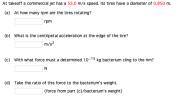
At takeoff a commercial jet has a 60.0 m/s speed. Its tires have a diameter of 0.400 m.
(a)At how many rpm are the tires rotating?
rpm
(b)What is the centripetal acceleration at the edge of the tire?
m/s2
(c)With what force must a determined 10−15 kg bacterium cling to the rim?
N
(d)Take the ratio of this force to the bacterium's weight.
(force from part (c)/bacterium's weight)
Homework Answers
Concepts used in the answer:- Circular motion

***************************************************************************************************
This concludes the answers. If there is any mistake,
let me know immediately and I will fix it....
Add Answer to:
At takeoff a commercial jet has a 60.0 m/s speed. Its tires have a diameter of...
At takeoff a commercial jet has a 75.0 m/s speed. Its tires have a diameter of...
 At takeoff a commercial jet has a 75.0 m/s speed. Its tires have a diameter of 0.400 m. (a) At how many rpm are the tires rotating? 3581 (b) What is the centripetal acceleration at the edge of the tire? 28125m/s (c) With what force must a determined 10 15 kg bacterium cling to the rim? rpm (d) Take the ratio of this force to the bacterium's weight. 2870(force from part (e)/ bacterium's weight)
At takeoff a commercial jet has a 55.0 m/s speed. Its tires have a diameter of...
 At takeoff a commercial jet has a 55.0 m/s speed. Its tires have a diameter of 0.850 m (a) At how many rpm are the tires rotating? rpm (b) What is the centripetal acceleration at the edge of the tire? m/s2 (c) With what force must a determined 10-15 kg bacterium cling to the rim? (d) Take the ratio of this force to the bacterium's weight. (force from part (c)/bacterium's weight)
At takeoff a commercial jet has a 75.0 m/s speed. Its tires have a diameter of...
At takeoff a commercial jet has a 75.0 m/s speed. Its tires have a diameter of 0.550 m. (a) At how many rpm are the tires rotating? (b) What is the centripetal acceleration at the edge of the tire? (c) With what force must a determined 10-15 kg bacterium cling to the rim? (d) Take the ratio of this force to the bacterium's weight. ____ force from part (c) / bacterium's weight)
At takeoff a commercial jet has a 55.0 m/s speed. Its tires have a diameter of...
At takeoff a commercial jet has a 55.0 m/s speed. Its tires have a diameter of 0.700 m. (a) At how many rpm are the tires rotating? Incorrect: Your answer is incorrect. rpm (b) What is the centripetal acceleration at the edge of the tire? Incorrect: Your answer is incorrect. m/s2 (c) With what force must a determined 10-15 kg bacterium cling to the rim? Incorrect: Your answer is incorrect. N (d) Take the ratio of this force to the...
A jet plane has a takeoff speed of vto = 66 m/s and can move along...
A jet plane has a takeoff speed of vto = 66 m/s and can move along the runway at an average acceleration of 2.0 m/s2. If the length of the runway is 3.0 km, will the plane be able to use this runway safely?
1. A jet plane has a takeoff speed of ? = 75 m/s and can move...
1. A jet plane has a takeoff speed of ? = 75 m/s and can move along the runway at an average acceleration of 1.3 m/s2. If the length of the runway is 2.5 km, will the plane be able to use this runway safely? Defend your answer. 2. A person takes a trip, driving with a constant speed of 89.5 km/h, except for a 22.0 min rest stop. If the person’s average speed is 77.8 km/h, (a) how much...
Two bicycle tires are set rolling with the same initial speed of 4.00 m/s along a...
Two bicycle tires are set rolling with the same initial speed of 4.00 m/s along a long, straight road, and the distance each travels before its speed is reduced by half is measured. One tire is inflated to a pressure of 40 psi and goes a distance of 19.0 m ; the other is at 105 psi and goes a distance of 92.8 m . Assume that the net horizontal force is due to rolling friction only and take the...
Two bicycle tires are set rolling with the same initial speed of 3.10 m/s along a...
Two bicycle tires are set rolling with the same initial speed of 3.10 m/s along a long, straight road, and the distance each travels before its speed is reduced by half is measured. One tire is inflated to a pressure of 40 psi and goes a distance of 19.0 m ; the other is at 105 psi and goes a distance of 92.5 m . Assume that the net horizontal force is due to rolling friction only and take the...
Two bicycle tires are set rolling with the same initial speed of 3.20 m/s along a...
Two bicycle tires are set rolling with the same initial speed of 3.20 m/s along a long, straight road, and the distance each travels before its speed is reduced by half is measured. One tire is inflated to a pressure of 40 psi and goes a distance of 18.3 m ; the other is at 105 psi and goes a distance of 93.1 m . Assume that the net horizontal force is due to rolling friction only and take the...
A 23-cm-diameter horizontal water jet with a speed of Vj = 20 m/s relative to the...
A 23-cm-diameter horizontal water jet with a speed of Vj = 20 m/s relative to the ground is deflected by a 40° cone moving to the left at Vc = 10 m/s. Determine the external force, F, needed to maintain the motion of the cone. Disregard the gravity and surface shear effects, and assume that the cross-sectional area of the water jet normal to the direction of motion remains constant throughout the flow. Take the density of water to be...
 At takeoff a commercial jet has a 75.0 m/s speed. Its tires have a diameter of 0.400 m. (a) At how many rpm are the tires rotating? 3581 (b) What is the centripetal acceleration at the edge of the tire? 28125m/s (c) With what force must a determined 10 15 kg bacterium cling to the rim? rpm (d) Take the ratio of this force to the bacterium's weight. 2870(force from part (e)/ bacterium's weight)
 At takeoff a commercial jet has a 55.0 m/s speed. Its tires have a diameter of 0.850 m (a) At how many rpm are the tires rotating? rpm (b) What is the centripetal acceleration at the edge of the tire? m/s2 (c) With what force must a determined 10-15 kg bacterium cling to the rim? (d) Take the ratio of this force to the bacterium's weight. (force from part (c)/bacterium's weight)
Most questions answered within 3 hours.
-
Where is the error in this code sequence?
String s1 = "Hello";
String s2 = "ello";...
asked 10 months ago -
Financial data for Joel de Paris, Inc., for last year
follow:
Joel de Paris, Inc.
Balance...
asked 10 months ago -
Consider this reaction:
Al2(SO4)3 (aq)+ BaCl3
(aq) Al2Cl6 (aq)- +
3BaSO4(s) . What is the...
asked 10 months ago -
Suppose that Savneet is considering increasing her
recent random sample from 20 car rentals to 40...
asked 10 months ago -
Trucks arrive at an unloading terminal at an average rate of 120
per hour.
Trucks arrive...
asked 10 months ago -
Why are methanol and ethanol completely soluble in water while
octanol is not very little soluble....
asked 10 months ago -
A facilities manager at a university reads in a research report
that the mean amount of...
asked 10 months ago -
When the CuSO4 is rehydrated by adding water to the anhydrous
compound, is this an endothermic...
asked 10 months ago -
A ray of sunlight is passing from diamond into crown glass; the
angle of incidence is...
asked 10 months ago -
A block of mass 0.249 kg is placed on top of a light, vertical
spring of...
asked 10 months ago -
how do the kidneys compensate in the presences of acidosis
a) trigger hyperventilate
b) reserve acid...
asked 10 months ago -
Question 501 pts
The rental rate of capital to the firm increases. Which of the
following...
asked 10 months ago