A projectile is shot directly away from Earth's surface. Neglect the rotation of the Earth. What...
Homework Answers
Add Answer to:
A projectile is shot directly away from Earth's surface. Neglect the rotation of the Earth. What...
A projectile is shot directly away from Earth's surface. Neglect the rotation of the Earth. What...
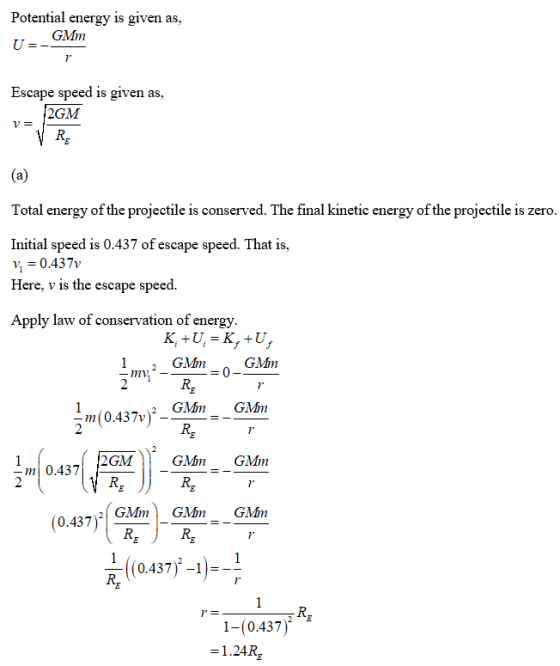
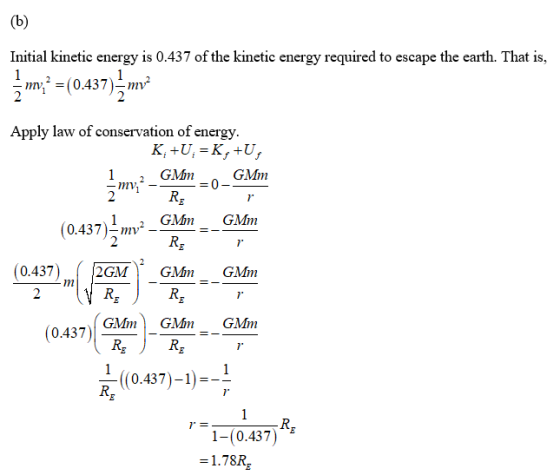
A projectile is shot directly away from Earth's surface. Neglect the rotation of the Earth. What multiple of Earth's radius RE gives the radial distance (from the Earth's center) the projectile reaches if a) its initial speed is 0.365 of the escape speed from Earth and b) its initial kinetic energy is 0.365 of the kinetic energy required to escape Earth? (Give your answers as unitless numbers.) c) What is the least initial mechanical energy required at launch if the...
A projectile is shot directly away from Earth's surface. Neglect the rotation of the Earth. What...
A projectile is shot directly away from Earth's surface. Neglect the rotation of the Earth. What multiple of Earth's radius RE gives the radial distance (from the Earth's center) the projectile reaches if (a) its initial speed is 0.662 of the escape speed from Earth and (b) its initial kinetic energy is 0.662 of the kinetic energy required to escape Earth? (Give your answers as unitless numbers.) (c) What is the least initial mechanical energy required at launch if the...
40 A projectile is shot directly away from Earth's surface. Neglect the rotation of Earth. What...
 40 A projectile is shot directly away from Earth's surface. Neglect the rotation of Earth. What multiple of Earth's radius Rg gives the radial distance a projectile reaches if (a) its initial speed is 0.500 of the escape speed from Earth and (b) its initial kinetic en- ergy is 0.500 of the kinetic energy required to escape Earth? (c) What is the least initial mechanical energy required at launch if the projectile is to escape Earth?
Suppose an object is launched from Earth with 0.52 times the escape speed. How many multiples of Earth's radius (RE 6.37 x 10⁶ m) in radial distance will the object reach before falling back towa...
 Suppose an object is launched from Earth with 0.52 times the escape speed. How many multiples of Earth's radius (RE 6.37 x 10⁶ m) in radial distance will the object reach before falling back toward Earth? The distances are measured relative to Earth's center, so a ratio of 1.00 would correspond to an object on Earth's surface. For this problem, neglect Earth's rotation and the effect of its atmosphere For reference, Earth's mass is 5.972 x1024 kg. Your answer is...
Suppose an object is launched from Earth with 0.56 times the kinetic energy for escape. How...
Suppose an object is launched from Earth with 0.56 times the kinetic energy for escape. How many multiples of Earth's radius (RE = 6.37 x 10⁶ m) in radial distance will the object reach before falling back toward Earth? The distances are measured relative to Earth's center, so a ratio of 1.00 would correspond to an object on Earth's surface. For this problem, neglect Earth's rotation and the effect of its atmosphere. For reference, Earth's mass is 5.972 x 1024...
(a) Imagine that a space probe could be fired as a projectile from the Earth's surface...
(a) Imagine that a space probe could be fired as a projectile from the Earth's surface with an initial speed of 4.98 104 m/s relative to the Sun. What would its speed be when it is very far from the Earth (in m/s)? Ignore atmospheric friction, the effects of other planets, and the rotation of the Earth. (Consider the mass of the Sun in your calculations.) (b) What If? The speed provided in part (a) is very difficult to achieve...
A projectile with mass 201.0 kg is launched straight up from Earth's surface with an initial...
A projectile with mass 201.0 kg is launched straight up from Earth's surface with an initial speed 10.7 km/s. What is the maxium height of the projectile, as measured from the center of the Earth? Answer in units of Re (g= 10 m/s^2, Re= 6.371 x 10^6 m) The answer is 4.9 but how, Please and Thankyou
A projectile is fired vertically from Earth's surface with an initial speed of 4.0 km/s. Neglecting...
A projectile is fired vertically from Earth's surface with an initial speed of 4.0 km/s. Neglecting air drag, how far above the surface of Earth will it go?
An electron is shot directly toward the center of a large metal plate that has surface...
An electron is shot directly toward the center of a large metal plate that has surface charge density - 1.00 × 10⁻⁶ C/m2. If the initial kinetic energy of the electron is 6.40 × 10⁻¹⁷ J and if the electron is to stop (due to electrostatic repulsion from the plate) just as it reaches the plate, how far from the plate must the launch point be? Please explain your reasoning, thank you!
5. A rocket is launched horizontal from the surface of earth. The launch velocity of the...
 5. A rocket is launched horizontal from the surface of earth. The launch velocity of the rocket is 0.80 vese where vesc = V2GM/R is the escape velocity from the surface of earth. Determine the maximum distance the rocket will reach above the center of earth. Express your answer as a multiple of earth's radius, R. (Answer 3.6) %3D
 40 A projectile is shot directly away from Earth's surface. Neglect the rotation of Earth. What multiple of Earth's radius Rg gives the radial distance a projectile reaches if (a) its initial speed is 0.500 of the escape speed from Earth and (b) its initial kinetic en- ergy is 0.500 of the kinetic energy required to escape Earth? (c) What is the least initial mechanical energy required at launch if the projectile is to escape Earth?
 Suppose an object is launched from Earth with 0.52 times the escape speed. How many multiples of Earth's radius (RE 6.37 x 10⁶ m) in radial distance will the object reach before falling back toward Earth? The distances are measured relative to Earth's center, so a ratio of 1.00 would correspond to an object on Earth's surface. For this problem, neglect Earth's rotation and the effect of its atmosphere For reference, Earth's mass is 5.972 x1024 kg. Your answer is...
 5. A rocket is launched horizontal from the surface of earth. The launch velocity of the rocket is 0.80 vese where vesc = V2GM/R is the escape velocity from the surface of earth. Determine the maximum distance the rocket will reach above the center of earth. Express your answer as a multiple of earth's radius, R. (Answer 3.6) %3D
Most questions answered within 3 hours.
-
Where is the error in this code sequence?
String s1 = "Hello";
String s2 = "ello";...
asked 10 months ago -
Financial data for Joel de Paris, Inc., for last year
follow:
Joel de Paris, Inc.
Balance...
asked 10 months ago -
Consider this reaction:
Al2(SO4)3 (aq)+ BaCl3
(aq) Al2Cl6 (aq)- +
3BaSO4(s) . What is the...
asked 10 months ago -
Suppose that Savneet is considering increasing her
recent random sample from 20 car rentals to 40...
asked 10 months ago -
Trucks arrive at an unloading terminal at an average rate of 120
per hour.
Trucks arrive...
asked 10 months ago -
Why are methanol and ethanol completely soluble in water while
octanol is not very little soluble....
asked 10 months ago -
A facilities manager at a university reads in a research report
that the mean amount of...
asked 10 months ago -
When the CuSO4 is rehydrated by adding water to the anhydrous
compound, is this an endothermic...
asked 10 months ago -
A ray of sunlight is passing from diamond into crown glass; the
angle of incidence is...
asked 10 months ago -
A block of mass 0.249 kg is placed on top of a light, vertical
spring of...
asked 10 months ago -
how do the kidneys compensate in the presences of acidosis
a) trigger hyperventilate
b) reserve acid...
asked 10 months ago -
Question 501 pts
The rental rate of capital to the firm increases. Which of the
following...
asked 10 months ago