Will a carbocation rearrangement occurs in the reaction of 2-bromo-3-methylbutane with methanol. Please explain why or...
Homework Answers
Add Answer to:
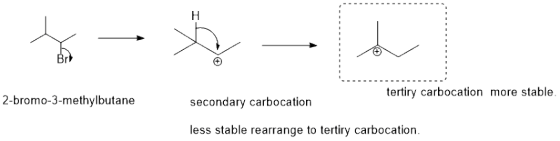
Will a carbocation rearrangement occurs in the reaction of 2-bromo-3-methylbutane with methanol. Please explain why or...
Will a carbocation rearrangement occur in the reaction of 2-bromo-3-methylbutane with methanol? thank you!
Will a carbocation rearrangement occur in the reaction of 2-bromo-3-methylbutane with methanol? thank you!
5. Explain how the following changes will influence the rate of the reaction of 2-bromo-2- methylbutane...
 5. Explain how the following changes will influence the rate of the reaction of 2-bromo-2- methylbutane with methanol: a. The alkyl halide is changed to 2-chloro-2-methylbutane b. The alkyl halide is changed to 2-chloro-3-methylbutane 6. What product(s) do you predict for the following reactions? Be specific with regard to stereochemistry. Also, indicate which stereoisomer will be more predominant. a. R-2-bromopentane + CH30 b. R-3-bromo-3-metylheptane + CH3OH C. 1-bromo-2-butene + CH30 d. 1-bromo-2-butene + CH3OH e. E2 reaction of 2-bromobutane f....
13a. Draw the electron pushing using arrows for 2-Bromo-2-methylbutane reacting with methanol. Consider both substitution and...
13a. Draw the electron pushing using arrows for 2-Bromo-2-methylbutane reacting with methanol. Consider both substitution and elimination mechanisms. Show the structure of products. 13b. Does cis- or trans- bromo-4-tert-butylcyclohexane react faster in an E2 reaction? Explain.
3) Complete the reactions to show the multi-step syntheses of each product from (R)-2 bromo-3-methylbutane. Reaction...
 3) Complete the reactions to show the multi-step syntheses of each product from (R)-2 bromo-3-methylbutane. Reaction conditions go in boxes above arrows (1 reaction/box) Complete the template molecules provided to show each step of the synthesis. [20] Hint- This question involves addition, elimination, substitution and alcohol chemistry Br (R)-2-bromo-3-methylbutane 3-methylbutan-1-ol (R)-2-bromo-3-methylbutane (R)-3-bromo-2 methylbutan-2-ol (R)-2-bromo-3-methylbutane (1-chloro-2-methylbutane (R)-2-bromo-3-methylbutane CN ()-1-cyano-3-methylbutan-1-ol
When 2-bromo-3-methylbutane reacts with ethanol,two products are formed, 2-ethoxy-3-methylbutane and 2-ethoxy-2-methylbutane. 1.Give an explanation for the...
When 2-bromo-3-methylbutane reacts with ethanol,two products are formed, 2-ethoxy-3-methylbutane and 2-ethoxy-2-methylbutane. 1.Give an explanation for the two products. 2. Draw the full mechanism for the formation of the second product. (mechanism should have fours steps in total, including a deprotonation step.) Please show all work!
On standing, 2-bromo-3-methylbutane is converted into 2-bromo-2-methytbutane. Propose a curved-arrow mechanism for this transformation. The reaction...
 On standing, 2-bromo-3-methylbutane is converted into 2-bromo-2-methytbutane. Propose a curved-arrow mechanism for this transformation. The reaction of butylamine, CH_3(CH_2)NH_2, with 1-bromoethane in 60% aqueous ethanol follows the rate law Rate = k[butylamine][1-bromobutane] The product of the reaction is (CH_3CH_2CH_2CH_2)_2NH_2-Br^-. The following very similar reaction, however, has a first order rate law: Give a mechanism for each reaction that is consistent with its rate law and with other facts about nucleophilic substitution reactions. Use the curved-arrow formalism.
please explain step by step how do this problem. it is a carbocation rearrangement. (hydride/methyl shift)
 please explain step by step how do this problem. it is
a carbocation rearrangement. (hydride/methyl shift)
please explain step by step how do this problem. it is
a carbocation rearrangement. (hydride/methyl shift)
please make it easy to read ( no cursive) thank you :) 4. If (R)-2-bromo-3-methylbutane were...
 please make it easy to read ( no cursive) thank you :)
4. If (R)-2-bromo-3-methylbutane were to react with water, describe reaction conditions of how the achiral compound 2-methylbutan-2-ol would form. Draw the mechanism. 6.What type of reaction happened if 3-chlorohexane reacted with water to form hexan-3-ol given the following chart and why? Draw the mechanism. Angle of light rotation as reaction proceeds 130 105 80 55 30 5 -20 -45 -70 -95 -120 . 0 1 2 3 4...
please make it easy to read ( no cursive) thank you :)
4. If (R)-2-bromo-3-methylbutane were to react with water, describe reaction conditions of how the achiral compound 2-methylbutan-2-ol would form. Draw the mechanism. 6.What type of reaction happened if 3-chlorohexane reacted with water to form hexan-3-ol given the following chart and why? Draw the mechanism. Angle of light rotation as reaction proceeds 130 105 80 55 30 5 -20 -45 -70 -95 -120 . 0 1 2 3 4...
Name the following compound. CÁCH Br. Н H CH CH.CH 1-bromo-1-methylbutane 1-bromo-2-methylbutane 3-bromo-2,4-dimethylhexane 4-bromo-2,2,3-trimethylhexane Show transcribed...
 Name the following compound. CÁCH Br. Н H CH CH.CH 1-bromo-1-methylbutane 1-bromo-2-methylbutane 3-bromo-2,4-dimethylhexane 4-bromo-2,2,3-trimethylhexane
1) Please explain what it means for a reaction to create a Markovnikov product. Why does...
 1) Please explain what it means for a reaction to create a Markovnikov product. Why does the reagent favor being added in this order and not Anti-Markovnikov See the reaction below. 2) Why do molecules perform carbocation rearrangements? How will you determine when to perform a carbocation rearrangement? see reaction below. The X-
 5. Explain how the following changes will influence the rate of the reaction of 2-bromo-2- methylbutane with methanol: a. The alkyl halide is changed to 2-chloro-2-methylbutane b. The alkyl halide is changed to 2-chloro-3-methylbutane 6. What product(s) do you predict for the following reactions? Be specific with regard to stereochemistry. Also, indicate which stereoisomer will be more predominant. a. R-2-bromopentane + CH30 b. R-3-bromo-3-metylheptane + CH3OH C. 1-bromo-2-butene + CH30 d. 1-bromo-2-butene + CH3OH e. E2 reaction of 2-bromobutane f....
 3) Complete the reactions to show the multi-step syntheses of each product from (R)-2 bromo-3-methylbutane. Reaction conditions go in boxes above arrows (1 reaction/box) Complete the template molecules provided to show each step of the synthesis. [20] Hint- This question involves addition, elimination, substitution and alcohol chemistry Br (R)-2-bromo-3-methylbutane 3-methylbutan-1-ol (R)-2-bromo-3-methylbutane (R)-3-bromo-2 methylbutan-2-ol (R)-2-bromo-3-methylbutane (1-chloro-2-methylbutane (R)-2-bromo-3-methylbutane CN ()-1-cyano-3-methylbutan-1-ol
 On standing, 2-bromo-3-methylbutane is converted into 2-bromo-2-methytbutane. Propose a curved-arrow mechanism for this transformation. The reaction of butylamine, CH_3(CH_2)NH_2, with 1-bromoethane in 60% aqueous ethanol follows the rate law Rate = k[butylamine][1-bromobutane] The product of the reaction is (CH_3CH_2CH_2CH_2)_2NH_2-Br^-. The following very similar reaction, however, has a first order rate law: Give a mechanism for each reaction that is consistent with its rate law and with other facts about nucleophilic substitution reactions. Use the curved-arrow formalism.
 please explain step by step how do this problem. it is
a carbocation rearrangement. (hydride/methyl shift)
please explain step by step how do this problem. it is
a carbocation rearrangement. (hydride/methyl shift)
 please make it easy to read ( no cursive) thank you :)
4. If (R)-2-bromo-3-methylbutane were to react with water, describe reaction conditions of how the achiral compound 2-methylbutan-2-ol would form. Draw the mechanism. 6.What type of reaction happened if 3-chlorohexane reacted with water to form hexan-3-ol given the following chart and why? Draw the mechanism. Angle of light rotation as reaction proceeds 130 105 80 55 30 5 -20 -45 -70 -95 -120 . 0 1 2 3 4...
please make it easy to read ( no cursive) thank you :)
4. If (R)-2-bromo-3-methylbutane were to react with water, describe reaction conditions of how the achiral compound 2-methylbutan-2-ol would form. Draw the mechanism. 6.What type of reaction happened if 3-chlorohexane reacted with water to form hexan-3-ol given the following chart and why? Draw the mechanism. Angle of light rotation as reaction proceeds 130 105 80 55 30 5 -20 -45 -70 -95 -120 . 0 1 2 3 4...
 Name the following compound. CÁCH Br. Н H CH CH.CH 1-bromo-1-methylbutane 1-bromo-2-methylbutane 3-bromo-2,4-dimethylhexane 4-bromo-2,2,3-trimethylhexane
 1) Please explain what it means for a reaction to create a Markovnikov product. Why does the reagent favor being added in this order and not Anti-Markovnikov See the reaction below. 2) Why do molecules perform carbocation rearrangements? How will you determine when to perform a carbocation rearrangement? see reaction below. The X-
Most questions answered within 3 hours.
-
Where is the error in this code sequence?
String s1 = "Hello";
String s2 = "ello";...
asked 10 months ago -
Financial data for Joel de Paris, Inc., for last year
follow:
Joel de Paris, Inc.
Balance...
asked 10 months ago -
Consider this reaction:
Al2(SO4)3 (aq)+ BaCl3
(aq) Al2Cl6 (aq)- +
3BaSO4(s) . What is the...
asked 10 months ago -
Suppose that Savneet is considering increasing her
recent random sample from 20 car rentals to 40...
asked 10 months ago -
Trucks arrive at an unloading terminal at an average rate of 120
per hour.
Trucks arrive...
asked 10 months ago -
Why are methanol and ethanol completely soluble in water while
octanol is not very little soluble....
asked 10 months ago -
A facilities manager at a university reads in a research report
that the mean amount of...
asked 10 months ago -
When the CuSO4 is rehydrated by adding water to the anhydrous
compound, is this an endothermic...
asked 10 months ago -
A ray of sunlight is passing from diamond into crown glass; the
angle of incidence is...
asked 10 months ago -
A block of mass 0.249 kg is placed on top of a light, vertical
spring of...
asked 10 months ago -
how do the kidneys compensate in the presences of acidosis
a) trigger hyperventilate
b) reserve acid...
asked 10 months ago -
Question 501 pts
The rental rate of capital to the firm increases. Which of the
following...
asked 10 months ago