
Homework Answers
Add Answer to:
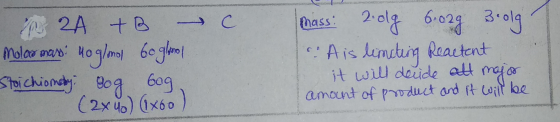
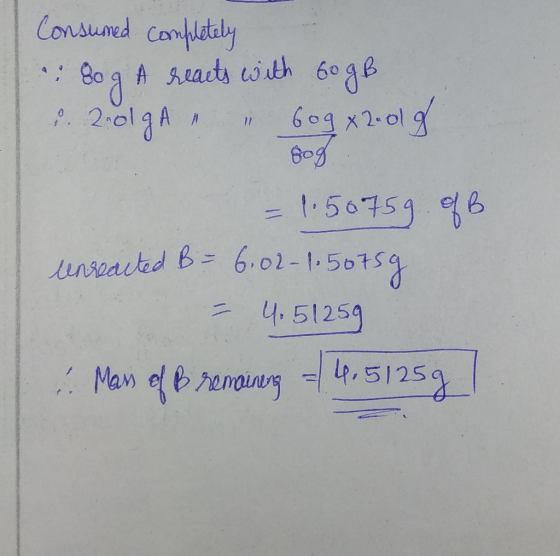
A is the limiting reactant in Expirement 1. Caculate the mass of B remaning after the...
Review | Constants Periodic Table Part A chemical reaction in which reactants A and B form...
 Review | Constants Periodic Table Part A chemical reaction in which reactants A and B form the product C is studied in the laboratory. The researcher carries out the reaction with differing relative amounts of reactants and measures the amount of product produced. Examine the given tabulated data from the experiment and answer the questions. A is the limiting reactant in Experiment 1. Calculate the mass of B remaining after the reaction in Experiment 1 has gone to completion, given...
Review Constants Periodic Table Part D A chemical reaction in which reactants A and B form...
 Review Constants Periodic Table Part D A chemical reaction in which reactants A and B form the product C is studied in the laboratory. The researcher carries out the reaction with differing relative amounts of reactants and measures the amount of product produced. Examine the given tabulated data from the experiment and answer the questions. A is the limiting reactant in Experiments 2 and 3. Calculate the mass of B remaining after the reaction in Experiments 2 and 3 have...
Question 27 3 pts In the limiting reactant" experiment, a mixture of 0.537 g of BaCl2...
 Question 27 3 pts In the limiting reactant" experiment, a mixture of 0.537 g of BaCl2 (molar mass - 208 g/mol) and 0.884g Na2SO.(molar mass - 142 g/mol) is added to water and the precipitation reaction occurs in the solution BaCl2t39) + Na2SO4(aq) --> BaSO4(s) +2 NaCl (aq) Please calculate: 2) The limiting reactantis hint: limiting reactant: the reactant that is not enough in the amount please calculate the amount of one reactant from the amount of the other reactant...
3. Determine the limiting reactant and the mass of AlCl3 produced by reacting 15.0 g of...
 3. Determine the limiting reactant and the mass of AlCl3 produced by reacting 15.0 g of Al with 30.0 g of Cly according to the following chemical equation. The molar mass of AICI is 133.33 g/mol. A1 = 26.98 g/mol 2 Al(s) + 3 Cl2 (g) → 2 AlCl3(s) C1 = 35.45 g/mol A) Al is the limiting reactant, 32.4 g of AlCl3 produced. B) Al is the limiting reactant, 74.1 g of AlCl3 produced. C) Cl2 is the limiting...
EXPERIMENT # 14 Assuming Na2CO, is the limiting reactant, how many grams of NaCl can be...
 EXPERIMENT # 14 Assuming Na2CO, is the limiting reactant, how many grams of NaCl can be produced from the amount of Na2CO, used in this experiment? Show calculations below: 8 Assuming HCI is the limiting reactant, how many gran of NaCl can be produced from the amount of HCI user this experiment? Show calculations below: 8 Which reactant is limiting? Which reactant is excess? 8 Actual yield of NaCl 8 Theoretical yield of NaCl % Percent yield of NaCl Show...
please answer 1 & 2 thank you 1. limiting Reactant - Mass to Mass: Perform two...
please answer 1 & 2 thank you 1. limiting Reactant - Mass to Mass: Perform two calculations to determine the limiting reactant and amount of product produced. Hydrogen cyanide, a highly toxic compound, is made by the following reaction: 2 CH4(g) + 2 NH3(g) + 3 O2(g) → 2 HCN(g) + 6 H2O(g) What is the limiting reagent with respect to HCN production if 45.4 g of O2 are added to 23.8 g of NH3? (assume CH4 is in excess)...
Find the limiting reactant of the experiment by converting reactants to product (remember to show all...
Find the limiting reactant of the experiment by converting reactants to product (remember to show all calculations used) Calculate the theoretical yield Calculate the percent yield using the limiting reactant data: melting point of trans P-anisalacetophenone: 73.0-76.0 C Density pf P-anisalahyde: 1.1191g/cm^3 Density of acetophenone: 1.0281g/gcm^3 Molar mass of trans P- anisalacetophenone: 238.28g/mol Molar mass of P-anisaldehyde: 136.15g/mol Molar mass of acetophenone: 120.15g/mol P-anisalaehyde used: 1.03ml Acetophenone used: 1.06ml 3.0ml ethanol first recrystallization 6 drops of sodium hydroxide 15ml of...
4. Based on the mole ratio of the reaction (1:1 for the reactants), determine which reactant...
4. Based on the mole ratio of the reaction (1:1 for the reactants), determine which reactant is the limiting reagent, based on the amounts you will be using as shown under “Reagents” above. Show your work. (Note: the density for the acetic anhydride solution is 1.08 g/mL) The amounts for p-aminophenol is 1.5 g, and the amounts for acetic anhydride is 2.5 g in 7.5 mL of water. The molar mass of p-aminophenol is 109.14 g/mol. The molar mass for...
NAME 1) For the reaction shown, find the limiting reactant and the theoretical yield in moles...
 NAME 1) For the reaction shown, find the limiting reactant and the theoretical yield in moles of potassium chloride (CI) with the following initial quantities of reactants: 14.6 mol K, 7.8 mol Cla 2 K{s} + Cla(g) – 2 KCl(s) 2) For the reaction shown, find the limiting reactant and the theoretical yield of the product (LiF) in grams for the following initial quantities of reactants: 10.5g Li and 37.2g F2 2 Li(s) + F2(g) → 2 Lif(s) 3) Consider...
Problem 6: (Mass, Moles, Limiting Reactant, Yields: 15 points) Chlorine gas can be prepared in the...
 Problem 6: (Mass, Moles, Limiting Reactant, Yields: 15 points) Chlorine gas can be prepared in the laboratory by the reaction of hydrochloric acid with manganese(IV) oxide. 4 HCl(aq) + MnO2 (s) → _MnCl(aq) + 2 H2O(l) + Cl2(g) a. Balance the above equation (2.5 points) b. A sample of 39.5 g MnO2 is added to a solution containing 45.9 g HCl. Determine the limiting reactant (4 points). Circle your final answer (0.5 point). MnO2 is limiting HCI is limiting c....
 Review | Constants Periodic Table Part A chemical reaction in which reactants A and B form the product C is studied in the laboratory. The researcher carries out the reaction with differing relative amounts of reactants and measures the amount of product produced. Examine the given tabulated data from the experiment and answer the questions. A is the limiting reactant in Experiment 1. Calculate the mass of B remaining after the reaction in Experiment 1 has gone to completion, given...
 Review Constants Periodic Table Part D A chemical reaction in which reactants A and B form the product C is studied in the laboratory. The researcher carries out the reaction with differing relative amounts of reactants and measures the amount of product produced. Examine the given tabulated data from the experiment and answer the questions. A is the limiting reactant in Experiments 2 and 3. Calculate the mass of B remaining after the reaction in Experiments 2 and 3 have...
 Question 27 3 pts In the limiting reactant" experiment, a mixture of 0.537 g of BaCl2 (molar mass - 208 g/mol) and 0.884g Na2SO.(molar mass - 142 g/mol) is added to water and the precipitation reaction occurs in the solution BaCl2t39) + Na2SO4(aq) --> BaSO4(s) +2 NaCl (aq) Please calculate: 2) The limiting reactantis hint: limiting reactant: the reactant that is not enough in the amount please calculate the amount of one reactant from the amount of the other reactant...
 3. Determine the limiting reactant and the mass of AlCl3 produced by reacting 15.0 g of Al with 30.0 g of Cly according to the following chemical equation. The molar mass of AICI is 133.33 g/mol. A1 = 26.98 g/mol 2 Al(s) + 3 Cl2 (g) → 2 AlCl3(s) C1 = 35.45 g/mol A) Al is the limiting reactant, 32.4 g of AlCl3 produced. B) Al is the limiting reactant, 74.1 g of AlCl3 produced. C) Cl2 is the limiting...
 EXPERIMENT # 14 Assuming Na2CO, is the limiting reactant, how many grams of NaCl can be produced from the amount of Na2CO, used in this experiment? Show calculations below: 8 Assuming HCI is the limiting reactant, how many gran of NaCl can be produced from the amount of HCI user this experiment? Show calculations below: 8 Which reactant is limiting? Which reactant is excess? 8 Actual yield of NaCl 8 Theoretical yield of NaCl % Percent yield of NaCl Show...
 NAME 1) For the reaction shown, find the limiting reactant and the theoretical yield in moles of potassium chloride (CI) with the following initial quantities of reactants: 14.6 mol K, 7.8 mol Cla 2 K{s} + Cla(g) – 2 KCl(s) 2) For the reaction shown, find the limiting reactant and the theoretical yield of the product (LiF) in grams for the following initial quantities of reactants: 10.5g Li and 37.2g F2 2 Li(s) + F2(g) → 2 Lif(s) 3) Consider...
 Problem 6: (Mass, Moles, Limiting Reactant, Yields: 15 points) Chlorine gas can be prepared in the laboratory by the reaction of hydrochloric acid with manganese(IV) oxide. 4 HCl(aq) + MnO2 (s) → _MnCl(aq) + 2 H2O(l) + Cl2(g) a. Balance the above equation (2.5 points) b. A sample of 39.5 g MnO2 is added to a solution containing 45.9 g HCl. Determine the limiting reactant (4 points). Circle your final answer (0.5 point). MnO2 is limiting HCI is limiting c....
Most questions answered within 3 hours.
-
Where is the error in this code sequence?
String s1 = "Hello";
String s2 = "ello";...
asked 10 months ago -
Financial data for Joel de Paris, Inc., for last year
follow:
Joel de Paris, Inc.
Balance...
asked 10 months ago -
Consider this reaction:
Al2(SO4)3 (aq)+ BaCl3
(aq) Al2Cl6 (aq)- +
3BaSO4(s) . What is the...
asked 10 months ago -
Suppose that Savneet is considering increasing her
recent random sample from 20 car rentals to 40...
asked 10 months ago -
Trucks arrive at an unloading terminal at an average rate of 120
per hour.
Trucks arrive...
asked 10 months ago -
Why are methanol and ethanol completely soluble in water while
octanol is not very little soluble....
asked 10 months ago -
A facilities manager at a university reads in a research report
that the mean amount of...
asked 10 months ago -
When the CuSO4 is rehydrated by adding water to the anhydrous
compound, is this an endothermic...
asked 10 months ago -
A ray of sunlight is passing from diamond into crown glass; the
angle of incidence is...
asked 10 months ago -
A block of mass 0.249 kg is placed on top of a light, vertical
spring of...
asked 10 months ago -
how do the kidneys compensate in the presences of acidosis
a) trigger hyperventilate
b) reserve acid...
asked 10 months ago -
Question 501 pts
The rental rate of capital to the firm increases. Which of the
following...
asked 10 months ago