![Notation and convention: r x +y The distance from the origin to the point r [x,y,z] + ê: The unit vector along the direction](http://img.homeworklib.com/images/7d38799e-95c1-4863-8d33-6d742b47b6ef.png?x-oss-process=image/resize,w_560)

6. (20pt) Verify Stokes's theorem in the following example by doing the line integral in (a) and the flux integral in (b). (a) Evaluate the line integral of the vector field F [y+2,2+ x,x+y] along the boundary curve of the surface: 2-1-x2-y, z2-1. (b) Evaluate the flux integral of Vx F through the surface mentioned in (a) and compare the result with the result obtained in (a).
Homework Answers


Add Answer to:
Notation and convention: r x +y The distance from the origin to the point r [x,y,z]...
first picture is the notation on the test paper Second picture is the question i would...
 first picture is the notation on the test paper
Second picture is the question i would like to solve
thanks~
Notation and convention: r x +y The distance from the origin to the point r [x,y,z] + ê: The unit vector along the direction of r-[x, y,z] (a.e,6)-i.j.):m :The orthonormal bases of a Cartesian coordinate system. for dummy indices Einstein convention: Omitting the summation notation (repeated indices). Examples:ab,-a b, ab a b Notice: No dummy index is allowed to be...
first picture is the notation on the test paper
Second picture is the question i would like to solve
thanks~
Notation and convention: r x +y The distance from the origin to the point r [x,y,z] + ê: The unit vector along the direction of r-[x, y,z] (a.e,6)-i.j.):m :The orthonormal bases of a Cartesian coordinate system. for dummy indices Einstein convention: Omitting the summation notation (repeated indices). Examples:ab,-a b, ab a b Notice: No dummy index is allowed to be...
5. A surface is parameterized by u and v as xacosucosv y bsinucosv z csinv Here...
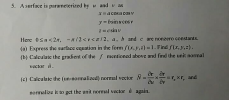 5. A surface is parameterized by u and v as xacosucosv y bsinucosv z csinv Here 0su<2r, -/2<v< /2, a, b and c are nonzero constants. (a) Express the surface equation in the form f(x, y,z) 1. Find f(x,y,2) (b) Calculate the gradient of the f mentioned above and find the unit normal vector n ar ar (c) Calculate the (un-normalized) normal vector N=- X Cu xr, and normalize it to get the unit normal vector n again. Notation and...
a. Sketch the solid S:= {[x; y; z] in |R3 | x,y,z ≥ 0, and 2x...
a. Sketch the solid S:= {[x; y; z] in |R3 | x,y,z ≥ 0, and 2x + 4 y + 2z ≤ 12}. b. Using your calculator evaluate, i) as a triple integral and ii) by the divergence theorem, the volume of S. c. Find i)the surface area of the solid S and ii)the flux thru the top of S due to the vector field F, where F(x,y,z) = ( x + yz , y + xz , z +...
(1 point) Let F(2, y, z) be a vector field, and let S be a closed...
 (1 point) Let F(2, y, z) be a vector field, and let S be a closed surface. Also, let D be the region inside S. Which of the following describe the Divergence Theorem in words? Select all that apply. L A. The outward flux of F(x, y, z) across S equals the triple integral of the divergence of F(2, y, z) on D. IB. The outward flux of F(x, y, z) across S equals the surface integral of the divergence...
Evaluate the surface integral lis(r,y,z) (x, y, z) ds where f(x, y, z) = x +...
 Evaluate the surface integral lis(r,y,z) (x, y, z) ds where f(x, y, z) = x + y + z and o is the is the surface of the cube defined by the inequalities 0 < x < 5,0 Sy < 5 and 0 <3 < 5. [Hint: integrate over each face separately.] 1 f(x, y, z) ds =
Evaluate the line integral f F dr for the vector field F(x, y, z) curve C...
 Evaluate the line integral f F dr for the vector field F(x, y, z) curve C parametrised by Vf (x, y, z) along the with tE [0, 2 r() -(Vt sin(2πt), t cos (2πi), ?) ,
Evaluate the line integral f F dr for the vector field F(x, y, z) curve C parametrised by Vf (x, y, z) along the with tE [0, 2 r() -(Vt sin(2πt), t cos (2πi), ?) ,
Evaluate the line integral f F dr for the vector field F(x, y, z) curve C parametrised by Vf (x, y, z) along the with tE [0, 2 r() -(Vt sin(2πt), t cos (2πi), ?) ,
Consider the vector field F(x, y, z) -(z,2x, 3y) and the surface z- /9 - x2 -y2 (an upper hemisph...
 Consider the vector field F(x, y, z) -(z,2x, 3y) and the surface z- /9 - x2 -y2 (an upper hemisphere of radius 3). (a) Compute the flux of the curl of F across the surface (with upward pointing unit normal vector N). That is, compute actually do the surface integral here. V x F dS. Note: I want you to b) Use Stokes' theorem to compute the integral from part (a) as a circulation integral (c) Use Green's theorem (ie...
r 37. Singular radial field Consider the radial field (x, y, z) F (x2 + y2...
 r 37. Singular radial field Consider the radial field (x, y, z) F (x2 + y2 + z2)1/2" a. Evaluate a surface integral to show that SsFonds = 4ta?, where S is the surface of a sphere of radius a centered at the origin. b. Note that the first partial derivatives of the components of F are undefined at the origin, so the Divergence Theorem does not apply directly. Nevertheless, the flux across the sphere as computed in part (a)...
(1) Let P denote the solid bounded by the surface of the hemisphere z -Vl-r-y? and the cone2y2 and let n denote an outw...
 (1) Let P denote the solid bounded by the surface of the hemisphere z -Vl-r-y? and the cone2y2 and let n denote an outwardly directed unit normal vector. Define the vector field F(x, y, z) = yi + zVJ + 21k. (a) Evaluate the surface integral F n dS directly without using Gauss' Divergence Theorem. (b) Evaluate the triple integral Ш div(F) dV directly without using Gauss' Diver- gence Theorem Note: You should obtain the same answer in (a) and...
1. Let F(x,y,z) =< 32, 5x, – 2y >. Use Stokes's Theorem to evaluate the integral...
 1. Let F(x,y,z) =< 32, 5x, – 2y >. Use Stokes's Theorem to evaluate the integral Scurl F.ds, where S is the part of the paraboloid z = x² + y2 that lies below the plane z = 4 with upward- pointing normal vector.
 first picture is the notation on the test paper
Second picture is the question i would like to solve
thanks~
Notation and convention: r x +y The distance from the origin to the point r [x,y,z] + ê: The unit vector along the direction of r-[x, y,z] (a.e,6)-i.j.):m :The orthonormal bases of a Cartesian coordinate system. for dummy indices Einstein convention: Omitting the summation notation (repeated indices). Examples:ab,-a b, ab a b Notice: No dummy index is allowed to be...
first picture is the notation on the test paper
Second picture is the question i would like to solve
thanks~
Notation and convention: r x +y The distance from the origin to the point r [x,y,z] + ê: The unit vector along the direction of r-[x, y,z] (a.e,6)-i.j.):m :The orthonormal bases of a Cartesian coordinate system. for dummy indices Einstein convention: Omitting the summation notation (repeated indices). Examples:ab,-a b, ab a b Notice: No dummy index is allowed to be...
 5. A surface is parameterized by u and v as xacosucosv y bsinucosv z csinv Here 0su<2r, -/2<v< /2, a, b and c are nonzero constants. (a) Express the surface equation in the form f(x, y,z) 1. Find f(x,y,2) (b) Calculate the gradient of the f mentioned above and find the unit normal vector n ar ar (c) Calculate the (un-normalized) normal vector N=- X Cu xr, and normalize it to get the unit normal vector n again. Notation and...
 (1 point) Let F(2, y, z) be a vector field, and let S be a closed surface. Also, let D be the region inside S. Which of the following describe the Divergence Theorem in words? Select all that apply. L A. The outward flux of F(x, y, z) across S equals the triple integral of the divergence of F(2, y, z) on D. IB. The outward flux of F(x, y, z) across S equals the surface integral of the divergence...
 Evaluate the surface integral lis(r,y,z) (x, y, z) ds where f(x, y, z) = x + y + z and o is the is the surface of the cube defined by the inequalities 0 < x < 5,0 Sy < 5 and 0 <3 < 5. [Hint: integrate over each face separately.] 1 f(x, y, z) ds =
 Evaluate the line integral f F dr for the vector field F(x, y, z) curve C parametrised by Vf (x, y, z) along the with tE [0, 2 r() -(Vt sin(2πt), t cos (2πi), ?) ,
Evaluate the line integral f F dr for the vector field F(x, y, z) curve C parametrised by Vf (x, y, z) along the with tE [0, 2 r() -(Vt sin(2πt), t cos (2πi), ?) ,
Evaluate the line integral f F dr for the vector field F(x, y, z) curve C parametrised by Vf (x, y, z) along the with tE [0, 2 r() -(Vt sin(2πt), t cos (2πi), ?) ,
 Consider the vector field F(x, y, z) -(z,2x, 3y) and the surface z- /9 - x2 -y2 (an upper hemisphere of radius 3). (a) Compute the flux of the curl of F across the surface (with upward pointing unit normal vector N). That is, compute actually do the surface integral here. V x F dS. Note: I want you to b) Use Stokes' theorem to compute the integral from part (a) as a circulation integral (c) Use Green's theorem (ie...
 r 37. Singular radial field Consider the radial field (x, y, z) F (x2 + y2 + z2)1/2" a. Evaluate a surface integral to show that SsFonds = 4ta?, where S is the surface of a sphere of radius a centered at the origin. b. Note that the first partial derivatives of the components of F are undefined at the origin, so the Divergence Theorem does not apply directly. Nevertheless, the flux across the sphere as computed in part (a)...
 (1) Let P denote the solid bounded by the surface of the hemisphere z -Vl-r-y? and the cone2y2 and let n denote an outwardly directed unit normal vector. Define the vector field F(x, y, z) = yi + zVJ + 21k. (a) Evaluate the surface integral F n dS directly without using Gauss' Divergence Theorem. (b) Evaluate the triple integral Ш div(F) dV directly without using Gauss' Diver- gence Theorem Note: You should obtain the same answer in (a) and...
 1. Let F(x,y,z) =< 32, 5x, – 2y >. Use Stokes's Theorem to evaluate the integral Scurl F.ds, where S is the part of the paraboloid z = x² + y2 that lies below the plane z = 4 with upward- pointing normal vector.
Most questions answered within 3 hours.
-
Where is the error in this code sequence?
String s1 = "Hello";
String s2 = "ello";...
asked 10 months ago -
Financial data for Joel de Paris, Inc., for last year
follow:
Joel de Paris, Inc.
Balance...
asked 10 months ago -
Consider this reaction:
Al2(SO4)3 (aq)+ BaCl3
(aq) Al2Cl6 (aq)- +
3BaSO4(s) . What is the...
asked 10 months ago -
Suppose that Savneet is considering increasing her
recent random sample from 20 car rentals to 40...
asked 10 months ago -
Trucks arrive at an unloading terminal at an average rate of 120
per hour.
Trucks arrive...
asked 10 months ago -
Why are methanol and ethanol completely soluble in water while
octanol is not very little soluble....
asked 10 months ago -
A facilities manager at a university reads in a research report
that the mean amount of...
asked 10 months ago -
When the CuSO4 is rehydrated by adding water to the anhydrous
compound, is this an endothermic...
asked 10 months ago -
A ray of sunlight is passing from diamond into crown glass; the
angle of incidence is...
asked 10 months ago -
A block of mass 0.249 kg is placed on top of a light, vertical
spring of...
asked 10 months ago -
how do the kidneys compensate in the presences of acidosis
a) trigger hyperventilate
b) reserve acid...
asked 10 months ago -
Question 501 pts
The rental rate of capital to the firm increases. Which of the
following...
asked 10 months ago