![Question 5 [2 + 2 + 2 + 3 + 3 = 12 marks ] (a) Briefly explain why we cannot find simultaneous eigenfunctions of Lg, Ly and L](http://img.homeworklib.com/images/e85253c1-83a7-4da8-9791-f1c2265d3879.png?x-oss-process=image/resize,w_560)
Homework Answers
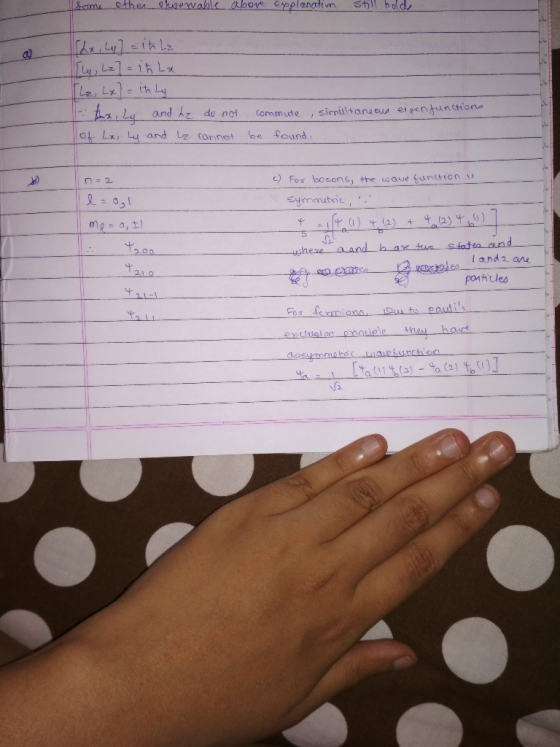

[ 2 + 2 + 2 + 3 + 3 = 12 marks ] Question 5 (a) Briefly explain why we cannot find simultaneous eigenfunctions of Lt, L...
 [ 2 + 2 + 2 + 3 + 3 = 12 marks ] Question 5 (a) Briefly explain why we cannot find simultaneous eigenfunctions of Lt, L, and Lz. An electron in a hydrogen atom is in the n = 2 state. Ignoring spin, write down the list of possible quantum numbers {n, l, m} (b) For two qubits briefly explain, giving examples, the difference between a product state and an entangled state (c) Consider a system of identical...
please write a detailed solution to each part of this problem you may refer to some of hints given below Short P...
 please write a detailed solution to each part of this
problem you may refer to some of hints given below
Short Problem 2 Let's explore some quantum logic gate identities a) What is the single gate that is equivalent to the following three single qubit gates? b) Show that the SWAP operator, that exchanges the state of two qubits, can be created with 3 CNOT gates. Give the rail diagram that puts this into effect. la) b) la) Rail diagram...
please write a detailed solution to each part of this
problem you may refer to some of hints given below
Short Problem 2 Let's explore some quantum logic gate identities a) What is the single gate that is equivalent to the following three single qubit gates? b) Show that the SWAP operator, that exchanges the state of two qubits, can be created with 3 CNOT gates. Give the rail diagram that puts this into effect. la) b) la) Rail diagram...
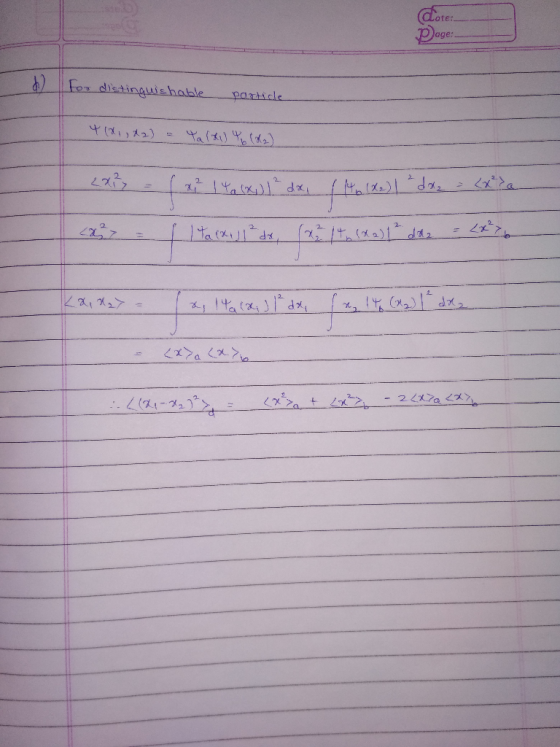
[1 44= 9 marks ] Question 5 Consider two identical particles in 1D which exist in single-particle (normalised) (x), and...
 [1 44= 9 marks ] Question 5 Consider two identical particles in 1D which exist in single-particle (normalised) (x), and are in such close proximity they can be considered as indistinguishable. wave functions /a(x) and (a) Write down the symmetrised two-particle wave function for the case where the particles are bosons (VB) and the case where the particles are fermions (Vp). (b) Show that the expectation value (xjr2)B,F is given by: (T122) в,F — (а:)a (х)ь + dx x y:(")...
THE PREVIOUSLY ANSWERED SOLUTION TO THIS PROBLEM WAS INCORRECT. PLEASE DO NOT JUST COPY AND PASTE THE SAME SOLUTION. I NEED AN ACTUAL DERIVATION WITH TRANSFORMATIONS. NOT JUST A WORD EXPLANATION. 5)...
 THE PREVIOUSLY ANSWERED SOLUTION TO THIS PROBLEM WAS INCORRECT.
PLEASE DO NOT JUST COPY AND PASTE THE SAME SOLUTION. I NEED AN
ACTUAL DERIVATION WITH TRANSFORMATIONS. NOT JUST A WORD
EXPLANATION.
5) In additional to single qubit gates, a quantum processor requires a two-qubit gate, such as controlled-NOT (CNOT) or controlled-Z (CZ) gates. Demonstrate that the CZ gate can be obtained as the transformation exp(-(in/4)σ(1)σ(2) followed by exp( (ir/4)t"4°) and exp((n/4)σ(1)σ(2)). There resulting gate is different from its standard definition...
THE PREVIOUSLY ANSWERED SOLUTION TO THIS PROBLEM WAS INCORRECT.
PLEASE DO NOT JUST COPY AND PASTE THE SAME SOLUTION. I NEED AN
ACTUAL DERIVATION WITH TRANSFORMATIONS. NOT JUST A WORD
EXPLANATION.
5) In additional to single qubit gates, a quantum processor requires a two-qubit gate, such as controlled-NOT (CNOT) or controlled-Z (CZ) gates. Demonstrate that the CZ gate can be obtained as the transformation exp(-(in/4)σ(1)σ(2) followed by exp( (ir/4)t"4°) and exp((n/4)σ(1)σ(2)). There resulting gate is different from its standard definition...
[ 2 + 3 + 3 + 5 = 13 marks ] Question 4 (a) For the case of two qubits, briefly explain the main difference between pro...
 [ 2 + 3 + 3 + 5 = 13 marks ] Question 4 (a) For the case of two qubits, briefly explain the main difference between product states and entangled states. Provide one example of each. (b) Show that the identity between spin angular momentum operators S+S- = S2- S2 ± hS, holds. Data: S S tiSy, [Se, Sy] = ihS2, [Sy, S2] = ihS, [S2, S = ihSy. (c) An s = 1/2 particle at t =0 is...
Problem 1. Consider a system of three identical particles. Each particle has 5 quantum states with...
 Problem 1. Consider a system of three identical particles. Each particle has 5 quantum states with energies 0, ε, 2E, 3E, 4E. For distinguishable particles, calculate the number of quantum states where (1) three particles are in the same single-particle state, (2) only two particles are in the same single-particle state, and (3) no two particles are in the same single-particle state. Problem 2. For fermions, (1) calculate the total number of quantum states, and (2) the number of states...
I need help with normalizing the piecewise function. I tried it already, but I have a...
 I need help with normalizing the piecewise function. I
tried it already, but I have a feeling that my answer is completely
off.
2. Normalisation, expectation values, and standard deviation Consider a particle in the state described by the wave function, 0; A(); A ); <0 0 < x a< <a, <b, ( 0; where A, a, and b are real, positive constants. (a) Discuss any features of the wave function that appear problematic. (b) Determine A by normalising the...
I need help with normalizing the piecewise function. I
tried it already, but I have a feeling that my answer is completely
off.
2. Normalisation, expectation values, and standard deviation Consider a particle in the state described by the wave function, 0; A(); A ); <0 0 < x a< <a, <b, ( 0; where A, a, and b are real, positive constants. (a) Discuss any features of the wave function that appear problematic. (b) Determine A by normalising the...
Extra Credit (3 points to Mideterm-2) Q1. A particle is described by the wave function (x)...
 Extra Credit (3 points to Mideterm-2) Q1. A particle is described by the wave function (x) b(a2-x2) for -a sx s a and (x) 0 for x -a and x +a, where a and b are positive real constants. (a) Using the normalization condition, find b in terms a. (b) What is the probability to find the particle at x = +a/2 in a small interval ofwidth 0.01 a ? (c) What is the probability for the particle to be...
Please answer the question in full and show all work. We have seen that the absolute...
 Please answer the question in full and show all work.
We have seen that the absolute square of the wave function VI,t) can be interpreted as the probability density for the location of the particle at time t. We have also seen that a particle's quantum state can be represented as a linear combination of eigenstates of a physical observable Q: V) SIT) where Q n ) = qn|n) and represents the probability to find the particle in the eigenstate...
Please answer the question in full and show all work.
We have seen that the absolute square of the wave function VI,t) can be interpreted as the probability density for the location of the particle at time t. We have also seen that a particle's quantum state can be represented as a linear combination of eigenstates of a physical observable Q: V) SIT) where Q n ) = qn|n) and represents the probability to find the particle in the eigenstate...
2. A particle of mass m in the infinite square well of width a at time...
 2. A particle of mass m in the infinite square well of width a at time 1 - 0 has wave function that is an equal weight mixture of the two lowest n= 1,2 energy stationary states: (x,0) - C[4,(x)+42(x)] (a) Normalize the wave function. Hints: 1. Exploit the orthonormality of W, 2. Recall that if a wave function is normalized at t = 0, it stays normalized. (b) Find '(x, t) and (x,1)1at a later time 1>0. Express Y*...
 [ 2 + 2 + 2 + 3 + 3 = 12 marks ] Question 5 (a) Briefly explain why we cannot find simultaneous eigenfunctions of Lt, L, and Lz. An electron in a hydrogen atom is in the n = 2 state. Ignoring spin, write down the list of possible quantum numbers {n, l, m} (b) For two qubits briefly explain, giving examples, the difference between a product state and an entangled state (c) Consider a system of identical...
 please write a detailed solution to each part of this
problem you may refer to some of hints given below
Short Problem 2 Let's explore some quantum logic gate identities a) What is the single gate that is equivalent to the following three single qubit gates? b) Show that the SWAP operator, that exchanges the state of two qubits, can be created with 3 CNOT gates. Give the rail diagram that puts this into effect. la) b) la) Rail diagram...
please write a detailed solution to each part of this
problem you may refer to some of hints given below
Short Problem 2 Let's explore some quantum logic gate identities a) What is the single gate that is equivalent to the following three single qubit gates? b) Show that the SWAP operator, that exchanges the state of two qubits, can be created with 3 CNOT gates. Give the rail diagram that puts this into effect. la) b) la) Rail diagram...
 [1 44= 9 marks ] Question 5 Consider two identical particles in 1D which exist in single-particle (normalised) (x), and are in such close proximity they can be considered as indistinguishable. wave functions /a(x) and (a) Write down the symmetrised two-particle wave function for the case where the particles are bosons (VB) and the case where the particles are fermions (Vp). (b) Show that the expectation value (xjr2)B,F is given by: (T122) в,F — (а:)a (х)ь + dx x y:(")...
 THE PREVIOUSLY ANSWERED SOLUTION TO THIS PROBLEM WAS INCORRECT.
PLEASE DO NOT JUST COPY AND PASTE THE SAME SOLUTION. I NEED AN
ACTUAL DERIVATION WITH TRANSFORMATIONS. NOT JUST A WORD
EXPLANATION.
5) In additional to single qubit gates, a quantum processor requires a two-qubit gate, such as controlled-NOT (CNOT) or controlled-Z (CZ) gates. Demonstrate that the CZ gate can be obtained as the transformation exp(-(in/4)σ(1)σ(2) followed by exp( (ir/4)t"4°) and exp((n/4)σ(1)σ(2)). There resulting gate is different from its standard definition...
THE PREVIOUSLY ANSWERED SOLUTION TO THIS PROBLEM WAS INCORRECT.
PLEASE DO NOT JUST COPY AND PASTE THE SAME SOLUTION. I NEED AN
ACTUAL DERIVATION WITH TRANSFORMATIONS. NOT JUST A WORD
EXPLANATION.
5) In additional to single qubit gates, a quantum processor requires a two-qubit gate, such as controlled-NOT (CNOT) or controlled-Z (CZ) gates. Demonstrate that the CZ gate can be obtained as the transformation exp(-(in/4)σ(1)σ(2) followed by exp( (ir/4)t"4°) and exp((n/4)σ(1)σ(2)). There resulting gate is different from its standard definition...
 [ 2 + 3 + 3 + 5 = 13 marks ] Question 4 (a) For the case of two qubits, briefly explain the main difference between product states and entangled states. Provide one example of each. (b) Show that the identity between spin angular momentum operators S+S- = S2- S2 ± hS, holds. Data: S S tiSy, [Se, Sy] = ihS2, [Sy, S2] = ihS, [S2, S = ihSy. (c) An s = 1/2 particle at t =0 is...
 Problem 1. Consider a system of three identical particles. Each particle has 5 quantum states with energies 0, ε, 2E, 3E, 4E. For distinguishable particles, calculate the number of quantum states where (1) three particles are in the same single-particle state, (2) only two particles are in the same single-particle state, and (3) no two particles are in the same single-particle state. Problem 2. For fermions, (1) calculate the total number of quantum states, and (2) the number of states...
 I need help with normalizing the piecewise function. I
tried it already, but I have a feeling that my answer is completely
off.
2. Normalisation, expectation values, and standard deviation Consider a particle in the state described by the wave function, 0; A(); A ); <0 0 < x a< <a, <b, ( 0; where A, a, and b are real, positive constants. (a) Discuss any features of the wave function that appear problematic. (b) Determine A by normalising the...
I need help with normalizing the piecewise function. I
tried it already, but I have a feeling that my answer is completely
off.
2. Normalisation, expectation values, and standard deviation Consider a particle in the state described by the wave function, 0; A(); A ); <0 0 < x a< <a, <b, ( 0; where A, a, and b are real, positive constants. (a) Discuss any features of the wave function that appear problematic. (b) Determine A by normalising the...
 Extra Credit (3 points to Mideterm-2) Q1. A particle is described by the wave function (x) b(a2-x2) for -a sx s a and (x) 0 for x -a and x +a, where a and b are positive real constants. (a) Using the normalization condition, find b in terms a. (b) What is the probability to find the particle at x = +a/2 in a small interval ofwidth 0.01 a ? (c) What is the probability for the particle to be...
 Please answer the question in full and show all work.
We have seen that the absolute square of the wave function VI,t) can be interpreted as the probability density for the location of the particle at time t. We have also seen that a particle's quantum state can be represented as a linear combination of eigenstates of a physical observable Q: V) SIT) where Q n ) = qn|n) and represents the probability to find the particle in the eigenstate...
Please answer the question in full and show all work.
We have seen that the absolute square of the wave function VI,t) can be interpreted as the probability density for the location of the particle at time t. We have also seen that a particle's quantum state can be represented as a linear combination of eigenstates of a physical observable Q: V) SIT) where Q n ) = qn|n) and represents the probability to find the particle in the eigenstate...
 2. A particle of mass m in the infinite square well of width a at time 1 - 0 has wave function that is an equal weight mixture of the two lowest n= 1,2 energy stationary states: (x,0) - C[4,(x)+42(x)] (a) Normalize the wave function. Hints: 1. Exploit the orthonormality of W, 2. Recall that if a wave function is normalized at t = 0, it stays normalized. (b) Find '(x, t) and (x,1)1at a later time 1>0. Express Y*...
Most questions answered within 3 hours.
-
Where is the error in this code sequence?
String s1 = "Hello";
String s2 = "ello";...
asked 11 months ago -
Financial data for Joel de Paris, Inc., for last year
follow:
Joel de Paris, Inc.
Balance...
asked 11 months ago -
Consider this reaction:
Al2(SO4)3 (aq)+ BaCl3
(aq) Al2Cl6 (aq)- +
3BaSO4(s) . What is the...
asked 11 months ago -
Suppose that Savneet is considering increasing her
recent random sample from 20 car rentals to 40...
asked 11 months ago -
Trucks arrive at an unloading terminal at an average rate of 120
per hour.
Trucks arrive...
asked 11 months ago -
Why are methanol and ethanol completely soluble in water while
octanol is not very little soluble....
asked 11 months ago -
A facilities manager at a university reads in a research report
that the mean amount of...
asked 11 months ago -
When the CuSO4 is rehydrated by adding water to the anhydrous
compound, is this an endothermic...
asked 11 months ago -
A ray of sunlight is passing from diamond into crown glass; the
angle of incidence is...
asked 11 months ago -
A block of mass 0.249 kg is placed on top of a light, vertical
spring of...
asked 11 months ago -
how do the kidneys compensate in the presences of acidosis
a) trigger hyperventilate
b) reserve acid...
asked 11 months ago -
Question 501 pts
The rental rate of capital to the firm increases. Which of the
following...
asked 11 months ago