
Homework Answers
Solution:
By default Accelerometers are sensitive to the difference between the linear acceleration of the sensor and the local gravitational field.The data sheet for any accelerometer will provide the positive x, y, and z axes on the sensor package and, by convention, these are defined so that a linear acceleration aligned in the direction of these axes will give a positive accelerometer output. However A gravitational field component aligned along the same axes directions will result in a negative reading on the accelerometer.
Measurement
Procedure:
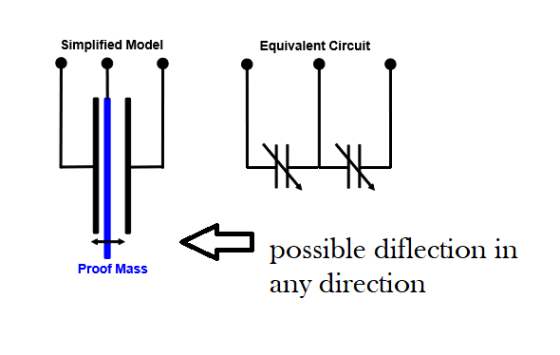
The acceleration is measured by the deflection of proof mass from
it's actual position.The upper proof mass is suspended by the
restoring springs. Both a gravitational field directed to the left
and a linear acceleration of the package to the right will deflect
the proof mass to the left.
The deflection of the proof mass is measured from the change in
capacitance between the fingers of the proof mass and the sensing
plates.A simplified transducer model and equivalent electrical
circuit are shown
Axis orientation
example:
The accelerometer used in a smartphone had the following
orientation aligned in the circuit board
• The x-axis is aligned along the body axis of the smartphone
• The z-axis points downwards so that it is aligned with gravity
when the smartphone is flat on a table
• The y-axis is aligned at right angles to both the x and z axes so
that the three axes form a right handed coordinate system.
Add Answer to:
QUESTION 5 Describe how one can use accelerometers to determine orientation. What orientation would be measured?...
Describe what input- and output-orientation is in the context of efficiency measurement. When would the two orientation...
 Describe what input- and output-orientation is in the context of efficiency measurement. When would the two orientations yield identical answers? And are there cases when one should use one but not the other (provide examples)?
List & describe in detail the topics that should be included in a department-specific orientation for...
List & describe in detail the topics that should be included in a department-specific orientation for new coding staff 2. Choose one of the topics and suppose it was not covered during the orientation process and determine what would/could happen. Explain & elaborate. 3. Develop a plan of activities for a 1-day orientation program for new coding staff, assuming two 3-hour sessions. Specify the activities that would occur at the various times of day (e.g., 8AM-9AM or 1PM-2-PM). This can...
How could one use non-financial measures as an employee incentive? How would they be measured?
How could one use non-financial measures as an employee incentive? How would they be measured?
Consider a research question on HIV or Pre-exposure prophylaxis and what qualitative method you would use...
Consider a research question on HIV or Pre-exposure prophylaxis and what qualitative method you would use to answer that question. How would you structure that research project? What sampling framework would you use to recruit participants? Why would this be the appropriate strategy? What data would result from this study? What design considerations or limitations might you need to overcome?
1. What is the difference between heterosexism and homophobia? 2. Can homosexuals change their sexual orientation...
 1. What is the difference between heterosexism and homophobia? 2. Can homosexuals change their sexual orientation if they want to? And if 3. Why do researchers generally recommend using the term "sexual 4. Should discrimination based on sexual orientation be outlawed to the 5. If people believe in a literal interpretation of the Bible, is it prejudiced so, can heterosexuals do the same? orientation" rather than "sexual preference"? same extent as discrimination based on race and sex? for them to......
Write units wherever necessary. Describe in 3-4 sentences how you would use Ohms Law to determine...
Write units wherever necessary. Describe in 3-4 sentences how you would use Ohms Law to determine the resistance of an unknown resistor. Tabulate your Voltage and Current values on Excel. Use this data to graphically determine the resistance value. Make a new observation table as shown below to summarize your results. Measured resistance value Graphical resistance value
How would I use DNA methylation analysis? What are the steps? Can someone describe to me...
How would I use DNA methylation analysis? What are the steps? Can someone describe to me and a detailed message? I’m trying to get a better understanding of this topic.
Please typing the answer don't use handwriting. Chapter 2: Research Methods 1. Describe a scenario where you would use an observational method, a correlational method, and an experimental meth...
 Please typing the answer don't use handwriting.
Chapter 2: Research Methods 1. Describe a scenario where you would use an observational method, a correlational method, and an experimental method to examine one research question. List the overall research question of interest. Then describe how each of these methods could be used to address this research question. Be sure to describe each method in as much detail as possible (and don't forget about those key terms!). Chapter 6: Memory 2. Describe...
Please typing the answer don't use handwriting.
Chapter 2: Research Methods 1. Describe a scenario where you would use an observational method, a correlational method, and an experimental method to examine one research question. List the overall research question of interest. Then describe how each of these methods could be used to address this research question. Be sure to describe each method in as much detail as possible (and don't forget about those key terms!). Chapter 6: Memory 2. Describe...
Define the term myogenic index and describe how it is measured experimentally. What cellular process can...
Define the term myogenic index and describe how it is measured experimentally. What cellular process can be assessed using myogenic index measurements? What does an increase in myogenic index tell you? Explain.
Describe the differences between correlations and regressions. Can you describe situations where you would use one...
Describe the differences between correlations and regressions. Can you describe situations where you would use one of these over the over, and why you would do so?
 Describe what input- and output-orientation is in the context of efficiency measurement. When would the two orientations yield identical answers? And are there cases when one should use one but not the other (provide examples)?
 1. What is the difference between heterosexism and homophobia? 2. Can homosexuals change their sexual orientation if they want to? And if 3. Why do researchers generally recommend using the term "sexual 4. Should discrimination based on sexual orientation be outlawed to the 5. If people believe in a literal interpretation of the Bible, is it prejudiced so, can heterosexuals do the same? orientation" rather than "sexual preference"? same extent as discrimination based on race and sex? for them to......
 Please typing the answer don't use handwriting.
Chapter 2: Research Methods 1. Describe a scenario where you would use an observational method, a correlational method, and an experimental method to examine one research question. List the overall research question of interest. Then describe how each of these methods could be used to address this research question. Be sure to describe each method in as much detail as possible (and don't forget about those key terms!). Chapter 6: Memory 2. Describe...
Please typing the answer don't use handwriting.
Chapter 2: Research Methods 1. Describe a scenario where you would use an observational method, a correlational method, and an experimental method to examine one research question. List the overall research question of interest. Then describe how each of these methods could be used to address this research question. Be sure to describe each method in as much detail as possible (and don't forget about those key terms!). Chapter 6: Memory 2. Describe...
Most questions answered within 3 hours.
-
Where is the error in this code sequence?
String s1 = "Hello";
String s2 = "ello";...
asked 10 months ago -
Financial data for Joel de Paris, Inc., for last year
follow:
Joel de Paris, Inc.
Balance...
asked 10 months ago -
Consider this reaction:
Al2(SO4)3 (aq)+ BaCl3
(aq) Al2Cl6 (aq)- +
3BaSO4(s) . What is the...
asked 10 months ago -
Suppose that Savneet is considering increasing her
recent random sample from 20 car rentals to 40...
asked 10 months ago -
Trucks arrive at an unloading terminal at an average rate of 120
per hour.
Trucks arrive...
asked 10 months ago -
Why are methanol and ethanol completely soluble in water while
octanol is not very little soluble....
asked 10 months ago -
A facilities manager at a university reads in a research report
that the mean amount of...
asked 10 months ago -
When the CuSO4 is rehydrated by adding water to the anhydrous
compound, is this an endothermic...
asked 10 months ago -
A ray of sunlight is passing from diamond into crown glass; the
angle of incidence is...
asked 10 months ago -
A block of mass 0.249 kg is placed on top of a light, vertical
spring of...
asked 10 months ago -
how do the kidneys compensate in the presences of acidosis
a) trigger hyperventilate
b) reserve acid...
asked 10 months ago -
Question 501 pts
The rental rate of capital to the firm increases. Which of the
following...
asked 10 months ago