(II) A skier moves down a 12° slope at constant speed. What can you say about...
(II) A skier moves down a 12° slope at constant speed. What can you say about the coefficient of friction,  Assume the speed is low enough that air resistance can be ignored.
Homework Answers
Use Newton’s second law of motion and the equation for frictional force to calculate the coefficient of kinetic friction.
According to Newton’s second law, the net force acting on a box is equal to the product of mass of the box and its acceleration. Mathematically it is given as,

Here, is the mass of the box and is the acceleration of the box.
The figure represents the free body diagram of the skier moving down the slope and the forces acting on him.
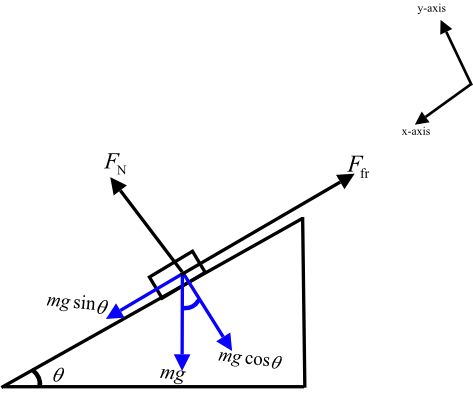
Since the skier is moving down, the friction force acting on him is,

Here,  is the frictional force acting on the box,
  is the coefficient of kinetic friction, and
  is the normal force acting on the box.
Apply Newton’s second law along direction.

Substitute for
for in equation
 .
.

Apply Newton’s second law along direction.

Since the skier is moving with a constant speed so the acceleration of the skier along x and y-directions will be zero.

Now equate the equation and
and .
.

Substitute for
for and solve for
 .
.

Thus, the coefficient of kinetic friction is . This value of coefficient of kinetic friction is very small.
Add Answer to:
(II) A skier moves down a 12° slope at constant speed. What can you say about...
At constant velocity, a skier is making turns as he skis down a slope. If the...
At constant velocity, a skier is making turns as he skis down a slope. If the coefficient of kinetic friction is 0.10, what is the total length of the skier’s tracks as he drops a vertical distance of 50.0 m down a 30°degree slope at constant velocity?
A skier going down a slope of angle θ below the horizontal is opposed by a...
A skier going down a slope of angle θ below the horizontal is opposed by a turbulent drag force that the air exerts on the skier and by a kinetic friction force that the snow exerts on the skier. The mass of the skier is m. Determine the terminal speed assuming that the coefficient of kinetic friction between the skis and the snow is μ, the density of air is ρ, the skier's frontal area is A, and the drag...
Consider a skier heading down a 8.5° slope. Assume the coefficient of friction for waxed wood...
Consider a skier heading down a 8.5° slope. Assume the coefficient of friction for waxed wood on wet snow is μk=0.10 and use a coordinate system in which down the slope is positive. θ = 8.5 ° a) Calculate the acceleration of the skier in m/s2. b) Find the angle of the slope down which this skier could coast at a constant velocity in degrees.
In downhill speed skiing a skier is retarded by both the air drag force on the...
In downhill speed skiing a skier is retarded by both the air drag force on the body and the kinetic frictional force on the skis. Suppose the slope angle is θ = 32.5°, the snow is dry snow with a coefficient of kinetic friction μk = 0.0400, the mass of the skier and equipment is m = 78.5 kg, the cross-sectional area of the (tucked) skier is A = 1.30 m2, the drag coefficient is C = 0.150, and the...
What is the terminal speed for a 79 kg skier going down a 37 ∘ snow-covered...
What is the terminal speed for a 79 kg skier going down a 37 ∘ snow-covered slope on wooden skis μk= 0.060? Assume that the skier is 1.8 m tall and 0.50 m wide. Assume the skier's drag coefficient is 0.80.
What is the terminal speed for an 85 kg skier going down a 35 ∘ snow-covered...
What is the terminal speed for an 85 kg skier going down a 35 ∘ snow-covered slope on wooden skis μk= 0.060?Assume that the skier is 1.8 m tall and 0.50 m wide. Assume the skier's drag coefficient is 0.80.
A skier starts down a 28 ∘ slope. After a vertical drop of 35 m ,...
A skier starts down a 28 ∘ slope. After a vertical drop of 35 m , the slope temporarily levels out and then drops at 18 ∘ an additional 40 m vertically before leveling out again. The coefficient of kinetic friction on both slopes is 0.15, the level stretches is frictionless. a)What is the skier's speed on the higher level stretch? b)What is the skier's speed on the lower level stretch?
A skier slides down a slope at an incline of 30 degrees. It takes 12 s...
A skier slides down a slope at an incline of 30 degrees. It takes 12 s for the skier to reach the bottomr of the slope. Assume motion is frictionless descent. How long is the slope? What is the skier’s velocity when he reaches the bottom of the slope?
••28 A 40 kg skier skis directly down a frictionless slope angled at 10° to the...
 ••28 A 40 kg skier skis directly down a frictionless slope angled at 10° to the horizontal. Assume the skier moves in the negative direction of an x axis along the slope. A wind force with component F, acts on the skier. What is F, if the mag- nitude of the skier's velocity is (a) constant, (b) increasing at a rate of 1.0 m/s2, and (c) increasing at a rate of 2.0 m/s??
A 63 kg skier skis directly down a frictionless slope angled at 20° to the horizontal....
A 63 kg skier skis directly down a frictionless slope angled at 20° to the horizontal. Assume the skier moves in the negative direction of an x axis along the slope. A wind force with component Fx acts on the skier. (Indicate the direction with the sign of your answer.) (a) What is Fx if the magnitude of the skier's velocity is constant? N (b) What is Fx if the magnitude of the skier's velocity is increasing at a rate...
 ••28 A 40 kg skier skis directly down a frictionless slope angled at 10° to the horizontal. Assume the skier moves in the negative direction of an x axis along the slope. A wind force with component F, acts on the skier. What is F, if the mag- nitude of the skier's velocity is (a) constant, (b) increasing at a rate of 1.0 m/s2, and (c) increasing at a rate of 2.0 m/s??
Most questions answered within 3 hours.
-
Where is the error in this code sequence?
String s1 = "Hello";
String s2 = "ello";...
asked 11 months ago -
Financial data for Joel de Paris, Inc., for last year
follow:
Joel de Paris, Inc.
Balance...
asked 11 months ago -
Consider this reaction:
Al2(SO4)3 (aq)+ BaCl3
(aq) Al2Cl6 (aq)- +
3BaSO4(s) . What is the...
asked 11 months ago -
Suppose that Savneet is considering increasing her
recent random sample from 20 car rentals to 40...
asked 11 months ago -
Trucks arrive at an unloading terminal at an average rate of 120
per hour.
Trucks arrive...
asked 11 months ago -
Why are methanol and ethanol completely soluble in water while
octanol is not very little soluble....
asked 11 months ago -
A facilities manager at a university reads in a research report
that the mean amount of...
asked 11 months ago -
When the CuSO4 is rehydrated by adding water to the anhydrous
compound, is this an endothermic...
asked 11 months ago -
A ray of sunlight is passing from diamond into crown glass; the
angle of incidence is...
asked 11 months ago -
A block of mass 0.249 kg is placed on top of a light, vertical
spring of...
asked 11 months ago -
how do the kidneys compensate in the presences of acidosis
a) trigger hyperventilate
b) reserve acid...
asked 11 months ago -
Question 501 pts
The rental rate of capital to the firm increases. Which of the
following...
asked 11 months ago