Arrange the following alcohols according to increasing rates of their acid-catalyzed dehydration to an alkene (slowest rate at top).

Homework Answers

Add Answer to:
Arrange the following alcohols according to increasing rates of
their acid-catalyzed dehydration to an alkene (slowest...
Arrange the following alcohols according to increasing rates of their acid-catalyzed dehydration to an alkene (slowest...
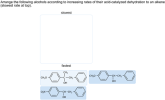 Arrange the following alcohols according to increasing rates of their acid-catalyzed dehydration to an alkene (slowest rate at top).
What is the product produced in the following reaction? In the following acid catalyzed dehydration reaction,...
What is the product produced in the following reaction? In the following acid catalyzed dehydration reaction, what is the alcohol that is most likely to give an alkene with a rearranged carbon skeleton? (Hint: a hydride shift does not rearrange the carbon skeleton) Arrange the given alcohols in order of reactivity in an acid-catalyzed dehydration reaction.
Predict the major products of acid-catalyzed dehydration of the following alcohols a. 2-methylpropan-1-ol
Predict the major products of acid-catalyzed dehydration of the following alcohols a. 2-methylpropan-1-ol
As a method for the preparation of alkenes, a weakness in the acid-catalyzed dehydration of alcohols...
 As a method for the preparation of alkenes, a weakness in the acid-catalyzed dehydration of alcohols is that the initially formed Ikene (or mixture of alkenes) sometimes isomerizes under the conditions of its formation. Write a stepwise mechanism for the reaction: 30+
Acid-catalyzed dehydration of secondary and tertiary alcohols proceeds through an E1 mechanism.
 Acid-catalyzed dehydration of secondary and tertiary alcohols
proceeds through an E1 mechanism. The first step is the protonation
of the alcohol oxygen to form an oxonium ion. Dehydration of
3-methyl-2-butanol forms one major and two minor organic products.
Draw the structures, including hydrogen atoms, of the three organic
products of this reaction.
Acid-catalyzed dehydration of secondary and tertiary alcohols
proceeds through an E1 mechanism. The first step is the protonation
of the alcohol oxygen to form an oxonium ion. Dehydration of
3-methyl-2-butanol forms one major and two minor organic products.
Draw the structures, including hydrogen atoms, of the three organic
products of this reaction.
This is an acid catalyzed dehydration of alcohols mechanism that I am supposed to provide the product for and I do not u...
 This is an acid catalyzed dehydration of alcohols mechanism that
I am supposed to provide the product for and I do not understand
the steps any help would be appreciated. This is supposed to be an
E1 reaction
2 Мео H2SO4 heat ni
This is an acid catalyzed dehydration of alcohols mechanism that
I am supposed to provide the product for and I do not understand
the steps any help would be appreciated. This is supposed to be an
E1 reaction
2 Мео H2SO4 heat ni
Acid-catalyzed dehydration of secondary and tertiary alcohols proceeds through an E1 mechanism. The first step is...
Acid-catalyzed dehydration of secondary and tertiary alcohols proceeds through an E1 mechanism. The first step is the protonation of the alcohol oxygen to form an oxonium ion. Dehydration of 3-methyl-2-butanol forms one major and two minor organic products. Draw the structures, including hydrogen atoms, of the three organic products of this reaction. 3-methyl-2-butanol ------->an oxonium ion
Rank the reactivity of the following toward H_2SO_4/delta catalyzed dehydration, from 1 (fastest) to 4 (slowest).
 Rank the reactivity of the following toward H_2SO_4/delta catalyzed dehydration, from 1 (fastest) to 4 (slowest).
Arrange the following alkyl iodides according to increasing rates of their SN1 reactions.
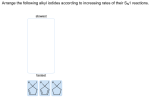 Arrange the following alkyl iodides according to increasing rates of their SN1 reactions.
HELP 12. Which of the following is/are the major products of reaction below) co > e) 13. The acid catalyzed dehy...
 HELP
12. Which of the following is/are the major products of reaction below) co > e) 13. The acid catalyzed dehydration of the alcohol below gives a major product which results from a carbocation rearrangement. Identify the major product. H2504) heat 14. What is the intermediate in the following reaction? D + Bra CH2Cle> 9) ol) 15. a) b) 2) d) The hydrohalogenation reaction can be described as: Anti-Markovnikov addition of halogen to an alkene Anti-Markovnikov addition of HX to...
HELP
12. Which of the following is/are the major products of reaction below) co > e) 13. The acid catalyzed dehydration of the alcohol below gives a major product which results from a carbocation rearrangement. Identify the major product. H2504) heat 14. What is the intermediate in the following reaction? D + Bra CH2Cle> 9) ol) 15. a) b) 2) d) The hydrohalogenation reaction can be described as: Anti-Markovnikov addition of halogen to an alkene Anti-Markovnikov addition of HX to...
 Arrange the following alcohols according to increasing rates of their acid-catalyzed dehydration to an alkene (slowest rate at top).
 As a method for the preparation of alkenes, a weakness in the acid-catalyzed dehydration of alcohols is that the initially formed Ikene (or mixture of alkenes) sometimes isomerizes under the conditions of its formation. Write a stepwise mechanism for the reaction: 30+
 This is an acid catalyzed dehydration of alcohols mechanism that
I am supposed to provide the product for and I do not understand
the steps any help would be appreciated. This is supposed to be an
E1 reaction
2 Мео H2SO4 heat ni
This is an acid catalyzed dehydration of alcohols mechanism that
I am supposed to provide the product for and I do not understand
the steps any help would be appreciated. This is supposed to be an
E1 reaction
2 Мео H2SO4 heat ni
 Rank the reactivity of the following toward H_2SO_4/delta catalyzed dehydration, from 1 (fastest) to 4 (slowest).
 Arrange the following alkyl iodides according to increasing rates of their SN1 reactions.
 HELP
12. Which of the following is/are the major products of reaction below) co > e) 13. The acid catalyzed dehydration of the alcohol below gives a major product which results from a carbocation rearrangement. Identify the major product. H2504) heat 14. What is the intermediate in the following reaction? D + Bra CH2Cle> 9) ol) 15. a) b) 2) d) The hydrohalogenation reaction can be described as: Anti-Markovnikov addition of halogen to an alkene Anti-Markovnikov addition of HX to...
HELP
12. Which of the following is/are the major products of reaction below) co > e) 13. The acid catalyzed dehydration of the alcohol below gives a major product which results from a carbocation rearrangement. Identify the major product. H2504) heat 14. What is the intermediate in the following reaction? D + Bra CH2Cle> 9) ol) 15. a) b) 2) d) The hydrohalogenation reaction can be described as: Anti-Markovnikov addition of halogen to an alkene Anti-Markovnikov addition of HX to...
Most questions answered within 3 hours.
-
Where is the error in this code sequence?
String s1 = "Hello";
String s2 = "ello";...
asked 10 months ago -
Financial data for Joel de Paris, Inc., for last year
follow:
Joel de Paris, Inc.
Balance...
asked 10 months ago -
Consider this reaction:
Al2(SO4)3 (aq)+ BaCl3
(aq) Al2Cl6 (aq)- +
3BaSO4(s) . What is the...
asked 10 months ago -
Suppose that Savneet is considering increasing her
recent random sample from 20 car rentals to 40...
asked 10 months ago -
Trucks arrive at an unloading terminal at an average rate of 120
per hour.
Trucks arrive...
asked 10 months ago -
Why are methanol and ethanol completely soluble in water while
octanol is not very little soluble....
asked 10 months ago -
A facilities manager at a university reads in a research report
that the mean amount of...
asked 10 months ago -
When the CuSO4 is rehydrated by adding water to the anhydrous
compound, is this an endothermic...
asked 10 months ago -
A ray of sunlight is passing from diamond into crown glass; the
angle of incidence is...
asked 10 months ago -
A block of mass 0.249 kg is placed on top of a light, vertical
spring of...
asked 10 months ago -
how do the kidneys compensate in the presences of acidosis
a) trigger hyperventilate
b) reserve acid...
asked 10 months ago -
Question 501 pts
The rental rate of capital to the firm increases. Which of the
following...
asked 10 months ago