
Homework Answers

Add Answer to:
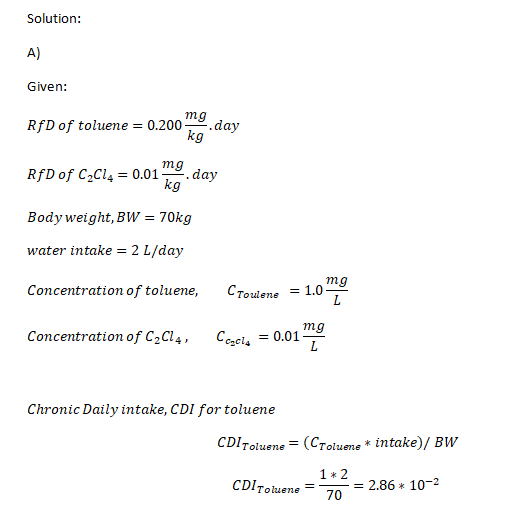
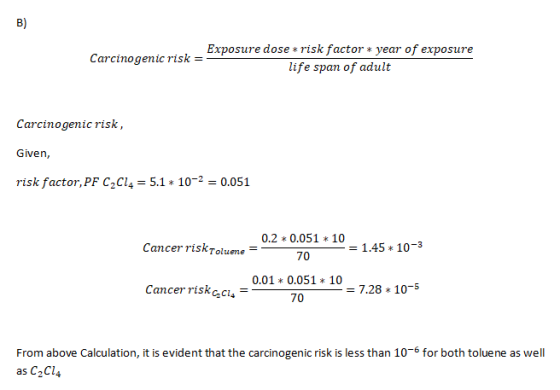
20/27OBLEM: Suppose drinking water contains 1 mg/l of toluene and 0.01 mg/l of tetrachloroethylene (C2C4). A...
1. The drinking water standard for tetrachloroethylene is 0.005 mg/L, The potency factor for tetrachloroethylene is...
1. The drinking water standard for tetrachloroethylene is 0.005 mg/L, The potency factor for tetrachloroethylene is 5.1*10^-2 (mg/kg-day)^-1. What lifetime risk would this pose? Assume 30 year exposure for 350 days per year. 2. •Suppose a 70-kg man is exposed to 0.1 mg/m3 o etrachloroethylene in the air at his workplace. If he inhales 1m3/hr, 8 hours per day, 5 days per week, 50 weeks per year, for 30 years, and if tetrachloroethylene has an absorption factor of 90 percent...
The drinking water standard for tetrachloroethylene is 0.005 mg/L. The potency factor for tetrachloroethylene is 5.1*10^-2(mg/kg-day)-1....
The drinking water standard for tetrachloroethylene is 0.005 mg/L. The potency factor for tetrachloroethylene is 5.1*10^-2(mg/kg-day)-1. What lifetime risk would this pose? Assume 30 year exposure for 350 days per year
A 70-kg individual drinks 2 L/day of water containing 0.015 mg/L of tetrachloroethylene for 20 years....
 A 70-kg individual drinks 2 L/day of water containing 0.015 mg/L of tetrachloroethylene for 20 years. (a) Find the hazard quotient for this exposure. (b) Find the cancer risk. (c) If the individual drinks this water for 30 years instead of just 20, recomputed the hazard quotient and the cancer risk. A man works in an Aluminum smelter for 10 years. The drinking water in the smelter contains 0.015 mg/L arsenic and 0.80 mg/L methylene chloride. His only exposure to...
Water with 1.0 mg/L methylene chloride + 0.01 mg/L tetrachloroethylene), 70 kg adult drinks 2L/day for...
Water with 1.0 mg/L methylene chloride + 0.01 mg/L tetrachloroethylene), 70 kg adult drinks 2L/day for 30 years. What is hazard index? RfD = 0.060 for methylene chloride, RfD = 0.010 for tetrachloride 1 0.512 2 0.029 3 0.483 4 0.00029 q2) A test bottle (Blank) containing just seeded dilution water has its DO level drop by 1.1 mg/L in a five-day test. A 300-mL BOD bottle filled with 30 mL of wastewater and the rest seeded dilution water (this...
Question #1 (from Mihelcic). Assume an adult female who weighs 50 kg drinks 2 L of...
Question #1 (from Mihelcic). Assume an adult female who weighs 50 kg drinks 2 L of water every day and the absorption factor for the chemical of concern is 75 percent. The concentration of the chemical in the drinking water is 55 ppb. Determine the dose in mg/kg-day. Question #2 (from Mihelcic). Determine if exposure by oral ingestion to the chemicals xylene, toluene, arsenic, and hexavalent chromium poses a noncarcinogenic health risk. The chemical-specific reference doses (mg/kg-day) obtained from IRIS...
1. Chloroform (CHCl3) has a Drinking Water standard concentration of 0.10 mg/L . a. What is...
1. Chloroform (CHCl3) has a Drinking Water standard concentration of 0.10 mg/L . a. What is this concentration expressed as parts per million (ppm)? b. Typical consumption Risk Analysis assumes the average human drinks 2.2 L/day for 70 years. How many grams of CHCl3 would the average human consume during a lifetime at the Drinking Water standard concentration? 2. The Air Quality Standard for sulfur dioxide (SO2) is 0.04 ppm. Express this as mg/m3 at 1 atm and 25oC.
Example Chloroform is sometimes formed incidentally in drinking water plants. Suppose a 70 kg person drinks...
 Example Chloroform is sometimes formed incidentally in drinking water plants. Suppose a 70 kg person drinks 2 L of water per day from water with 0.10 mg/L chloroform. Find the upper bound cancer risk for this person, and estimate the number of extra deaths caused in a city of 500,000 with this exposure risk. How does this compare with the cancer risk in the US, which is 189/100,000/year?
Q.3 The drinking water standard for 2,3,7,8-TCDD (dioxin) is 3×10⁻⁸ mg/L. Using EPA exposure factors for...
Q.3 The drinking water standard for 2,3,7,8-TCDD (dioxin) is 3×10⁻⁸ mg/L. Using EPA exposure factors for residential consumption, what lifetime risk would this pose? Note that the potency factor of dioxin is 1.56×10⁵ mg/kg-d.
23. Calculate the ThOD for wastewater containing 40 mg/l. sucrose C.H0.1. (atomic weights: C: 12 H:1 0:16) a 192 b...
 23. Calculate the ThOD for wastewater containing 40 mg/l. sucrose C.H0.1. (atomic weights: C: 12 H:1 0:16) a 192 b 180 40.0 42.7 d e 85.4 other, write you answer- 24. When drinking water is disinfected with chlorine, an undesired byproduct, chloroform (CHCb). may be formed. Suppose a 70-kg person drinks 2 L of water every day for 70 years with a chloroform concentration of 0.04 mg/L (the drinking water standard). Potency factor for chloroform- 6.1 x 10 (mg/kg-day) The...
The Safe Drinking Water Quality Standard for nitrate nitrogen (NO3--N) is 10.0 mg/L. Convert this into...
The Safe Drinking Water Quality Standard for nitrate nitrogen (NO3--N) is 10.0 mg/L. Convert this into nitrate (NO3-) in ppm, mmol/L, and normality (N). (Given: N=14, O=16) The highest maximum one-hour ozone (O3; molecular weight = 48) concentration in Houston during 1999-2001 was 175 ppb. Convert this into mg/m3 at STP. The National Ambient Air Quality Standards for 1-hr O3 is 155 mg/m3. (Given: mg/m3 = ppm*MW/22.4).
 A 70-kg individual drinks 2 L/day of water containing 0.015 mg/L of tetrachloroethylene for 20 years. (a) Find the hazard quotient for this exposure. (b) Find the cancer risk. (c) If the individual drinks this water for 30 years instead of just 20, recomputed the hazard quotient and the cancer risk. A man works in an Aluminum smelter for 10 years. The drinking water in the smelter contains 0.015 mg/L arsenic and 0.80 mg/L methylene chloride. His only exposure to...
 Example Chloroform is sometimes formed incidentally in drinking water plants. Suppose a 70 kg person drinks 2 L of water per day from water with 0.10 mg/L chloroform. Find the upper bound cancer risk for this person, and estimate the number of extra deaths caused in a city of 500,000 with this exposure risk. How does this compare with the cancer risk in the US, which is 189/100,000/year?
 23. Calculate the ThOD for wastewater containing 40 mg/l. sucrose C.H0.1. (atomic weights: C: 12 H:1 0:16) a 192 b 180 40.0 42.7 d e 85.4 other, write you answer- 24. When drinking water is disinfected with chlorine, an undesired byproduct, chloroform (CHCb). may be formed. Suppose a 70-kg person drinks 2 L of water every day for 70 years with a chloroform concentration of 0.04 mg/L (the drinking water standard). Potency factor for chloroform- 6.1 x 10 (mg/kg-day) The...
Most questions answered within 3 hours.
-
Where is the error in this code sequence?
String s1 = "Hello";
String s2 = "ello";...
asked 10 months ago -
Financial data for Joel de Paris, Inc., for last year
follow:
Joel de Paris, Inc.
Balance...
asked 10 months ago -
Consider this reaction:
Al2(SO4)3 (aq)+ BaCl3
(aq) Al2Cl6 (aq)- +
3BaSO4(s) . What is the...
asked 10 months ago -
Suppose that Savneet is considering increasing her
recent random sample from 20 car rentals to 40...
asked 10 months ago -
Trucks arrive at an unloading terminal at an average rate of 120
per hour.
Trucks arrive...
asked 10 months ago -
Why are methanol and ethanol completely soluble in water while
octanol is not very little soluble....
asked 10 months ago -
A facilities manager at a university reads in a research report
that the mean amount of...
asked 10 months ago -
When the CuSO4 is rehydrated by adding water to the anhydrous
compound, is this an endothermic...
asked 10 months ago -
A ray of sunlight is passing from diamond into crown glass; the
angle of incidence is...
asked 10 months ago -
A block of mass 0.249 kg is placed on top of a light, vertical
spring of...
asked 10 months ago -
how do the kidneys compensate in the presences of acidosis
a) trigger hyperventilate
b) reserve acid...
asked 10 months ago -
Question 501 pts
The rental rate of capital to the firm increases. Which of the
following...
asked 10 months ago