
Homework Answers
Add Answer to:
Match one or more of the structures below with each of the following statements (Check all...
Match one or more of the structures below with each of the following statements. (Check all...
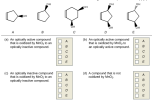 Match one or more of the structures below with each of the
following statements. (Check all that apply.)
Match one or more of the structures below with each of the
following statements. (Check all that apply.)
Match each of the following with their corresponding statements. Part A 5s and 6s orbitals Check...
Match each of the following with their corresponding statements. Part A 5s and 6s orbitals Check all that apply. Check all that apply. None of these statements are true. They are in the same energy level. They have the same shape. They have the same maximum number of electrons.
A. Consider the following pairs of structures. Designate each chirality center as (R) or (S) and...
 A. Consider the following pairs of structures. Designate each
chirality center as (R) or (S) and identify the
relationship between them by describing them as representing
enantiomers, diastereomers, constitutional isomers, or two
molecules of the same compound. Use handheld molecular models to
check your answers.
B. Tartaric acid
[HO2CCH(OH)CH(OH)CO2H] was an important
compound in the history of stereochemistry. Two naturally occurring
forms of tartaric acid are optically inactive. One optically
inactive form has a melting point of 210 − 212 °...
A. Consider the following pairs of structures. Designate each
chirality center as (R) or (S) and identify the
relationship between them by describing them as representing
enantiomers, diastereomers, constitutional isomers, or two
molecules of the same compound. Use handheld molecular models to
check your answers.
B. Tartaric acid
[HO2CCH(OH)CH(OH)CO2H] was an important
compound in the history of stereochemistry. Two naturally occurring
forms of tartaric acid are optically inactive. One optically
inactive form has a melting point of 210 − 212 °...
For the following question(s) MATCH each definition to a term from the list below. Place the...
 For the following question(s) MATCH each definition to a term from the list below. Place the letter of the term in the blank to the left of the definition. a. racemates b. chirality center c. chirality d. diastereomers e. enantiomers f. meso compounds g. optically active h. prochirality center i. optically inactive j. achiral ____ describes organic molecules which rotate plane-polarized light. ___ is the property of "handedness": the property of an object that causes it to be nonsuperimposable on...
Match the correct term to the following structures. Choose... Choose... Choose... ÅHz NH2 - y CHO...
 Match the correct term to the following structures. Choose... Choose... Choose... ÅHz NH2 - y CHO OH Choose... CHO NH2 Choose... Match the correct definitions to the terms below. Possess more than one stereocentre and are not mirror images of each other Choose... A carbon connected to 4 different groups Choose... Examples include (Z)-3-chloropent-2-ene and (E)-3-chloropent-2-ene Optically inactive compounds with 2 stereogenic centres that possess a plane of symmetry Possess the same Rf values if spotted on a TLC plate...
please help solve question 10 and question 11. thank you [2] QUESTION 10 Which of the...
 please help solve question 10 and question 11. thank you
[2] QUESTION 10 Which of the following statements is correct? A B (1) and (2) are optically active, (3) and (4) are meso thus optically inactive 1) and (2) are optically active, (3) and (4) are meso thus optically active too (1) and (2) are meso thus optically inactive, (3) and (4) are optically active All the compounds are optically active. с D [2] QUESTION 11 Which of the following...
please help solve question 10 and question 11. thank you
[2] QUESTION 10 Which of the following statements is correct? A B (1) and (2) are optically active, (3) and (4) are meso thus optically inactive 1) and (2) are optically active, (3) and (4) are meso thus optically active too (1) and (2) are meso thus optically inactive, (3) and (4) are optically active All the compounds are optically active. с D [2] QUESTION 11 Which of the following...
1 Use the structures below to answer the following questions Br Z=0 Br vi 3 1...
 1 Use the structures below to answer the following questions Br Z=0 Br vi 3 1 2 a Enter the number of the compound that could undergo Nucleophilic Aromatic Substitution here b Enter the number of one of the compounds that will not undergo Nucleophilic Aromatic Substitution here c Explain why it will not undergo this reaction in the space below d Enter the number of one of the compounds that will not undergo Nucleophilic Aromatic Substitution here e Explain...
Explain your answer 13. Consider the following reaction. Which choice below best describes the stereochemistry of...
 Explain your answer
13. Consider the following reaction. Which choice below best describes the stereochemistry of the product(s) (circle one)? (A) R major product, and optically active (B) S major product, and optically active (C) Both S and R, and optically inactive (D) S major product, and optically inactive soci, pyridine Product(s) OH
Explain your answer
13. Consider the following reaction. Which choice below best describes the stereochemistry of the product(s) (circle one)? (A) R major product, and optically active (B) S major product, and optically active (C) Both S and R, and optically inactive (D) S major product, and optically inactive soci, pyridine Product(s) OH
Match the propositional statements to the types of connective used in each one. Each is only...
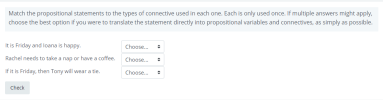 Match the propositional statements to the types of connective
used in each one. Each is only used once. If multiple answers might
apply, choose the best option if you were to translate the
statement directly into propositional variables and connectives, as
simply as possible. It is Friday and Ioana is happy. Answer 1
Rachel needs to take a nap or have a coffee. Answer 2 If it is
Friday, then Tony will wear a tie. Answer 3
Match the propositional...
Match the propositional statements to the types of connective
used in each one. Each is only used once. If multiple answers might
apply, choose the best option if you were to translate the
statement directly into propositional variables and connectives, as
simply as possible. It is Friday and Ioana is happy. Answer 1
Rachel needs to take a nap or have a coffee. Answer 2 If it is
Friday, then Tony will wear a tie. Answer 3
Match the propositional...
10) Which of the following statements is (are) true for the compound (R)-2-butanol? A) This compound...
 10) Which of the following statements is (are) true for the compound (R)-2-butanol? A) This compound is chiral. B) This compound is optically active. C) This compound has an enantiomer D) all of the above E) none of the above 11) Predict the specific rotation of the compound shown. CH нс A) It is impossible to predict; it must be determined experimentally. B) Because both asymmetric centers are R, the compound is dextrorotatory. C) Because both asymmetric centers are S,...
 Match one or more of the structures below with each of the
following statements. (Check all that apply.)
Match one or more of the structures below with each of the
following statements. (Check all that apply.)
 A. Consider the following pairs of structures. Designate each
chirality center as (R) or (S) and identify the
relationship between them by describing them as representing
enantiomers, diastereomers, constitutional isomers, or two
molecules of the same compound. Use handheld molecular models to
check your answers.
B. Tartaric acid
[HO2CCH(OH)CH(OH)CO2H] was an important
compound in the history of stereochemistry. Two naturally occurring
forms of tartaric acid are optically inactive. One optically
inactive form has a melting point of 210 − 212 °...
A. Consider the following pairs of structures. Designate each
chirality center as (R) or (S) and identify the
relationship between them by describing them as representing
enantiomers, diastereomers, constitutional isomers, or two
molecules of the same compound. Use handheld molecular models to
check your answers.
B. Tartaric acid
[HO2CCH(OH)CH(OH)CO2H] was an important
compound in the history of stereochemistry. Two naturally occurring
forms of tartaric acid are optically inactive. One optically
inactive form has a melting point of 210 − 212 °...
 For the following question(s) MATCH each definition to a term from the list below. Place the letter of the term in the blank to the left of the definition. a. racemates b. chirality center c. chirality d. diastereomers e. enantiomers f. meso compounds g. optically active h. prochirality center i. optically inactive j. achiral ____ describes organic molecules which rotate plane-polarized light. ___ is the property of "handedness": the property of an object that causes it to be nonsuperimposable on...
 Match the correct term to the following structures. Choose... Choose... Choose... ÅHz NH2 - y CHO OH Choose... CHO NH2 Choose... Match the correct definitions to the terms below. Possess more than one stereocentre and are not mirror images of each other Choose... A carbon connected to 4 different groups Choose... Examples include (Z)-3-chloropent-2-ene and (E)-3-chloropent-2-ene Optically inactive compounds with 2 stereogenic centres that possess a plane of symmetry Possess the same Rf values if spotted on a TLC plate...
 please help solve question 10 and question 11. thank you
[2] QUESTION 10 Which of the following statements is correct? A B (1) and (2) are optically active, (3) and (4) are meso thus optically inactive 1) and (2) are optically active, (3) and (4) are meso thus optically active too (1) and (2) are meso thus optically inactive, (3) and (4) are optically active All the compounds are optically active. с D [2] QUESTION 11 Which of the following...
please help solve question 10 and question 11. thank you
[2] QUESTION 10 Which of the following statements is correct? A B (1) and (2) are optically active, (3) and (4) are meso thus optically inactive 1) and (2) are optically active, (3) and (4) are meso thus optically active too (1) and (2) are meso thus optically inactive, (3) and (4) are optically active All the compounds are optically active. с D [2] QUESTION 11 Which of the following...
 1 Use the structures below to answer the following questions Br Z=0 Br vi 3 1 2 a Enter the number of the compound that could undergo Nucleophilic Aromatic Substitution here b Enter the number of one of the compounds that will not undergo Nucleophilic Aromatic Substitution here c Explain why it will not undergo this reaction in the space below d Enter the number of one of the compounds that will not undergo Nucleophilic Aromatic Substitution here e Explain...
 Explain your answer
13. Consider the following reaction. Which choice below best describes the stereochemistry of the product(s) (circle one)? (A) R major product, and optically active (B) S major product, and optically active (C) Both S and R, and optically inactive (D) S major product, and optically inactive soci, pyridine Product(s) OH
Explain your answer
13. Consider the following reaction. Which choice below best describes the stereochemistry of the product(s) (circle one)? (A) R major product, and optically active (B) S major product, and optically active (C) Both S and R, and optically inactive (D) S major product, and optically inactive soci, pyridine Product(s) OH
 Match the propositional statements to the types of connective
used in each one. Each is only used once. If multiple answers might
apply, choose the best option if you were to translate the
statement directly into propositional variables and connectives, as
simply as possible. It is Friday and Ioana is happy. Answer 1
Rachel needs to take a nap or have a coffee. Answer 2 If it is
Friday, then Tony will wear a tie. Answer 3
Match the propositional...
Match the propositional statements to the types of connective
used in each one. Each is only used once. If multiple answers might
apply, choose the best option if you were to translate the
statement directly into propositional variables and connectives, as
simply as possible. It is Friday and Ioana is happy. Answer 1
Rachel needs to take a nap or have a coffee. Answer 2 If it is
Friday, then Tony will wear a tie. Answer 3
Match the propositional...
 10) Which of the following statements is (are) true for the compound (R)-2-butanol? A) This compound is chiral. B) This compound is optically active. C) This compound has an enantiomer D) all of the above E) none of the above 11) Predict the specific rotation of the compound shown. CH нс A) It is impossible to predict; it must be determined experimentally. B) Because both asymmetric centers are R, the compound is dextrorotatory. C) Because both asymmetric centers are S,...
Most questions answered within 3 hours.
-
Where is the error in this code sequence?
String s1 = "Hello";
String s2 = "ello";...
asked 10 months ago -
Financial data for Joel de Paris, Inc., for last year
follow:
Joel de Paris, Inc.
Balance...
asked 10 months ago -
Consider this reaction:
Al2(SO4)3 (aq)+ BaCl3
(aq) Al2Cl6 (aq)- +
3BaSO4(s) . What is the...
asked 10 months ago -
Suppose that Savneet is considering increasing her
recent random sample from 20 car rentals to 40...
asked 10 months ago -
Trucks arrive at an unloading terminal at an average rate of 120
per hour.
Trucks arrive...
asked 10 months ago -
Why are methanol and ethanol completely soluble in water while
octanol is not very little soluble....
asked 10 months ago -
A facilities manager at a university reads in a research report
that the mean amount of...
asked 10 months ago -
When the CuSO4 is rehydrated by adding water to the anhydrous
compound, is this an endothermic...
asked 10 months ago -
A ray of sunlight is passing from diamond into crown glass; the
angle of incidence is...
asked 10 months ago -
A block of mass 0.249 kg is placed on top of a light, vertical
spring of...
asked 10 months ago -
how do the kidneys compensate in the presences of acidosis
a) trigger hyperventilate
b) reserve acid...
asked 10 months ago -
Question 501 pts
The rental rate of capital to the firm increases. Which of the
following...
asked 10 months ago