The National Occupant Protection Use Survey (NOPUS) was
conducted to provide probability-based data on motorcycle helmet
use in the United States. The survey was conducted by sending
observers to randomly selected roadway sites where they collected
data on motorcycle helmet use, including the number of
motorcyclists wearing a Department of Transportation
(DOT)-compliant helmet (National Highway Traffic Safety
Administration website, January 7, 2010). Sample data consistent
with the most recent NOPUS are shown below.
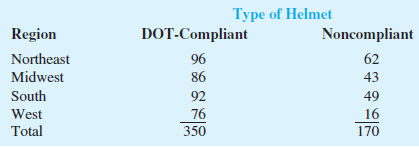
a. Use the data to compute the probability that a motorcyclist wears a DOT-compliant helmet. Round your answer to four decimal places.
b. The probability that a motorcyclist wore a DOT-compliant helmet five years ago was 0.48, and last year this probability was 0.63. Would the National Highway Traffic Safety Administration be pleased with the most recent survey results shown above?
c. What is the probability of DOT-compliant helmet use by region of the country? Round your answer to four decimal places.
| Northeast: | |
| Midwest: | |
| South: | |
| West: |
Homework Answers
The concept of probability is used here to determine the probability.
The probability can be defined as a measure of likelihood that an event will occur. The probability will lies between 0 and 1 where o implies the impossibility of the occurrence of the event and 1 implies that the event will certainly occur where the outcomes of the random experiment consider as event.
The probability of an event  can be calculated as:

(a)
The total number of motorcyclist is  and among them there are 350 motor cyclist who wear a DOT-compliant helmet.
So, the probability that a motorcyclist wears a DOT-compliant helmet is calculated as:

(b)
The probability that motorcyclist wore a DOT-compliant helmet five years ago was 0.48 and last year the probability was 0.63. According to the recent study the probability that a motorcyclist wears a DOT-compliant helmet is 0.6731.
It shows an increase in the probability that a motorcyclist wears a DOT-compliant helmet. So, the National Highway Traffic Safety Administration should be pleased with the recent survey results.
(c)
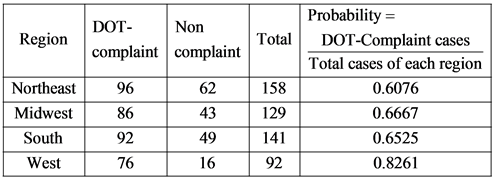
The total number of motorcyclist who wear the helmet in each region is the total number of possible cases and the number of motorcyclist who wear the DOT-complaint helmet is the number of favorable cases in each region.
The probability of DOT-complaint helmet use by each region of the country is calculated and shown in the table below:
The probability that a motorcyclist wears a DOT-compliant helmet is 0.6731.
Part bYes, the National Highway Traffic Safety Administration should be pleased with the recent survey results as there in an increase in the probability.
Part cThe probability of DOT-complaint helmet use by Northeast, Midwest, South, and West of the country are  respectively.
Add Answer to:
The National Occupant Protection Use Survey (NOPUS) was
conducted to provide probability-based data on motorcycle helmet...
A survey was conducted to provide probability-based data on motorcycle helmet use within a country. The...
A survey was conducted to provide probability-based data on motorcycle helmet use within a country. The survey was conducted by sending observers to randomly selected roadway sites where they collected data on motorcycle helmet use, including the number of motorcyclists wearing a compliant helmet. Sample data consistent with the most recent survey are shown below. Region Compliant Noncompliant Northeast 97 61 Midwest 87 42 South 93 48 West 77 15 Total 354 166 (a) Use the sample data to compute...
6. Pedestrian Deaths A researcher wanted to determinse whether pedestrian deaths were uniformly distributed over the days of the week. She randomly selected 300 pedestrian...
 6. Pedestrian Deaths A researcher wanted to determinse whether pedestrian deaths were uniformly distributed over the days of the week. She randomly selected 300 pedestrian deaths, recorded the day of the week on which the death occurred, and obtained the following results (the data are based on information obtained from the Insurance Institute for Highway Safety) Day of the Week Sunday Monday Tuesday Wednesday Frequency Day of Frequency the Week Thursday Friday Saturday 41 49 61 39 40 30 40...
 6. Pedestrian Deaths A researcher wanted to determinse whether pedestrian deaths were uniformly distributed over the days of the week. She randomly selected 300 pedestrian deaths, recorded the day of the week on which the death occurred, and obtained the following results (the data are based on information obtained from the Insurance Institute for Highway Safety) Day of the Week Sunday Monday Tuesday Wednesday Frequency Day of Frequency the Week Thursday Friday Saturday 41 49 61 39 40 30 40...
Most questions answered within 3 hours.
-
Where is the error in this code sequence?
String s1 = "Hello";
String s2 = "ello";...
asked 11 months ago -
Financial data for Joel de Paris, Inc., for last year
follow:
Joel de Paris, Inc.
Balance...
asked 11 months ago -
Consider this reaction:
Al2(SO4)3 (aq)+ BaCl3
(aq) Al2Cl6 (aq)- +
3BaSO4(s) . What is the...
asked 11 months ago -
Suppose that Savneet is considering increasing her
recent random sample from 20 car rentals to 40...
asked 11 months ago -
Trucks arrive at an unloading terminal at an average rate of 120
per hour.
Trucks arrive...
asked 11 months ago -
Why are methanol and ethanol completely soluble in water while
octanol is not very little soluble....
asked 11 months ago -
A facilities manager at a university reads in a research report
that the mean amount of...
asked 11 months ago -
When the CuSO4 is rehydrated by adding water to the anhydrous
compound, is this an endothermic...
asked 11 months ago -
A ray of sunlight is passing from diamond into crown glass; the
angle of incidence is...
asked 11 months ago -
A block of mass 0.249 kg is placed on top of a light, vertical
spring of...
asked 11 months ago -
how do the kidneys compensate in the presences of acidosis
a) trigger hyperventilate
b) reserve acid...
asked 11 months ago -
Question 501 pts
The rental rate of capital to the firm increases. Which of the
following...
asked 11 months ago