


![bousluoles oddnsp Analysis Initial rate [H2O,] ] Rate constant Ru(M/s) after mixing after mixing 1 2 o onit i ai li ADVICE F](http://img.homeworklib.com/images/4d5a427e-71ba-452b-8f4c-d927a8acd822.png?x-oss-process=image/resize,w_560)


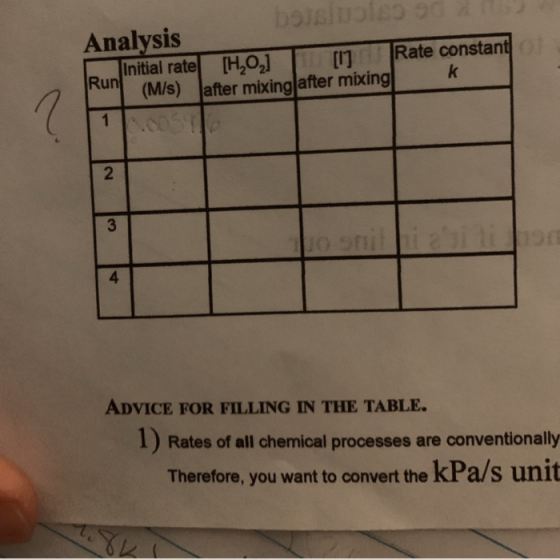
p6 capcarsrGa o1 Analysis Initial rate Run (M/s) after mixing after mixing I Rate constant k H2O2 1 2 3 ai ti ADVICE FOR FILLING IN THE TABLE. 1) Rates of all chemical processes are conventionally kPa/s unit Therefore, you want to convert the 4
Recall that the ideal gas law is: PiCuehmedume aqual moesin time pcan Pu-naT CS CTanperas Divide both perts of the ideal gas law by V*R*TS What does molarity (moles over iters) per 2) second equal to, based on your rearranged equation? M/3= VA Use vour fnding above to calculate the first column of the analysis table, Use the iterature vale 3) of 8314 PaKmol for the ideal gas constant R. Show here how to caloulate the nun 1's veae 0.014 Afas omL) O:1i9 4(2a43) n(.134LPa/ mats n( 2397,9032 4) The moment you mixed your 3% (by weight) H,O, with 0.cc024 moes other solutions, its concentration (underline) decreased/increased. You can always use calculate molarity changes during dilutions. As long as you use same units for volume on both sides, formula will work. 3% (by weight) HO, is the same as 0.88 M. Show here how to calculate the run 1's [HO] value. M- Goc029 mdl O.050L M=0.0059ao M,V-M,V, to mol are same values, because KI is a soluble salt, 5) [KI] and [I] strong electrolyte. In water, it will dissociate completely into K' and I. Therefore, [KI]-[K'] = [I]. Show here how to calculate the run 1's [I] value. 6) For calculation of k's value (rate constant), assume it's a first order reaction by each of the reagents. That is, rate k[H.O.][I].Based on this equation, how can k be calculated and what are its units? Show here how to calculate the run l's k value. 7) Does k value vary for runs 1-32 Comment if it's in line our out of line with your expectations.
Data and Observations (Be mindful of units and significant figures) Initial rate Total volume Temperature Reactants Run (kPa/s) 1 50 mL H,O mL 0.5 M KI+ ,mL 3.0% H,O, +S 2 OmL 3.0% H,O, mL H2O mL 0.5 M KI + + 10 mL 0.5 M KI+mL H,O mL 3.0% H2O2 + 4 GO mL 3.0% H2O2 mL 0.5 M KI+ IGML + ctom
bousluoles oddnsp Analysis Initial rate [H2O,] ] Rate constant Ru(M/s) after mixing after mixing 1 2 o onit i a'i li ADVICE FOR FILLING IN THE TABLE. 1) Rates of all chemical processes are conventiona kPa/s un Therefore, you want to convert the 13 4
Expt 2. Decomposition of Hydrogen Peroxide-Worksheet View Review Mailings References Aa 1 AABBC 1.1 AABBCc 1.1.1 AatbCcl AabbCcDdfer AutbCcDdEe Ac -w Aa v Heading 2 Heading 3 Heading 1 No Spacing Normal A Data and Observations (Be mindful of units and significant figures) Initial rate Temperature Total Reactants Run (kPa/s) volume 0.0179 60.0 mL 21.8 °C 1 kPa/s mL 3.0% HO2+-5 mL 0.5 M KI+50- 5 mL H-O 60.0 mL 0.0196 21.8 C 2 kPa/s 10 mL 3.0 % H2O2 +-5_mL 0.5 M KI+45 mL H2O 60.0 mL 0.0514 21.8 C 3 5 mL 3.0 % H2O2+10 mL 0.5 M KI+-45 mL H2O kPa/s 0.0976 kPa/s 13.2 C 60.0 mL 4. 10 mL 3.0 % H2O 2 + -5 mL 0.5 M KI+ 45 mL HO Observations during the experiments: When mixing HO2, KI, and H2O together, the substances turned yellow color. After stirring, bubble started to form. The initial rate (in kPa/s) was calculated in the following way (brief description): Find pressure vs. time graph Select steepest 20 second segments Next analyze graph to fit curve then click linear, and finally pressure C Compared to run 1, run 2 uses twice as concentrated H2O), while keeping [KI] the same. How does the initial rate change? What does it telll us about order of the reaction by H2O1? The initial rate was 3-4 times more than rate two. It's first order reaction because rate depends on (United States) Focus
Mailings Review View ences Ap AatibCcDdEe 1 AABBC AaßhCrDdFe 1.1 AABBCC 1.1.1 AaßbCel Normal No Spacing Heading 1 Heading 2 Heading 3 Analysis Initial rate [HO after mixing Rate constant Run after mixing (M/s) 2 3 4 ADVICE FOR FILLING IN THE TABLE. 1) Rates of all chemical processes are conventionally measured in M/s (molarity per second). Therefore, you want to convert the kPa/s units into M/s. Recall that the ideal gas law is: PV nRT C 2) Divide both parts of the ideal gas law by V R T s. What does molarity (moles over liters) per second equal to, based on your rearranged equation? 3) Use your finding above to calculate the first column of the analysis table. Use the literature value of 8.314 LkPa/Kmol for the ideal gas constant R. Show here how to calculate the run 1's value: The moment you mixed your 3 % ( by weight) H:O2 with other solutions, its concentration (underline) decreased/increased. You can always use M;Vi MaV to calculate molarity changes during dilutions. As long as you use same units for volume on both sides, formula will work, 3 % (by weight) H20, is the same as 0.88 M. Show here how to calculate the run 1's [HOa] value. 4) d States) Focus MacBook Pro 80 DC DII E5 F6 F7 FA
Homework Answers
The '/s ' or per second term is present possibly to highlight the order of the reaction which will help you to solve for n in the PV=nRT equation.
Add Answer to:
my chemistry lab did the composition of hydrogen peroxide. i
am having trouble trying to fugure...
From the data table determine the rate law for reactions 1-4 and calculate the value of...
 From the data table determine the rate law for reactions 1-4
and calculate the value of k for each. Thanks
I-IV
BACKGROUND
INFORMATION
Given: 3% H2O2 Concentration= 0.88M & 1.5% H2O2
Concentration= 0.44 M
•Calculation of H2O2 after mixing for parts I,II, IV= 0.704 M
•Calculation of I^- after mixing for parts I,II, IV= 0.10
M
•Calculation of Initial (mol/L-s)
Filled in Table
Now the solutions for Rate Order and Rate Constant are
needed
Reactants 8 ml 30% HO, 2...
From the data table determine the rate law for reactions 1-4
and calculate the value of k for each. Thanks
I-IV
BACKGROUND
INFORMATION
Given: 3% H2O2 Concentration= 0.88M & 1.5% H2O2
Concentration= 0.44 M
•Calculation of H2O2 after mixing for parts I,II, IV= 0.704 M
•Calculation of I^- after mixing for parts I,II, IV= 0.10
M
•Calculation of Initial (mol/L-s)
Filled in Table
Now the solutions for Rate Order and Rate Constant are
needed
Reactants 8 ml 30% HO, 2...
Hi. I'm having trouble solving the rate law for my chemistry lab report sheet. I'm unsure...
 Hi. I'm having trouble solving the rate law for my chemistry lab
report sheet. I'm unsure if I'm doing it right. Below is my
trials
To calculate rate law, I choose experiment 1
and 2 for [I]x and experiment 2 and 3 for
[H2O2]y. I got x=1 and y=1. This would make my rate law:
rate = k [I-] [H2O2]
Is this correct? Please help! Thanks in advance
Trial [1] [H202] Rate (M/s) 1 3.00 x 10^-2 M 1.50 x...
Hi. I'm having trouble solving the rate law for my chemistry lab
report sheet. I'm unsure if I'm doing it right. Below is my
trials
To calculate rate law, I choose experiment 1
and 2 for [I]x and experiment 2 and 3 for
[H2O2]y. I got x=1 and y=1. This would make my rate law:
rate = k [I-] [H2O2]
Is this correct? Please help! Thanks in advance
Trial [1] [H202] Rate (M/s) 1 3.00 x 10^-2 M 1.50 x...
(A) Calculate the molarity (M) of a 3% H2O2 assuming that 3.0 g of hydrogen peroxide...
(A) Calculate the molarity (M) of a 3% H2O2 assuming that 3.0 g of hydrogen peroxide are contained in 100 mL of solution (density = 1.00 g/mL). (B) Calculate the concentration of the dilutions shown in Table I. Just include the number with three significant digits and leading zeros, not the units. Include any zero to the left of the decimal point. Table 1. Trial (% H2O2 by mass) Required volume of 3% H2O2 solution (mL) Req. volume of water...
4. Experimental Procedure, Part A, Table 5.1 a. In Trial 1, what is the function of...
 4. Experimental Procedure, Part A, Table 5.1 a. In Trial 1, what is the function of the sodium thiosulfate in studying the kinetics of the hydrogen peroxide-iodide reaction? b. Calculate the moles of S,0,2 that are consumed during the course of the reaction in Trial 1 produced during the course of the reaction. See equation 5.1 that are c. Calculate the moles of I Eveian 3 noitoviioA b d. Calculate the initial molar concentration of I (at time 0), [I...
2) 20 points in the lab you studied the decomposition of peroxide in ACIDIC solution If...
 2) 20 points in the lab you studied the decomposition of peroxide in ACIDIC solution If the reaction is run under BASIC conditions a different result is obtained. 2 H2O2(aq) + 2 H2O(l) + O2(g) The rate of reaction can be determined by measuring the rate at which the volume of O2 increases at a pressure of latm. Use the data below to determine the rate law including! the value of the rate constant, “rate =k [H2021 [ITY". Show your...
I need help with the rate constants for trials 1 through 4. I put as much...
 I need help with the rate constants for trials 1 through 4. I
put as much info as I thought would be necessary. The last question
I posted I was told I didn't have enough info, so I hope this is
enough.
This is all the info I was given to solve the questions, so this
has to be enough to solve them.
Rate Constant, k', for the reaction occurring in Solution 1 (M1.51) NG 0.5 Info Rate Constant, k',...
I need help with the rate constants for trials 1 through 4. I
put as much info as I thought would be necessary. The last question
I posted I was told I didn't have enough info, so I hope this is
enough.
This is all the info I was given to solve the questions, so this
has to be enough to solve them.
Rate Constant, k', for the reaction occurring in Solution 1 (M1.51) NG 0.5 Info Rate Constant, k',...
Please help me find the average k, determining the order with respect to H2O2 (B) and...
 Please help me find the average k, determining the order with
respect to H2O2 (B) and H+ (y), and what is the complete rate law
by including the experimentally numerical value of k, a, b and
y.
The lodine Clock: Initial Rate Law Kinetics - 71 Calculations Below is a description and outline for the calculations you need to complete for this laboratory. Make sure to include all of your calculations. Use extra paper if you need to Initial Concentrations:...
Please help me find the average k, determining the order with
respect to H2O2 (B) and H+ (y), and what is the complete rate law
by including the experimentally numerical value of k, a, b and
y.
The lodine Clock: Initial Rate Law Kinetics - 71 Calculations Below is a description and outline for the calculations you need to complete for this laboratory. Make sure to include all of your calculations. Use extra paper if you need to Initial Concentrations:...
Final M of Acetone, Final M of H+ (hydrogen) and I2 (iodide)? Procedure: • Collect about...
 Final M of Acetone, Final M of H+ (hydrogen) and I2
(iodide)?
Procedure: • Collect about 5 mL of each of the three solutions (IM HCl and 0.005M I/KI) in separate 10 ml beakers. Collect 4M acetone in an Erlenmeyer flask and cover it with a stopper it to avoid evaporation. Perform each of the runs three times. Record the individual time and take the average. Run #1 Use an automatic delivery pipet. Pipet exactly 200 ul acetone, 200 uL...
Final M of Acetone, Final M of H+ (hydrogen) and I2
(iodide)?
Procedure: • Collect about 5 mL of each of the three solutions (IM HCl and 0.005M I/KI) in separate 10 ml beakers. Collect 4M acetone in an Erlenmeyer flask and cover it with a stopper it to avoid evaporation. Perform each of the runs three times. Record the individual time and take the average. Run #1 Use an automatic delivery pipet. Pipet exactly 200 ul acetone, 200 uL...
The oxidation of iodide ion by hydrogen peroxide in an acidic solution is described by the...
The oxidation of iodide ion by hydrogen peroxide in an acidic solution is described by the balanced equation H2O2(aq)+3I−(aq)+2H+(aq)⟶I3−(aq)+2H2O(l)H2O2(aq)+3I−(aq)+2H+(aq)⟶I3−(aq)+2H2O(l) The rate of formation of the red triiodide ion, Δ[I3−]/ΔtΔ[I3−]/Δt, can be determined by measuring the rate of appearance of the color. A sequence of photographs showing the progress of the reaction of hydrogen peroxide (H2O2)(H2O2) and iodide ion (I−)(I−). As time passes (left to right), the red color due to the triiodide ion (I3−)(I3−) increases in intensity. Initial rate data...
2 H2O2(aq) + 2 H2O(l) + O2(g) 5. Hydrogen peroxide decomposes according to the equation above. a. An aqueous solutio...
 2 H2O2(aq) + 2 H2O(l) + O2(g) 5. Hydrogen peroxide decomposes according to the equation above. a. An aqueous solution of H2O, that is 6.00 percent H,O, by mass has a density of 1.03 g ml. Calculate each of the following. (i) The original number of moles of H2O, in a 125 ml sample of the 6.00 percent H2O2 solution (ii) The number of moles of O,(g) that are produced when all of the H2O2 in the 125 mL sample...
 From the data table determine the rate law for reactions 1-4
and calculate the value of k for each. Thanks
I-IV
BACKGROUND
INFORMATION
Given: 3% H2O2 Concentration= 0.88M & 1.5% H2O2
Concentration= 0.44 M
•Calculation of H2O2 after mixing for parts I,II, IV= 0.704 M
•Calculation of I^- after mixing for parts I,II, IV= 0.10
M
•Calculation of Initial (mol/L-s)
Filled in Table
Now the solutions for Rate Order and Rate Constant are
needed
Reactants 8 ml 30% HO, 2...
From the data table determine the rate law for reactions 1-4
and calculate the value of k for each. Thanks
I-IV
BACKGROUND
INFORMATION
Given: 3% H2O2 Concentration= 0.88M & 1.5% H2O2
Concentration= 0.44 M
•Calculation of H2O2 after mixing for parts I,II, IV= 0.704 M
•Calculation of I^- after mixing for parts I,II, IV= 0.10
M
•Calculation of Initial (mol/L-s)
Filled in Table
Now the solutions for Rate Order and Rate Constant are
needed
Reactants 8 ml 30% HO, 2...
 Hi. I'm having trouble solving the rate law for my chemistry lab
report sheet. I'm unsure if I'm doing it right. Below is my
trials
To calculate rate law, I choose experiment 1
and 2 for [I]x and experiment 2 and 3 for
[H2O2]y. I got x=1 and y=1. This would make my rate law:
rate = k [I-] [H2O2]
Is this correct? Please help! Thanks in advance
Trial [1] [H202] Rate (M/s) 1 3.00 x 10^-2 M 1.50 x...
Hi. I'm having trouble solving the rate law for my chemistry lab
report sheet. I'm unsure if I'm doing it right. Below is my
trials
To calculate rate law, I choose experiment 1
and 2 for [I]x and experiment 2 and 3 for
[H2O2]y. I got x=1 and y=1. This would make my rate law:
rate = k [I-] [H2O2]
Is this correct? Please help! Thanks in advance
Trial [1] [H202] Rate (M/s) 1 3.00 x 10^-2 M 1.50 x...
 4. Experimental Procedure, Part A, Table 5.1 a. In Trial 1, what is the function of the sodium thiosulfate in studying the kinetics of the hydrogen peroxide-iodide reaction? b. Calculate the moles of S,0,2 that are consumed during the course of the reaction in Trial 1 produced during the course of the reaction. See equation 5.1 that are c. Calculate the moles of I Eveian 3 noitoviioA b d. Calculate the initial molar concentration of I (at time 0), [I...
 2) 20 points in the lab you studied the decomposition of peroxide in ACIDIC solution If the reaction is run under BASIC conditions a different result is obtained. 2 H2O2(aq) + 2 H2O(l) + O2(g) The rate of reaction can be determined by measuring the rate at which the volume of O2 increases at a pressure of latm. Use the data below to determine the rate law including! the value of the rate constant, “rate =k [H2021 [ITY". Show your...
 I need help with the rate constants for trials 1 through 4. I
put as much info as I thought would be necessary. The last question
I posted I was told I didn't have enough info, so I hope this is
enough.
This is all the info I was given to solve the questions, so this
has to be enough to solve them.
Rate Constant, k', for the reaction occurring in Solution 1 (M1.51) NG 0.5 Info Rate Constant, k',...
I need help with the rate constants for trials 1 through 4. I
put as much info as I thought would be necessary. The last question
I posted I was told I didn't have enough info, so I hope this is
enough.
This is all the info I was given to solve the questions, so this
has to be enough to solve them.
Rate Constant, k', for the reaction occurring in Solution 1 (M1.51) NG 0.5 Info Rate Constant, k',...
 Please help me find the average k, determining the order with
respect to H2O2 (B) and H+ (y), and what is the complete rate law
by including the experimentally numerical value of k, a, b and
y.
The lodine Clock: Initial Rate Law Kinetics - 71 Calculations Below is a description and outline for the calculations you need to complete for this laboratory. Make sure to include all of your calculations. Use extra paper if you need to Initial Concentrations:...
Please help me find the average k, determining the order with
respect to H2O2 (B) and H+ (y), and what is the complete rate law
by including the experimentally numerical value of k, a, b and
y.
The lodine Clock: Initial Rate Law Kinetics - 71 Calculations Below is a description and outline for the calculations you need to complete for this laboratory. Make sure to include all of your calculations. Use extra paper if you need to Initial Concentrations:...
 Final M of Acetone, Final M of H+ (hydrogen) and I2
(iodide)?
Procedure: • Collect about 5 mL of each of the three solutions (IM HCl and 0.005M I/KI) in separate 10 ml beakers. Collect 4M acetone in an Erlenmeyer flask and cover it with a stopper it to avoid evaporation. Perform each of the runs three times. Record the individual time and take the average. Run #1 Use an automatic delivery pipet. Pipet exactly 200 ul acetone, 200 uL...
Final M of Acetone, Final M of H+ (hydrogen) and I2
(iodide)?
Procedure: • Collect about 5 mL of each of the three solutions (IM HCl and 0.005M I/KI) in separate 10 ml beakers. Collect 4M acetone in an Erlenmeyer flask and cover it with a stopper it to avoid evaporation. Perform each of the runs three times. Record the individual time and take the average. Run #1 Use an automatic delivery pipet. Pipet exactly 200 ul acetone, 200 uL...
 2 H2O2(aq) + 2 H2O(l) + O2(g) 5. Hydrogen peroxide decomposes according to the equation above. a. An aqueous solution of H2O, that is 6.00 percent H,O, by mass has a density of 1.03 g ml. Calculate each of the following. (i) The original number of moles of H2O, in a 125 ml sample of the 6.00 percent H2O2 solution (ii) The number of moles of O,(g) that are produced when all of the H2O2 in the 125 mL sample...
Most questions answered within 3 hours.
-
Where is the error in this code sequence?
String s1 = "Hello";
String s2 = "ello";...
asked 11 months ago -
Financial data for Joel de Paris, Inc., for last year
follow:
Joel de Paris, Inc.
Balance...
asked 11 months ago -
Consider this reaction:
Al2(SO4)3 (aq)+ BaCl3
(aq) Al2Cl6 (aq)- +
3BaSO4(s) . What is the...
asked 11 months ago -
Suppose that Savneet is considering increasing her
recent random sample from 20 car rentals to 40...
asked 11 months ago -
Trucks arrive at an unloading terminal at an average rate of 120
per hour.
Trucks arrive...
asked 11 months ago -
Why are methanol and ethanol completely soluble in water while
octanol is not very little soluble....
asked 11 months ago -
A facilities manager at a university reads in a research report
that the mean amount of...
asked 11 months ago -
When the CuSO4 is rehydrated by adding water to the anhydrous
compound, is this an endothermic...
asked 11 months ago -
A ray of sunlight is passing from diamond into crown glass; the
angle of incidence is...
asked 11 months ago -
A block of mass 0.249 kg is placed on top of a light, vertical
spring of...
asked 11 months ago -
how do the kidneys compensate in the presences of acidosis
a) trigger hyperventilate
b) reserve acid...
asked 11 months ago -
Question 501 pts
The rental rate of capital to the firm increases. Which of the
following...
asked 11 months ago