
Homework Answers
Structure of a molecule can be drawn based on valance of the atoms involved in the structure.
An atom form maximum number of bonds in order to get octet configuration.
Consider the atoms present in the bicarbonate ion; connect them by satisfying their valance. Place the nonbonding electrons and formal charges on the atoms in the structure.
Charge on an atom without considering electronegativity differences is called as formal charge.
Electrons that do not involved in the bond formation are called as non-bonding electrons.
Hydrogen forms one bond with other atoms. Carbon belongs to Group 4A of the periodic table, thus its valance is 4. Oxygen belongs to Group 6A of the periodic table, its valance is 4.
Draw the supposed structure of the bicarbonate ion as shown below.
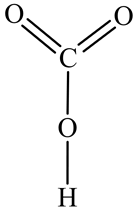
Correct the bonding on carbon atom by adding formal charges on one of the oxygen atoms.
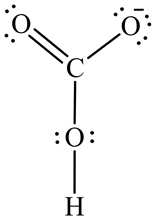
Structure of the bicarbonate ion is as follows:
Add Answer to:
The skeleton of the bicarbonate ion, HCO3^-, is shown here. Complete the structure by adding bonds,...
The skeleton of acetic acid is shown. Complete the structure by adding bonds and nonbonding electrons.
The skeleton of acetic acid is shown. Complete the structure by adding bonds and nonbonding electrons.
Complete the mechanism for the following Mannich reaction by adding any missing atoms, bonds, charges, curved...
 Complete the mechanism for the following Mannich reaction by
adding any missing atoms, bonds, charges, curved arrows and
nonbonding electrons. The steps up to the formation of the iminium
and the enol are pre-drawn for you. Use the skeleton provided in
each subsequent box to help guide which bonds are
formed/broken.
Complete the mechanism for the following Mannich reaction by
adding any missing atoms, bonds, charges, curved arrows and
nonbonding electrons. The steps up to the formation of the iminium
and the enol are pre-drawn for you. Use the skeleton provided in
each subsequent box to help guide which bonds are
formed/broken.
The following structure is an anion with three possible resonance contributors. One incomplete resonance form is...
 The following structure is an anion with three possible
resonance contributors. One incomplete resonance form is shown
below. Complete the given structure by adding nonbonding electrons
and formal charges. Draw the two remaining resonance structures (in
any order), including nonbonding electrons and formal charges.
The following structure is an anion with three possible
resonance contributors. One incomplete resonance form is shown
below. Complete the given structure by adding nonbonding electrons
and formal charges. Draw the two remaining resonance structures (in
any order), including nonbonding electrons and formal charges.
The following structure is an anion with three possible resonance contributors. One incomplete resonance form is...
 The following structure is an anion with three possible resonance contributors. One incomplete resonance form is shown below. Complete the given structure by adding nonbonding electrons and formal charges. Draw the two remaining resonance structures (in any order), including nonbonding electrons and formal charges.
Complete the mechanism for the following reaction by adding the missing bonds, charges, non-bonding electrons, and curv...
 Complete the mechanism for the following reaction by adding the
missing bonds, charges, non-bonding electrons, and curved
arrows.
Complete the mechanism for the following reaction by adding the missing bonds, charges, nonbonding electrons and curved arrows. Draw only one curved arrow. Omit H2O
Complete the mechanism for the following reaction by adding the
missing bonds, charges, non-bonding electrons, and curved
arrows.
Complete the mechanism for the following reaction by adding the missing bonds, charges, nonbonding electrons and curved arrows. Draw only one curved arrow. Omit H2O
Complete the mechanism for the following reaction by adding the missing bonds, charges, nonbonding electrons, and...
 Complete the mechanism for the
following reaction by adding the missing bonds, charges, nonbonding
electrons, and curved arrows.
Complete the mechanism for the
following reaction by adding the missing bonds, charges, nonbonding
electrons, and curved arrows.
Complete the mechanism for the cleavage of the ether by adding any missing atoms, bonds, charges,...
 Complete the mechanism for the
cleavage of the ether by adding any missing atoms, bonds, charges,
nonbonding electrons, and curved arrows.
Complete the mechanism for the
cleavage of the ether by adding any missing atoms, bonds, charges,
nonbonding electrons, and curved arrows.
Draw the Lewis structure (including resonance structures) for the acetate ion (CH3COO−). For each resonance structure,...
Draw the Lewis structure (including resonance structures) for the acetate ion (CH3COO−). For each resonance structure, assign formal charges to all atoms that have formal charge. Draw the Lewis dot structures for the acetate ion. Show the formal charges of all atoms. Include all hydrogen atoms and nonbonding electrons.
A Lewis structure of the carbamate ion is shown. :0: H. H Lewis structure A Draw...
 A Lewis structure of the carbamate ion is shown. :0: H. H Lewis structure A Draw the two other major resonance structures. Be sure to include all nonbonding electrons and formal charges where appropriate, Lewis structure C Lewis structure B More Rings Select Draw Erase Rings More Select Draw H C z Question 1 of9 The charges and sizes of the ions in an ionic compound affect the strength of the electrostatic attraction holding that compound together. Based on ion...
Draw all possible resonance structures by copying the skeleton shown. Edit bonds and charges to complete...
Draw all possible resonance structures by copying the skeleton shown. Edit bonds and charges to complete each resonance structure. (for each of these structures)
 Complete the mechanism for the following Mannich reaction by
adding any missing atoms, bonds, charges, curved arrows and
nonbonding electrons. The steps up to the formation of the iminium
and the enol are pre-drawn for you. Use the skeleton provided in
each subsequent box to help guide which bonds are
formed/broken.
Complete the mechanism for the following Mannich reaction by
adding any missing atoms, bonds, charges, curved arrows and
nonbonding electrons. The steps up to the formation of the iminium
and the enol are pre-drawn for you. Use the skeleton provided in
each subsequent box to help guide which bonds are
formed/broken.
 The following structure is an anion with three possible
resonance contributors. One incomplete resonance form is shown
below. Complete the given structure by adding nonbonding electrons
and formal charges. Draw the two remaining resonance structures (in
any order), including nonbonding electrons and formal charges.
The following structure is an anion with three possible
resonance contributors. One incomplete resonance form is shown
below. Complete the given structure by adding nonbonding electrons
and formal charges. Draw the two remaining resonance structures (in
any order), including nonbonding electrons and formal charges.
 The following structure is an anion with three possible resonance contributors. One incomplete resonance form is shown below. Complete the given structure by adding nonbonding electrons and formal charges. Draw the two remaining resonance structures (in any order), including nonbonding electrons and formal charges.
 Complete the mechanism for the following reaction by adding the
missing bonds, charges, non-bonding electrons, and curved
arrows.
Complete the mechanism for the following reaction by adding the missing bonds, charges, nonbonding electrons and curved arrows. Draw only one curved arrow. Omit H2O
Complete the mechanism for the following reaction by adding the
missing bonds, charges, non-bonding electrons, and curved
arrows.
Complete the mechanism for the following reaction by adding the missing bonds, charges, nonbonding electrons and curved arrows. Draw only one curved arrow. Omit H2O
 Complete the mechanism for the
following reaction by adding the missing bonds, charges, nonbonding
electrons, and curved arrows.
Complete the mechanism for the
following reaction by adding the missing bonds, charges, nonbonding
electrons, and curved arrows.
 Complete the mechanism for the
cleavage of the ether by adding any missing atoms, bonds, charges,
nonbonding electrons, and curved arrows.
Complete the mechanism for the
cleavage of the ether by adding any missing atoms, bonds, charges,
nonbonding electrons, and curved arrows.
 A Lewis structure of the carbamate ion is shown. :0: H. H Lewis structure A Draw the two other major resonance structures. Be sure to include all nonbonding electrons and formal charges where appropriate, Lewis structure C Lewis structure B More Rings Select Draw Erase Rings More Select Draw H C z Question 1 of9 The charges and sizes of the ions in an ionic compound affect the strength of the electrostatic attraction holding that compound together. Based on ion...
Most questions answered within 3 hours.
-
Where is the error in this code sequence?
String s1 = "Hello";
String s2 = "ello";...
asked 11 months ago -
Financial data for Joel de Paris, Inc., for last year
follow:
Joel de Paris, Inc.
Balance...
asked 11 months ago -
Consider this reaction:
Al2(SO4)3 (aq)+ BaCl3
(aq) Al2Cl6 (aq)- +
3BaSO4(s) . What is the...
asked 11 months ago -
Suppose that Savneet is considering increasing her
recent random sample from 20 car rentals to 40...
asked 11 months ago -
Trucks arrive at an unloading terminal at an average rate of 120
per hour.
Trucks arrive...
asked 11 months ago -
Why are methanol and ethanol completely soluble in water while
octanol is not very little soluble....
asked 11 months ago -
A facilities manager at a university reads in a research report
that the mean amount of...
asked 11 months ago -
When the CuSO4 is rehydrated by adding water to the anhydrous
compound, is this an endothermic...
asked 11 months ago -
A ray of sunlight is passing from diamond into crown glass; the
angle of incidence is...
asked 11 months ago -
A block of mass 0.249 kg is placed on top of a light, vertical
spring of...
asked 11 months ago -
how do the kidneys compensate in the presences of acidosis
a) trigger hyperventilate
b) reserve acid...
asked 11 months ago -
Question 501 pts
The rental rate of capital to the firm increases. Which of the
following...
asked 11 months ago