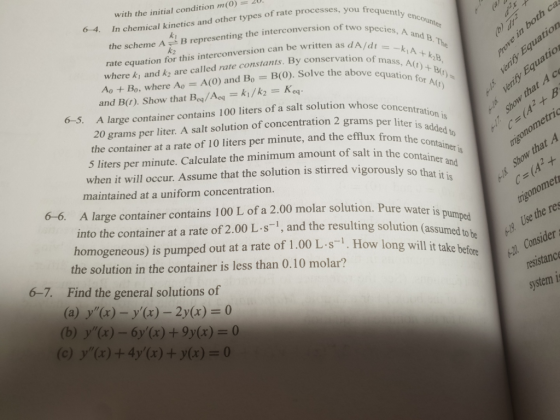

6-6
6-17
6-18
please help me, how could solve these problems
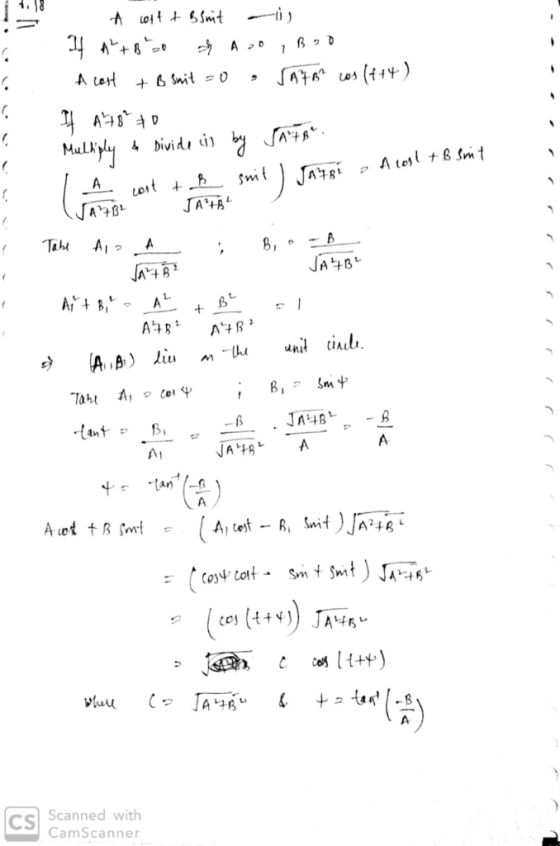
find a second solution. x)+y(x) = 0, use reduction of order to 6-13 Prove that x(t) = cos ot oscillates with a frequency v=/27. Prove that x (r)= A cos ot +B sin ot oscillates with the same frequency, o/2T. solve the following initial value problems; -14 + a2x(t) = o (a) r d2x x(0) 0; x' (0)= vo +wx(t) = 0 x(0)= xo: x (0) = vo (b) d12 Prove in both cases that x(t) oscillates with frequency o/2t. Verify Equation 6.33. 6-15 Verify Equation 6.34. 6-16 Show that A cost + B sin t can be written as C sin (t +), where 6-17 C = (A2 B2)2 and = tan-'(A/B). Hint: Work backward from the trigonometric identity sin (a + B) = sin a cos B + cos a sin B. Show that A cost + B sin t can be written as C cos (t +), where 6-18 C = (A2+ B2) 1/2 and = tan'(-B/A). Hint: Work backward from the trigonometric identity cos (a + B) = cos a cos B- sina sin B mg 6-19. Use the result of Problem 6-18 to derive Equation 6.35 from Equation 6.34. 6-20 Consider a body falling from a height h, and suppose that it encounters a resistance proportional to its velocity. Show that Newton's equation for this system is (see Figure 6.10) Figure 6.10. The geometry to be used in Problem 6-20 dv d2x = + mg dt2 dx Y -V = g or dt dt
Homework Answers

Add Answer to:
6-6
6-17
6-18
please help me, how could solve these problems
In chemical kinetics and other...
please solve problems 1 & 4 & 13 & 17 Review exercise 21 Solve the following:...
 please solve problems 1 & 4 & 13 & 17
Review exercise 21 Solve the following: dx2 dx dx2 0 dx For the o given that at t = t, 2 13 Obtain the general solution of the equation dy and determine the amplitude and frequency of the steady-state function [Note: The steady state function describes the behaviour of the solution as t00] 14 Solve the equation dx dx given that at t = 0, x = 0 and =...
please solve problems 1 & 4 & 13 & 17
Review exercise 21 Solve the following: dx2 dx dx2 0 dx For the o given that at t = t, 2 13 Obtain the general solution of the equation dy and determine the amplitude and frequency of the steady-state function [Note: The steady state function describes the behaviour of the solution as t00] 14 Solve the equation dx dx given that at t = 0, x = 0 and =...
I need help with how to solve these simultaneous equations. Could someone please show me the...
 I need help with how to solve these simultaneous equations.
Could someone please show me the steps to get to the answer.
Sum of forces in the x direction is zero i.e. FCD COs 33.69"-FAD COS 33.69"-FDE COS 33.690-0 54.08xcos 33.69 - FAD coS 33.69 F cos 33.69... .(5) Sum of forces in the y direction is zero i.e FRD +Fcn sin 33.69" + FAD sin 33.69 - FDE sin 33.690 -20-54.08x sin 33.69" + FD sin 33.69-Fg sin 33.690...
I need help with how to solve these simultaneous equations.
Could someone please show me the steps to get to the answer.
Sum of forces in the x direction is zero i.e. FCD COs 33.69"-FAD COS 33.69"-FDE COS 33.690-0 54.08xcos 33.69 - FAD coS 33.69 F cos 33.69... .(5) Sum of forces in the y direction is zero i.e FRD +Fcn sin 33.69" + FAD sin 33.69 - FDE sin 33.690 -20-54.08x sin 33.69" + FD sin 33.69-Fg sin 33.690...
can someone help me with 53 and 54. if you can, please show your work so...
 can someone help me with 53 and 54. if you can, please show
your work so I can understand
Exer. 51-54: Refer to the graph of the equation on the specified interval. Find all values of x such that for the real number a, (a) y = a, (b) y > a, and (c) y <a. 51 y = sin x; [-277, 27]; a = 52 y = cos x; [0, 477]; a = 13/2 53 y = cos x;...
can someone help me with 53 and 54. if you can, please show
your work so I can understand
Exer. 51-54: Refer to the graph of the equation on the specified interval. Find all values of x such that for the real number a, (a) y = a, (b) y > a, and (c) y <a. 51 y = sin x; [-277, 27]; a = 52 y = cos x; [0, 477]; a = 13/2 53 y = cos x;...
Verify the following using MATLAB 2) (a) Consider the following function f(t)=e"" sinwt u (t (1)...
 Verify the following using MATLAB
2) (a) Consider the following function f(t)=e"" sinwt u (t (1) .... Write the formula for Laplace transform. L[f)]=F(6) F(6))e"d Where f(t is the function in time domain. F(s) is the function in frequency domain Apply Laplace transform to equation 1. Le sin cot u()]F(s) Consider, f() sin wtu(t). From the frequency shifting theorem, L(e"f()F(s+a) (2) Apply Laplace transform to f(t). F,(s)sin ot u (t)e" "dt Define the step function, u(t u(t)= 1 fort >0...
Verify the following using MATLAB
2) (a) Consider the following function f(t)=e"" sinwt u (t (1) .... Write the formula for Laplace transform. L[f)]=F(6) F(6))e"d Where f(t is the function in time domain. F(s) is the function in frequency domain Apply Laplace transform to equation 1. Le sin cot u()]F(s) Consider, f() sin wtu(t). From the frequency shifting theorem, L(e"f()F(s+a) (2) Apply Laplace transform to f(t). F,(s)sin ot u (t)e" "dt Define the step function, u(t u(t)= 1 fort >0...
Could someone show me how to solve this: Find the maximum and minimum values attained by...
 Could someone show me how to solve this:
Find the maximum and minimum values attained by the function f along the path c(t). f(x, y) = xy; c(t) = (cos(t), sin(t)); 0 lessthanorequalto t lessthanorequalto 2n maximum value minimum value f(x, y) = x^2 + y^2; c(t) = (cos(t), 3 sin(t)); 0 lessthanorequalto t lessthanorequalto 2 pi maximum value minimum value
Could someone show me how to solve this:
Find the maximum and minimum values attained by the function f along the path c(t). f(x, y) = xy; c(t) = (cos(t), sin(t)); 0 lessthanorequalto t lessthanorequalto 2n maximum value minimum value f(x, y) = x^2 + y^2; c(t) = (cos(t), 3 sin(t)); 0 lessthanorequalto t lessthanorequalto 2 pi maximum value minimum value
(1 point) Solve the wave equation with fixed endpoints and the given initial displacement and velocity. a2 ,0<x<L, t > 0 a(0. t) = 0, u(L, t) = 0, t > 0 Ou Ot ηπα t) + B,, sin (m Now we c...
 (1 point) Solve the wave equation with fixed endpoints and the given initial displacement and velocity. a2 ,0<x<L, t > 0 a(0. t) = 0, u(L, t) = 0, t > 0 Ou Ot ηπα t) + B,, sin (m Now we can solve the PDE using the series solution u(r,t)-> An C computed many times: An example: t) ) sin (-1 ). The coefficients .An and i, are Fourier coefficients we have , cos n-1 sin(n pix/ L) dr...
Please solve all three. Thank you very much 5. (a) Let a be a constant (we...
 Please solve all three. Thank you very
much
5. (a) Let a be a constant (we can write “a ER” to mean “a is a real number”). Verify that y(x) = ci cos(ax) + C2 sin(ax) is a solution for y" = -a’y, where C1,C2 ER. (b) Consider the hyperbolic trigonometric functions defined by cosh(x) = et tex 2 ex – e- sinh(x) = * d Show that I cosh(x) = sinh(x) and sinh(x) = cosh(x). (e) Verify that y(x)...
Please solve all three. Thank you very
much
5. (a) Let a be a constant (we can write “a ER” to mean “a is a real number”). Verify that y(x) = ci cos(ax) + C2 sin(ax) is a solution for y" = -a’y, where C1,C2 ER. (b) Consider the hyperbolic trigonometric functions defined by cosh(x) = et tex 2 ex – e- sinh(x) = * d Show that I cosh(x) = sinh(x) and sinh(x) = cosh(x). (e) Verify that y(x)...
This is Differential equations, please help me, solve and show step by step. MAT 204 Elementary...
 This is Differential equations, please help me, solve
and show step by step.
MAT 204 Elementary Differential Equations 1. A mass-spring-dashpot system is described by my" + cy' + ky = Fo coswt, see $3.6 Eq. (17). This second-order differential equation has been used in simulations, such as this one at the PhET site: https://phet.colorado.edu/en/simulation/legacy/resonance. = 48.6 N, and w will be For m = 2.53 kg, c = 0.502 N/(m/s), k 97.2 N/m, Fo = 97.2 x 0.5 N...
This is Differential equations, please help me, solve
and show step by step.
MAT 204 Elementary Differential Equations 1. A mass-spring-dashpot system is described by my" + cy' + ky = Fo coswt, see $3.6 Eq. (17). This second-order differential equation has been used in simulations, such as this one at the PhET site: https://phet.colorado.edu/en/simulation/legacy/resonance. = 48.6 N, and w will be For m = 2.53 kg, c = 0.502 N/(m/s), k 97.2 N/m, Fo = 97.2 x 0.5 N...
Problem 5. Prove that parametric equations: x a-cosh(s) (a > 0) or back half(a < 0) of hyperboloid of one she...
 Problem 5. Prove that parametric equations: x a-cosh(s) (a > 0) or back half(a < 0) of hyperboloid of one sheet: Χ t), y b-sinh(s) cos (t) zc-sinh(s) sin( t), (x,y,z) lies on the front half L" a2 b2 c2 Problem 6 What graph of this Compute the arc length : rit)- < sin t, cos t, 2Vt', when 0<t < function: a) Compute the arc length : re)-3cos(9) and 0 < θ < π/2 b) Problem 7. Find parametric...
can i have a step by step of 1, 3, and 5 please In Problems 1-6,...
 can i have a step by step of 1, 3, and 5 please
In Problems 1-6, determine whether the given equation is separable, linear, neither or both. dx 1. +xt = ex 2. 2dy +sin x y = 0 dt dx 3. 3t e'+ y ln t 4. (t+ \ dt yt - y dy Srortar dr 5. 3r = de vorla (d) dx TU6. x +Px = sin t dt 03
can i have a step by step of 1, 3, and 5 please
In Problems 1-6, determine whether the given equation is separable, linear, neither or both. dx 1. +xt = ex 2. 2dy +sin x y = 0 dt dx 3. 3t e'+ y ln t 4. (t+ \ dt yt - y dy Srortar dr 5. 3r = de vorla (d) dx TU6. x +Px = sin t dt 03
 please solve problems 1 & 4 & 13 & 17
Review exercise 21 Solve the following: dx2 dx dx2 0 dx For the o given that at t = t, 2 13 Obtain the general solution of the equation dy and determine the amplitude and frequency of the steady-state function [Note: The steady state function describes the behaviour of the solution as t00] 14 Solve the equation dx dx given that at t = 0, x = 0 and =...
please solve problems 1 & 4 & 13 & 17
Review exercise 21 Solve the following: dx2 dx dx2 0 dx For the o given that at t = t, 2 13 Obtain the general solution of the equation dy and determine the amplitude and frequency of the steady-state function [Note: The steady state function describes the behaviour of the solution as t00] 14 Solve the equation dx dx given that at t = 0, x = 0 and =...
 I need help with how to solve these simultaneous equations.
Could someone please show me the steps to get to the answer.
Sum of forces in the x direction is zero i.e. FCD COs 33.69"-FAD COS 33.69"-FDE COS 33.690-0 54.08xcos 33.69 - FAD coS 33.69 F cos 33.69... .(5) Sum of forces in the y direction is zero i.e FRD +Fcn sin 33.69" + FAD sin 33.69 - FDE sin 33.690 -20-54.08x sin 33.69" + FD sin 33.69-Fg sin 33.690...
I need help with how to solve these simultaneous equations.
Could someone please show me the steps to get to the answer.
Sum of forces in the x direction is zero i.e. FCD COs 33.69"-FAD COS 33.69"-FDE COS 33.690-0 54.08xcos 33.69 - FAD coS 33.69 F cos 33.69... .(5) Sum of forces in the y direction is zero i.e FRD +Fcn sin 33.69" + FAD sin 33.69 - FDE sin 33.690 -20-54.08x sin 33.69" + FD sin 33.69-Fg sin 33.690...
 can someone help me with 53 and 54. if you can, please show
your work so I can understand
Exer. 51-54: Refer to the graph of the equation on the specified interval. Find all values of x such that for the real number a, (a) y = a, (b) y > a, and (c) y <a. 51 y = sin x; [-277, 27]; a = 52 y = cos x; [0, 477]; a = 13/2 53 y = cos x;...
can someone help me with 53 and 54. if you can, please show
your work so I can understand
Exer. 51-54: Refer to the graph of the equation on the specified interval. Find all values of x such that for the real number a, (a) y = a, (b) y > a, and (c) y <a. 51 y = sin x; [-277, 27]; a = 52 y = cos x; [0, 477]; a = 13/2 53 y = cos x;...
 Verify the following using MATLAB
2) (a) Consider the following function f(t)=e"" sinwt u (t (1) .... Write the formula for Laplace transform. L[f)]=F(6) F(6))e"d Where f(t is the function in time domain. F(s) is the function in frequency domain Apply Laplace transform to equation 1. Le sin cot u()]F(s) Consider, f() sin wtu(t). From the frequency shifting theorem, L(e"f()F(s+a) (2) Apply Laplace transform to f(t). F,(s)sin ot u (t)e" "dt Define the step function, u(t u(t)= 1 fort >0...
Verify the following using MATLAB
2) (a) Consider the following function f(t)=e"" sinwt u (t (1) .... Write the formula for Laplace transform. L[f)]=F(6) F(6))e"d Where f(t is the function in time domain. F(s) is the function in frequency domain Apply Laplace transform to equation 1. Le sin cot u()]F(s) Consider, f() sin wtu(t). From the frequency shifting theorem, L(e"f()F(s+a) (2) Apply Laplace transform to f(t). F,(s)sin ot u (t)e" "dt Define the step function, u(t u(t)= 1 fort >0...
 Could someone show me how to solve this:
Find the maximum and minimum values attained by the function f along the path c(t). f(x, y) = xy; c(t) = (cos(t), sin(t)); 0 lessthanorequalto t lessthanorequalto 2n maximum value minimum value f(x, y) = x^2 + y^2; c(t) = (cos(t), 3 sin(t)); 0 lessthanorequalto t lessthanorequalto 2 pi maximum value minimum value
Could someone show me how to solve this:
Find the maximum and minimum values attained by the function f along the path c(t). f(x, y) = xy; c(t) = (cos(t), sin(t)); 0 lessthanorequalto t lessthanorequalto 2n maximum value minimum value f(x, y) = x^2 + y^2; c(t) = (cos(t), 3 sin(t)); 0 lessthanorequalto t lessthanorequalto 2 pi maximum value minimum value
 (1 point) Solve the wave equation with fixed endpoints and the given initial displacement and velocity. a2 ,0<x<L, t > 0 a(0. t) = 0, u(L, t) = 0, t > 0 Ou Ot ηπα t) + B,, sin (m Now we can solve the PDE using the series solution u(r,t)-> An C computed many times: An example: t) ) sin (-1 ). The coefficients .An and i, are Fourier coefficients we have , cos n-1 sin(n pix/ L) dr...
 Please solve all three. Thank you very
much
5. (a) Let a be a constant (we can write “a ER” to mean “a is a real number”). Verify that y(x) = ci cos(ax) + C2 sin(ax) is a solution for y" = -a’y, where C1,C2 ER. (b) Consider the hyperbolic trigonometric functions defined by cosh(x) = et tex 2 ex – e- sinh(x) = * d Show that I cosh(x) = sinh(x) and sinh(x) = cosh(x). (e) Verify that y(x)...
Please solve all three. Thank you very
much
5. (a) Let a be a constant (we can write “a ER” to mean “a is a real number”). Verify that y(x) = ci cos(ax) + C2 sin(ax) is a solution for y" = -a’y, where C1,C2 ER. (b) Consider the hyperbolic trigonometric functions defined by cosh(x) = et tex 2 ex – e- sinh(x) = * d Show that I cosh(x) = sinh(x) and sinh(x) = cosh(x). (e) Verify that y(x)...
 This is Differential equations, please help me, solve
and show step by step.
MAT 204 Elementary Differential Equations 1. A mass-spring-dashpot system is described by my" + cy' + ky = Fo coswt, see $3.6 Eq. (17). This second-order differential equation has been used in simulations, such as this one at the PhET site: https://phet.colorado.edu/en/simulation/legacy/resonance. = 48.6 N, and w will be For m = 2.53 kg, c = 0.502 N/(m/s), k 97.2 N/m, Fo = 97.2 x 0.5 N...
This is Differential equations, please help me, solve
and show step by step.
MAT 204 Elementary Differential Equations 1. A mass-spring-dashpot system is described by my" + cy' + ky = Fo coswt, see $3.6 Eq. (17). This second-order differential equation has been used in simulations, such as this one at the PhET site: https://phet.colorado.edu/en/simulation/legacy/resonance. = 48.6 N, and w will be For m = 2.53 kg, c = 0.502 N/(m/s), k 97.2 N/m, Fo = 97.2 x 0.5 N...
 Problem 5. Prove that parametric equations: x a-cosh(s) (a > 0) or back half(a < 0) of hyperboloid of one sheet: Χ t), y b-sinh(s) cos (t) zc-sinh(s) sin( t), (x,y,z) lies on the front half L" a2 b2 c2 Problem 6 What graph of this Compute the arc length : rit)- < sin t, cos t, 2Vt', when 0<t < function: a) Compute the arc length : re)-3cos(9) and 0 < θ < π/2 b) Problem 7. Find parametric...
 can i have a step by step of 1, 3, and 5 please
In Problems 1-6, determine whether the given equation is separable, linear, neither or both. dx 1. +xt = ex 2. 2dy +sin x y = 0 dt dx 3. 3t e'+ y ln t 4. (t+ \ dt yt - y dy Srortar dr 5. 3r = de vorla (d) dx TU6. x +Px = sin t dt 03
can i have a step by step of 1, 3, and 5 please
In Problems 1-6, determine whether the given equation is separable, linear, neither or both. dx 1. +xt = ex 2. 2dy +sin x y = 0 dt dx 3. 3t e'+ y ln t 4. (t+ \ dt yt - y dy Srortar dr 5. 3r = de vorla (d) dx TU6. x +Px = sin t dt 03
Most questions answered within 3 hours.
-
Where is the error in this code sequence?
String s1 = "Hello";
String s2 = "ello";...
asked 10 months ago -
Financial data for Joel de Paris, Inc., for last year
follow:
Joel de Paris, Inc.
Balance...
asked 10 months ago -
Consider this reaction:
Al2(SO4)3 (aq)+ BaCl3
(aq) Al2Cl6 (aq)- +
3BaSO4(s) . What is the...
asked 10 months ago -
Suppose that Savneet is considering increasing her
recent random sample from 20 car rentals to 40...
asked 10 months ago -
Trucks arrive at an unloading terminal at an average rate of 120
per hour.
Trucks arrive...
asked 10 months ago -
Why are methanol and ethanol completely soluble in water while
octanol is not very little soluble....
asked 10 months ago -
A facilities manager at a university reads in a research report
that the mean amount of...
asked 10 months ago -
When the CuSO4 is rehydrated by adding water to the anhydrous
compound, is this an endothermic...
asked 10 months ago -
A ray of sunlight is passing from diamond into crown glass; the
angle of incidence is...
asked 10 months ago -
A block of mass 0.249 kg is placed on top of a light, vertical
spring of...
asked 10 months ago -
how do the kidneys compensate in the presences of acidosis
a) trigger hyperventilate
b) reserve acid...
asked 10 months ago -
Question 501 pts
The rental rate of capital to the firm increases. Which of the
following...
asked 10 months ago