For the following dehydration, use curved arrows to show the formation of the carbocation intermediate in...
For the following dehydration, use curved arrows to show the
formation of the carbocation intermediate in the presence of
sulfuric acid (H2SO4), then draw the structures of the minor and
major products of the elimination.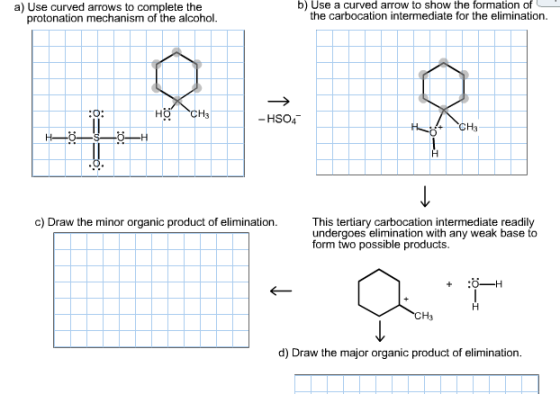
Homework Answers

Add Answer to:
For the following dehydration, use curved arrows to show the
formation of the carbocation intermediate in...
For the dehydration shown, use curved arrows to show the formation of the carbocation intermediate in...
 For the dehydration shown, use curved arrows to show the formation of the carbocation intermediate in the presence of sulfuric acid H, SO2, then draw the structures of the minor and major products of the elimination. H2SO4 - Major and Minor products O Step 1: Use curved arrows to complete the protonation mechanism of the alcohol. Step 2: Use a curved arrow to show the formation of the carbocation intermediate for the elimination. Select Draw Rings More Erase Select Draw...
For the dehydration shown, use curved arrows to show the formation of the carbocation intermediate in the presence of sulfuric acid H2SO4
 For the dehydration shown, use curved arrows to show the formation of the carbocation intermediate in the presence of sulfuric acid H2SO4, then draw the structures of the minor and major products of the elimination.
For the dehydration shown, use curved arrows to show the formation of the carbocation intermediate in...
 For the dehydration shown, use curved arrows to show the formation of the carbocation intermediate in the presence of sulfuric acid H, SO4, then draw the structure of the major product of the elimination. ОН H2SO4 - product Step 1: Use curved arrows to complete the protonation mechanism of the alcohol. Step 2: Use a curved arrow to show the formation the carbocation intermediate. Note: HSOZ is formed from step 1, but not shown. Select Draw Rings More Erase Select...
For the dehydration shown, use curved arrows to show the formation of the carbocation intermediate in...
 For the dehydration shown, use curved arrows to show the formation of the carbocation intermediate in the presence of sulfuric acid H, SO4, then draw the structure of the major product of the elimination. OH to selectivacain intermediate in the prese H2SO4 - product Step 1: Use curved arrows to complete the protonation mechanism of the alcohol. Step 2: Use a curved arrow to show the formation of the carbocation intermediate. Note: HSO, is formed from step 1, but not...
estion 14 of 14 Attemp For the dehydration shown, use curved arrows to show the formation...
 estion 14 of 14 Attemp For the dehydration shown, use curved arrows to show the formation of the carbocation intermediate in the presence of sulfuric acid H,SOą, then draw the structure of the major product of the elimination. ОН H, SO product Step 1: Use curved arrows to complete the protonation mechanism of the alcohol. Step 2: Use a curved arrow to show the formation the carbocation intermediate. Note: HSO, is formed from step 1, but not shown. Select Draw...
D esures Hint Chech Question 14 of 14 > Step 1: Use curved arrows to complete...
 D esures Hint Chech Question 14 of 14 > Step 1: Use curved arrows to complete the protonation mechanism of the alcohol. Step 2: Use a curved arrow to show the formation of the carbocation intermediate. Note: HSO is formed from step 1, but not shown. Select Draw Rings More Erase Select Draw Rings More Erase CHO 2 Q Step 3: Use a curved arrow to show the carbocation rearrangement. Step 4: Draw curved arrows to show the elimination to...
b. Use numbers to represent curved arrows to show how the carbocation intermediate reacts with Nu:-...
 b. Use numbers to represent curved arrows to show how the carbocation intermediate reacts with Nu:- to form the electrophilic aromatic substitution product. Your first number is atom or bond where the curved arrow starts; your second number is atom or bond where the curved arrow ends. Do not put a comma between your numbers. H I-1 8H7 10 woo + Nu: → CoHJE -1°
b. Use numbers to represent curved arrows to show how the carbocation intermediate reacts with Nur-to...
 b. Use numbers to represent curved arrows to show how the carbocation intermediate reacts with Nur-to form the electrophilic aromatic substitution product. Your first number is atom or bond where the curved arrow starts; your second number is atom or bond where the curved arrow ends. Do not put a comma between your numbers. н H. I 8H7 10 19 + Nu: C6H5E Your answer. Do not put a comma between your numbers. Your answer
уон 6. The following reaction yields multiple products (16 points) H2O H2SO4 Use curved arrows to...
 уон 6. The following reaction yields multiple products (16 points) H2O H2SO4 Use curved arrows to show the mechanism for the formation A. Use curved arrows to show the mechanism for the formation B. Use curved arrows to show the mechanism for the formation of C.
T ylic uelydration reaction, draw the curved arrow mechanism leading to the major alkene product and...
 T ylic uelydration reaction, draw the curved arrow mechanism leading to the major alkene product and one of the minor alkene products. Draw a picture of the hyperconjugation interaction that explains the greater thermodynamic stability of the major product versus the minor product. Concisely explain why the uncatalyzed dehydration reaction would not form the carbocation intermediate Me catalytic H2SO4 -он H,0
 For the dehydration shown, use curved arrows to show the formation of the carbocation intermediate in the presence of sulfuric acid H, SO2, then draw the structures of the minor and major products of the elimination. H2SO4 - Major and Minor products O Step 1: Use curved arrows to complete the protonation mechanism of the alcohol. Step 2: Use a curved arrow to show the formation of the carbocation intermediate for the elimination. Select Draw Rings More Erase Select Draw...
 For the dehydration shown, use curved arrows to show the formation of the carbocation intermediate in the presence of sulfuric acid H2SO4, then draw the structures of the minor and major products of the elimination.
 For the dehydration shown, use curved arrows to show the formation of the carbocation intermediate in the presence of sulfuric acid H, SO4, then draw the structure of the major product of the elimination. ОН H2SO4 - product Step 1: Use curved arrows to complete the protonation mechanism of the alcohol. Step 2: Use a curved arrow to show the formation the carbocation intermediate. Note: HSOZ is formed from step 1, but not shown. Select Draw Rings More Erase Select...
 For the dehydration shown, use curved arrows to show the formation of the carbocation intermediate in the presence of sulfuric acid H, SO4, then draw the structure of the major product of the elimination. OH to selectivacain intermediate in the prese H2SO4 - product Step 1: Use curved arrows to complete the protonation mechanism of the alcohol. Step 2: Use a curved arrow to show the formation of the carbocation intermediate. Note: HSO, is formed from step 1, but not...
 estion 14 of 14 Attemp For the dehydration shown, use curved arrows to show the formation of the carbocation intermediate in the presence of sulfuric acid H,SOą, then draw the structure of the major product of the elimination. ОН H, SO product Step 1: Use curved arrows to complete the protonation mechanism of the alcohol. Step 2: Use a curved arrow to show the formation the carbocation intermediate. Note: HSO, is formed from step 1, but not shown. Select Draw...
 D esures Hint Chech Question 14 of 14 > Step 1: Use curved arrows to complete the protonation mechanism of the alcohol. Step 2: Use a curved arrow to show the formation of the carbocation intermediate. Note: HSO is formed from step 1, but not shown. Select Draw Rings More Erase Select Draw Rings More Erase CHO 2 Q Step 3: Use a curved arrow to show the carbocation rearrangement. Step 4: Draw curved arrows to show the elimination to...
 b. Use numbers to represent curved arrows to show how the carbocation intermediate reacts with Nu:- to form the electrophilic aromatic substitution product. Your first number is atom or bond where the curved arrow starts; your second number is atom or bond where the curved arrow ends. Do not put a comma between your numbers. H I-1 8H7 10 woo + Nu: → CoHJE -1°
 b. Use numbers to represent curved arrows to show how the carbocation intermediate reacts with Nur-to form the electrophilic aromatic substitution product. Your first number is atom or bond where the curved arrow starts; your second number is atom or bond where the curved arrow ends. Do not put a comma between your numbers. н H. I 8H7 10 19 + Nu: C6H5E Your answer. Do not put a comma between your numbers. Your answer
 уон 6. The following reaction yields multiple products (16 points) H2O H2SO4 Use curved arrows to show the mechanism for the formation A. Use curved arrows to show the mechanism for the formation B. Use curved arrows to show the mechanism for the formation of C.
 T ylic uelydration reaction, draw the curved arrow mechanism leading to the major alkene product and one of the minor alkene products. Draw a picture of the hyperconjugation interaction that explains the greater thermodynamic stability of the major product versus the minor product. Concisely explain why the uncatalyzed dehydration reaction would not form the carbocation intermediate Me catalytic H2SO4 -он H,0
Most questions answered within 3 hours.
-
Where is the error in this code sequence?
String s1 = "Hello";
String s2 = "ello";...
asked 10 months ago -
Financial data for Joel de Paris, Inc., for last year
follow:
Joel de Paris, Inc.
Balance...
asked 10 months ago -
Consider this reaction:
Al2(SO4)3 (aq)+ BaCl3
(aq) Al2Cl6 (aq)- +
3BaSO4(s) . What is the...
asked 10 months ago -
Suppose that Savneet is considering increasing her
recent random sample from 20 car rentals to 40...
asked 10 months ago -
Trucks arrive at an unloading terminal at an average rate of 120
per hour.
Trucks arrive...
asked 10 months ago -
Why are methanol and ethanol completely soluble in water while
octanol is not very little soluble....
asked 10 months ago -
A facilities manager at a university reads in a research report
that the mean amount of...
asked 10 months ago -
When the CuSO4 is rehydrated by adding water to the anhydrous
compound, is this an endothermic...
asked 10 months ago -
A ray of sunlight is passing from diamond into crown glass; the
angle of incidence is...
asked 10 months ago -
A block of mass 0.249 kg is placed on top of a light, vertical
spring of...
asked 10 months ago -
how do the kidneys compensate in the presences of acidosis
a) trigger hyperventilate
b) reserve acid...
asked 10 months ago -
Question 501 pts
The rental rate of capital to the firm increases. Which of the
following...
asked 10 months ago