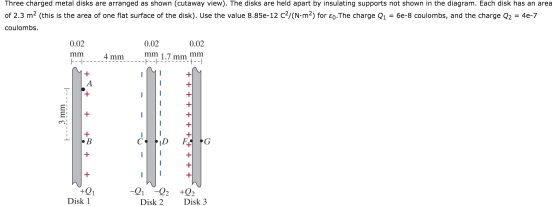
What is the potential difference VC -
VB?
VC - VB = ??????
volts
What is the potential difference VD -
VC?
VD - VC =
?????? volts
What is the potential difference VF -
VD?
VF - VD = ??????
volts
What is the potential difference VG -
VF? VG -
VF = ?????? volts
What is the potential difference VG -
VA? VG -
VA = ?????? volts
The charged disks have tiny holes which allow a particle to pass
through them. An electron which is traveling at a fast speed
approaches the plates from the left side. It travels along a path
from A to G. Since no external work is done on
the system of plates + electron,
?K + ?U = Wext = 0
Consider the following states: Initial, electron at location
A. Final, electron at location G.
What is the change in potential energy of the system?
?U = ?????? joules
What is the change in kinetic energy of the electron?
?K = ?????? joules
Homework Answers

Add Answer to:
What is the potential difference VC -
VB?
VC - VB = ??????
volts
What is the...
Potential Difference - Three charged plates - Will rate lifesaver for at least half correct
 Please show me some work? i just need help getting started, Will rate lifesaver for at least half correctThree charged metal disks are arranged as shown (cutaway view). The disks are held apart by insulating supports not shown in the diagram. Each disk has an area of2.2 m2 (this is the area of one flat surface of the disk). Use the value 8.85e-12 C2/(N·m2) for ε0.The charge Q1 = 3e-8 coulombs, and the charge Q2 = 3e-7coulombs.What is the magnitude...
Three charged metal disks are arranged as shown (cutaway view). The disks are held apart...
Three charged metal disks are arranged as shown (cutaway view). The disks are held apart by insulating supports not shown in the diagram. Each disk has an area of 2.5 m2 (this is the area of one flat surface of the disk). Use the value 8.85e-12 C2/(N·m2) for ?0.The charge Q1 = 5e-8 coulombs, and the charge Q2 = 2e-7 coulombs. What is the magnitude of the electric field in the region between disks 1 and 2? |12| =________________V/m...
Find the potential energy of three metal disks
 Three charged metal disks are arranged as shown (cutaway view). The disks are held apart by insulating supports not shown in the diagram. Each disk has an area of 2.5 m2 (this is the area of one flat surface of the disk). Use the value 8.85e-12 C2/(N·m2) for e0.The charge Q1 = 3e-8 coulombs, and the charge Q2 = 2e-7 coulombs.The figure of the disks can be viewed at this website: http://www.webassign.net/mi3/17-070-3plates_D_res.jpg.What is the potential difference between VC-VB and VD-VF?
Three very large charged metal plates are arranged as shown. The radius of each plate is...
 Three very large charged metal plates are arranged as shown. The
radius of each plate is 4 meters, and each plate is w = 0.05 mm
thick. The separation d1 is 8 mm, and the separation d2 is 3 mm.
Each plate has a tiny hole in it, so it is possible for a small
charged particle to pass through all the plates.
You are able to adjust the apparatus by varying the electric field
in the region between location...
Three very large charged metal plates are arranged as shown. The
radius of each plate is 4 meters, and each plate is w = 0.05 mm
thick. The separation d1 is 8 mm, and the separation d2 is 3 mm.
Each plate has a tiny hole in it, so it is possible for a small
charged particle to pass through all the plates.
You are able to adjust the apparatus by varying the electric field
in the region between location...
A capacitor with a 3 mm gap has a potential difference of 6 volts (see the...
A capacitor with a 3 mm gap has a potential difference of 6 volts (see the figure). A disk of glass 1.64 mm thick, with area the same as the area of the metal plates, has a dielectric constant of 1.9. It is inserted in the middle of the gap between the metal plates. Now what is the potential difference of the two metal disks? (It helps to make a diagram showing the electric field along a path.)
What is the potential difference (in Volts) ΔV = VA-VB between point A, situated 7 cm...
What is the potential difference (in Volts) ΔV = VA-VB between point A, situated 7 cm and point B, situated 21 cm from a 3 nC point charge? You should round your answer to an integer, indicate only the number, do not include the unit.
What is the potential difference (in Volts) ΔV = VA-VB between point A, situated 7 cm...
What is the potential difference (in Volts) ΔV = VA-VB between point A, situated 7 cm and point B, situated 20 cm from a 4 nC point charge? You should round your answer to an integer, indicate only the number, do not include the unit.
What is the potential difference (in Volts) ΔV = VA-VB between point A, situated 10 cm...
What is the potential difference (in Volts) ΔV = VA-VB between point A, situated 10 cm and point B, situated 18 cm from a 4 nC point charge? You should round your answer to an integer, indicate only the number, do not include the unit.
Calculate the magnitude of potential difference Va-Vb ( in units of volts) if Q1=-79 n C and Q2=50 nC.
 Calculate the magnitude of potential difference Va-Vb ( in units of volts) if Q1=-79 n C and Q2=50 nC.
Draw a diagram of the electric field between parallel plates. Take potential difference of 1000 volts...
Draw a diagram of the electric field between parallel plates. Take potential difference of 1000 volts over 4 centimeters. Find the electric field intensity. Find the charge density on the positive plate. Find the force on the proton or electron between the plates. When released from rest either particle has KE = 1000 eV at the opposite plate. Give the KE in Joules and find the speed of the electron. Find the speed of the proton. What would be the...
 Please show me some work? i just need help getting started, Will rate lifesaver for at least half correctThree charged metal disks are arranged as shown (cutaway view). The disks are held apart by insulating supports not shown in the diagram. Each disk has an area of2.2 m2 (this is the area of one flat surface of the disk). Use the value 8.85e-12 C2/(N·m2) for ε0.The charge Q1 = 3e-8 coulombs, and the charge Q2 = 3e-7coulombs.What is the magnitude...
 Three very large charged metal plates are arranged as shown. The
radius of each plate is 4 meters, and each plate is w = 0.05 mm
thick. The separation d1 is 8 mm, and the separation d2 is 3 mm.
Each plate has a tiny hole in it, so it is possible for a small
charged particle to pass through all the plates.
You are able to adjust the apparatus by varying the electric field
in the region between location...
Three very large charged metal plates are arranged as shown. The
radius of each plate is 4 meters, and each plate is w = 0.05 mm
thick. The separation d1 is 8 mm, and the separation d2 is 3 mm.
Each plate has a tiny hole in it, so it is possible for a small
charged particle to pass through all the plates.
You are able to adjust the apparatus by varying the electric field
in the region between location...
Most questions answered within 3 hours.
-
Where is the error in this code sequence?
String s1 = "Hello";
String s2 = "ello";...
asked 10 months ago -
Financial data for Joel de Paris, Inc., for last year
follow:
Joel de Paris, Inc.
Balance...
asked 10 months ago -
Consider this reaction:
Al2(SO4)3 (aq)+ BaCl3
(aq) Al2Cl6 (aq)- +
3BaSO4(s) . What is the...
asked 10 months ago -
Suppose that Savneet is considering increasing her
recent random sample from 20 car rentals to 40...
asked 10 months ago -
Trucks arrive at an unloading terminal at an average rate of 120
per hour.
Trucks arrive...
asked 10 months ago -
Why are methanol and ethanol completely soluble in water while
octanol is not very little soluble....
asked 10 months ago -
A facilities manager at a university reads in a research report
that the mean amount of...
asked 10 months ago -
When the CuSO4 is rehydrated by adding water to the anhydrous
compound, is this an endothermic...
asked 10 months ago -
A ray of sunlight is passing from diamond into crown glass; the
angle of incidence is...
asked 10 months ago -
A block of mass 0.249 kg is placed on top of a light, vertical
spring of...
asked 10 months ago -
how do the kidneys compensate in the presences of acidosis
a) trigger hyperventilate
b) reserve acid...
asked 10 months ago -
Question 501 pts
The rental rate of capital to the firm increases. Which of the
following...
asked 10 months ago