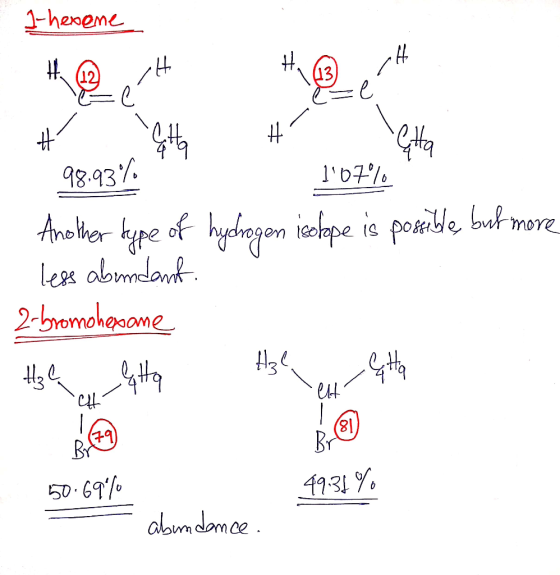
Draw the two most abundant isotopes for each of the parent ions of 1-hexene and 2-bromohexane....
Draw the two most abundant isotopes for each of the parent ions of 1-hexene and 2-bromohexane. Also determine what atomic isotopes exist in each molecular isotope of the parent molecule’s isotope pattern.
Homework Answers
The answer is given in the attachment .
Add Answer to:
Draw the two most abundant isotopes for each of the parent ions
of 1-hexene and 2-bromohexane....
magnesium is the ninth most abundant element in the universe and has three isotopes, given the...
magnesium is the ninth most abundant element in the universe and has three isotopes, given the fellowing information table and the average atomic mass of magnesium is 24.31amu, determine and write the atomic symbol of the unknown isotope of magnesium
9. Bromine has two abundant isotopes, "Br (51%) and Br (49%). Chlorine has two abundant isotopes,...
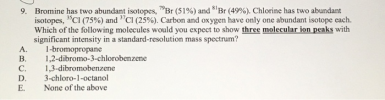 9. Bromine has two abundant isotopes, "Br (51%) and Br (49%). Chlorine has two abundant isotopes, 3$CI (75%) and "CI (25%). Carbon and oxygen have only one abundant isotope each. Which of the following molecules would you expect to show three molecular ion peaks with significant intensity in a standard-resolution mass spectrum? A. 1-bromopropane 1,2-dibromo-3-chlorobenzene 1,3-dibromobenzene 3-chloro-1-octanol None of the above
The original mixture contains petroleum ether, 1-hexene, and 1-bromohexane in a 1:1:1 ratio. Petroleum ether has...
 The original mixture contains petroleum ether, 1-hexene,
and 1-bromohexane in a 1:1:1 ratio.
Petroleum ether has the lowest boiling point range of
40-60ºC and the lower boiling point compounds travel through the
column faster than the higher boiling point compounds. 1-hexene
would have the second highest retention time with its boiling point
of 63ºC and 1-bromohexane would have the lowest with a boiling
point of 143ºC.
i) Draw the FID spectrum for the original mixture (you will not
know the...
The original mixture contains petroleum ether, 1-hexene,
and 1-bromohexane in a 1:1:1 ratio.
Petroleum ether has the lowest boiling point range of
40-60ºC and the lower boiling point compounds travel through the
column faster than the higher boiling point compounds. 1-hexene
would have the second highest retention time with its boiling point
of 63ºC and 1-bromohexane would have the lowest with a boiling
point of 143ºC.
i) Draw the FID spectrum for the original mixture (you will not
know the...
Most elements occur naturally as a mix of different isotopes. An element's atomic mass is the...
 Most elements occur naturally as a mix of different isotopes. An element's atomic mass is the weighted average of the isotope masses. In other words, it is an average that takes into account the percentage of each isotope. For example, the two naturally occurring isotopes of boron are given here The atomic mass of boron is calculated as follows: (10.0 times 0.199) + (11.0 times 0.801) = 10.8 amu Because the heavier isotope is more abundant the atomic mass a...
In another universe, element trinium has two naturally occurring isotopes, 34Tr and 35Tr. One of these...
In another universe, element trinium has two naturally occurring isotopes, 34Tr and 35Tr. One of these has a natural abundance of about 10% and one is about 90%. If the atomic mass of trinium is 34.1 amu, what is most likely to be the isotope that is about 90% abundant? options: trinium-34 trinium-35
Atoms and Isotopes 1 Activity: Atoms and Isotopes Why? Atoms and isotopes are identified by the...
 Atoms and Isotopes 1 Activity: Atoms and Isotopes Why? Atoms and isotopes are identified by the numbers of protons, electrons, and neutrons that they contain The number of protons, electrons, and neutrons in atoms determines the chemical properties of the elements .A knowledge of the number of protons and electrons in an atom will help you understand how atoms combine to form molecules Identify the composition of atoms in terms of protons, neutrons, and electrons Use atomic symbols to represent...
Sort each isotope based on the abundance of isotopes on Earth, as shown in the PhET...
Sort each isotope based on the abundance of isotopes on Earth, as shown in the PhET simulation by selecting Nature's Mix, and on planet X given the following information: Average atomic mass values for planet X (amu) Oxygen 16.09 Chlorine 36.97 Boron 10.31 Although there are three isotopes for oxygen, you only need to sort the two listed. Drag the appropriate items to their respective bins. 1. O-16 2. O-18 3. Cl-37 4. B-11 5. Cl-35 6. B-10 CHOICES (bins...
Using the periodic table, which isotope is probably the most abundant isotope of potassium (K)? 41 K 39 K 38.10 K 19 K...
 Using the periodic table, which isotope is probably the most abundant isotope of potassium (K)? 41 K 39 K 38.10 K 19 K 40 K Lithium forms compounds which are used in dry cells and storage batteries and in high-temperature lubricants. It has two naturally occurring isotopes, Li (atomic mass = 6.015121 amu) and 7Li (atomic mass 7.016003 amu). What is the percent abundance of lithium-6? You should use the periodic table to help you answer this. 7.5% 92.5% 86.7%...
1. An element, A, has 2 naturally occurring isotopes. Isotope-1 has a mass of 40.00 amu,...
1. An element, A, has 2 naturally occurring isotopes. Isotope-1 has a mass of 40.00 amu, and isotope-2 has a mass of 44.00 amu. If isotope-1 is 4 times more abundant than the isotope-2, what is the mass of element A?
1. What is the ground state configuration for each of the following ions? (a) Mg2+ (b)...
1. What is the ground state configuration for each of the following ions? (a) Mg2+ (b) F− (c) Cu+ (d) Mn3+ (e) S2− 2. The average atomic weight of silicon is 28.086 amu. It has three stable isotopes, two of which are 28Si (92.23% abundance, mass = 27.977 amu) and 30Si (3.10% abundance, mass = 29.974 amu). What is the mass of the third stable isotope? 3. Considering their EN values, explain why potassium, strontium, and aluminum are classified as...
 9. Bromine has two abundant isotopes, "Br (51%) and Br (49%). Chlorine has two abundant isotopes, 3$CI (75%) and "CI (25%). Carbon and oxygen have only one abundant isotope each. Which of the following molecules would you expect to show three molecular ion peaks with significant intensity in a standard-resolution mass spectrum? A. 1-bromopropane 1,2-dibromo-3-chlorobenzene 1,3-dibromobenzene 3-chloro-1-octanol None of the above
 The original mixture contains petroleum ether, 1-hexene,
and 1-bromohexane in a 1:1:1 ratio.
Petroleum ether has the lowest boiling point range of
40-60ºC and the lower boiling point compounds travel through the
column faster than the higher boiling point compounds. 1-hexene
would have the second highest retention time with its boiling point
of 63ºC and 1-bromohexane would have the lowest with a boiling
point of 143ºC.
i) Draw the FID spectrum for the original mixture (you will not
know the...
The original mixture contains petroleum ether, 1-hexene,
and 1-bromohexane in a 1:1:1 ratio.
Petroleum ether has the lowest boiling point range of
40-60ºC and the lower boiling point compounds travel through the
column faster than the higher boiling point compounds. 1-hexene
would have the second highest retention time with its boiling point
of 63ºC and 1-bromohexane would have the lowest with a boiling
point of 143ºC.
i) Draw the FID spectrum for the original mixture (you will not
know the...
 Most elements occur naturally as a mix of different isotopes. An element's atomic mass is the weighted average of the isotope masses. In other words, it is an average that takes into account the percentage of each isotope. For example, the two naturally occurring isotopes of boron are given here The atomic mass of boron is calculated as follows: (10.0 times 0.199) + (11.0 times 0.801) = 10.8 amu Because the heavier isotope is more abundant the atomic mass a...
 Atoms and Isotopes 1 Activity: Atoms and Isotopes Why? Atoms and isotopes are identified by the numbers of protons, electrons, and neutrons that they contain The number of protons, electrons, and neutrons in atoms determines the chemical properties of the elements .A knowledge of the number of protons and electrons in an atom will help you understand how atoms combine to form molecules Identify the composition of atoms in terms of protons, neutrons, and electrons Use atomic symbols to represent...
 Using the periodic table, which isotope is probably the most abundant isotope of potassium (K)? 41 K 39 K 38.10 K 19 K 40 K Lithium forms compounds which are used in dry cells and storage batteries and in high-temperature lubricants. It has two naturally occurring isotopes, Li (atomic mass = 6.015121 amu) and 7Li (atomic mass 7.016003 amu). What is the percent abundance of lithium-6? You should use the periodic table to help you answer this. 7.5% 92.5% 86.7%...
Most questions answered within 3 hours.
-
Where is the error in this code sequence?
String s1 = "Hello";
String s2 = "ello";...
asked 10 months ago -
Financial data for Joel de Paris, Inc., for last year
follow:
Joel de Paris, Inc.
Balance...
asked 10 months ago -
Consider this reaction:
Al2(SO4)3 (aq)+ BaCl3
(aq) Al2Cl6 (aq)- +
3BaSO4(s) . What is the...
asked 10 months ago -
Suppose that Savneet is considering increasing her
recent random sample from 20 car rentals to 40...
asked 10 months ago -
Trucks arrive at an unloading terminal at an average rate of 120
per hour.
Trucks arrive...
asked 10 months ago -
Why are methanol and ethanol completely soluble in water while
octanol is not very little soluble....
asked 10 months ago -
A facilities manager at a university reads in a research report
that the mean amount of...
asked 10 months ago -
When the CuSO4 is rehydrated by adding water to the anhydrous
compound, is this an endothermic...
asked 10 months ago -
A ray of sunlight is passing from diamond into crown glass; the
angle of incidence is...
asked 10 months ago -
A block of mass 0.249 kg is placed on top of a light, vertical
spring of...
asked 10 months ago -
how do the kidneys compensate in the presences of acidosis
a) trigger hyperventilate
b) reserve acid...
asked 10 months ago -
Question 501 pts
The rental rate of capital to the firm increases. Which of the
following...
asked 10 months ago