A disk with a diameter of 0.08 m is spinning with a constant velocity about an...
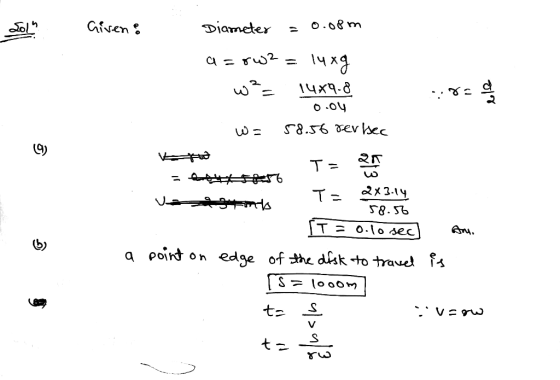
A disk with a diameter of 0.08 m is spinning with a constant velocity about an axle perpendicular to the disk and running through its center.
At this same frequency, what is the period of rotation of this \"halfway point\"?
T =
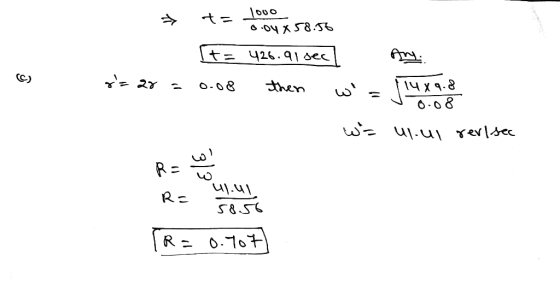
How long does it take a point on the edge of the disk to travel 1 km?
T1000 =
Suppose we double the diameter of the disk. We still want the same 14 g acceleration at the outer edge. Let f2 be the number of revolutions per second needed to get that acceleration. What is the ratio R = f2/f, where f is your answer to part (a)? Answer according to the following key:
- 1 = 0.500
- 2 = 0.707
- 3 = 1.000
- 4 = 1.414
- 5 = 2.000
- 6 = none of the above
R =
Homework Answers
Add Answer to:
A disk with a diameter of 0.08 m is spinning
with a constant velocity about an...
A disk with a diameter of 0.06 m is spinning with a constant velocity about an...
A disk with a diameter of 0.06 m is spinning with a constant velocity about an axle perpendicular to the disk and running through its center. 1) How many revolutions per second would it have to rotate in order for the acceleration of the outer edge of the disk to be 12 g's (i.e., 12 times the gravitational acceleration g)? f = 2) For the frequency determined in part (a), what is the speed of a point half way between...
A disk with a mass of 15 kg is spinning about its center with a constant...
 A disk with a mass of 15 kg is spinning about its center with a constant angular acceleration applied to it. Its c value is 1/2 about its center and it is initally spinning at 5 rad/s clockwise. If the disk stops spinning in a time of 1.5 s, how many revolutions does the disk make until it stops? 1.79 rev. 3.75 rev. 11.25 rex 0.60 rev. MacBook Pro $ % 5 & 7 8 E R T Y F...
1). A metal disk with radius, r, is spinning with a constant angular velocity. A red...
 1). A metal disk with radius, r, is spinning with a constant
angular velocity. A red magnet is placed on the disk
at
and a blue magnet is placed at r. If you compare the
tangential speed of the two magnets,
a. the red magnet is going half as fast
b. the magnets are going the same speed
c. the blue magnet is going twice as fast
d. the blue magnet is going four times as fast
2). In the...
1). A metal disk with radius, r, is spinning with a constant
angular velocity. A red magnet is placed on the disk
at
and a blue magnet is placed at r. If you compare the
tangential speed of the two magnets,
a. the red magnet is going half as fast
b. the magnets are going the same speed
c. the blue magnet is going twice as fast
d. the blue magnet is going four times as fast
2). In the...
A mouse steps onto the edge of a disk of radius R that is spinning at...
 A mouse steps onto the edge of a disk of radius R that is
spinning at a constant angular speed of , rad/second
(assume counterclockwise rotation). The mouse moves with the
constant velocity towards the cheese,
located at the center of the rotating disk.
(a) Derive a differential equation for the path of the mouse in
polar coordinates.
(b) How many revolutions will the disk make before the mouse
gets the cheese? The solution should be in terms of ,...
A mouse steps onto the edge of a disk of radius R that is
spinning at a constant angular speed of , rad/second
(assume counterclockwise rotation). The mouse moves with the
constant velocity towards the cheese,
located at the center of the rotating disk.
(a) Derive a differential equation for the path of the mouse in
polar coordinates.
(b) How many revolutions will the disk make before the mouse
gets the cheese? The solution should be in terms of ,...
(a) What is the magnitude of the torque on the disk (about the z axis)...

(a) What is the magnitude of the torque on the disk (about the z
axis) due to F1? (1pt)
(b) What is the magnitude of the torque on the disk due to F2?
(1pt)
(c) What is the magnitude of the torque on the disk due to F3?
(1pt)
(d) What is the magnitude and direction (clockwise or
counterclockwise) of the angular ac- celeration about the z-axis of
the disk? (2pt)
(e) If the disk starts from rest, what...
(a) What is the magnitude of the torque on the disk (about the z
axis) due to F1? (1pt)
(b) What is the magnitude of the torque on the disk due to F2?
(1pt)
(c) What is the magnitude of the torque on the disk due to F3?
(1pt)
(d) What is the magnitude and direction (clockwise or
counterclockwise) of the angular ac- celeration about the z-axis of
the disk? (2pt)
(e) If the disk starts from rest, what...
A uniform disk with mass m = 8.55 kg and radius R = 1.35 m lies...
A uniform disk with mass m = 8.55 kg and radius R = 1.35 m lies in the xy plane and centered at the origin. Three forces act on the disk in the +y-direction (see figure below): (1) a force F1 = 335 N at the edge of the disk on the +x-axis, (2) a force F2 = 335 N at the edge of the disk on the ?y-axis, and (3) a force F3 = 335 N at the edge...
A 2.4-m-diameter merry-go-round with a mass of 210 kg is spinning at 20 rpm. John runs...
 A 2.4-m-diameter merry-go-round with a mass of 210 kg is spinning at 20 rpm. John runs around the merry-go-round at 5.0 m/s, in the same direction that it is turning, and jumps onto the outer edge. John's mass is 35 kg. Part A What is the merry-go-round's angular speed, in rpm, after John jumps on? Express your answer in revolutions per minute. O AC O ? W = | rpm rpm Submit Request Answer
The disk ntating with a constant angular accelerstion Assurse the axle is frictionkess Ca) Calcud...
 please answer 5 and 6
im sorry thats the closest pic i can get to
it
the disk ntating with a constant angular accelerstion Assurse the axle is frictionkess Ca) Calcudlate the magnituke and direction of the net torpsue prodhuced by the twe lorces b) Determine the magnitude of the angular acceleration of the disk rad/s Cakulate the angular momentum, in kg mP/s, of an ice skater spinning at 6.00 rew/s given is moment of inertia is 0 rew/s given...
please answer 5 and 6
im sorry thats the closest pic i can get to
it
the disk ntating with a constant angular accelerstion Assurse the axle is frictionkess Ca) Calcudlate the magnituke and direction of the net torpsue prodhuced by the twe lorces b) Determine the magnitude of the angular acceleration of the disk rad/s Cakulate the angular momentum, in kg mP/s, of an ice skater spinning at 6.00 rew/s given is moment of inertia is 0 rew/s given...
A solid disk with mass M (1.00 kg) and radius R (0.200 m) is sitting on...
 A solid disk with mass M (1.00 kg)
and radius R (0.200 m) is sitting on a frictionless surface. We
analyzed the situation at left below, where a force F (2.00 N) is
applied for four seconds, by a string that has been wrapped around
the outer surface of a cylindrical disk.
Two students are debating the
following question. ‘The same force is applied for the same amount
of time, but this time by a string attached to the edge...
A solid disk with mass M (1.00 kg)
and radius R (0.200 m) is sitting on a frictionless surface. We
analyzed the situation at left below, where a force F (2.00 N) is
applied for four seconds, by a string that has been wrapped around
the outer surface of a cylindrical disk.
Two students are debating the
following question. ‘The same force is applied for the same amount
of time, but this time by a string attached to the edge...
1. Three children are riding on the edge of a merry‑go‑round that has a mass of...
1. Three children are riding on the edge of a merry‑go‑round that has a mass of 105 kg and a radius of 1.80 m. The merry‑go‑round is spinning at 22.0 rpm. The children have masses of 22.0, 28.0, and 33.0 kg. If the 28.0 kg child moves to the center of the merry‑go‑round, what is the new angular velocity in revolutions per minute? Ignore friction, and assume that the merry‑go‑round can be treated as a solid disk and the children...
 A disk with a mass of 15 kg is spinning about its center with a constant angular acceleration applied to it. Its c value is 1/2 about its center and it is initally spinning at 5 rad/s clockwise. If the disk stops spinning in a time of 1.5 s, how many revolutions does the disk make until it stops? 1.79 rev. 3.75 rev. 11.25 rex 0.60 rev. MacBook Pro $ % 5 & 7 8 E R T Y F...
 1). A metal disk with radius, r, is spinning with a constant
angular velocity. A red magnet is placed on the disk
at
and a blue magnet is placed at r. If you compare the
tangential speed of the two magnets,
a. the red magnet is going half as fast
b. the magnets are going the same speed
c. the blue magnet is going twice as fast
d. the blue magnet is going four times as fast
2). In the...
1). A metal disk with radius, r, is spinning with a constant
angular velocity. A red magnet is placed on the disk
at
and a blue magnet is placed at r. If you compare the
tangential speed of the two magnets,
a. the red magnet is going half as fast
b. the magnets are going the same speed
c. the blue magnet is going twice as fast
d. the blue magnet is going four times as fast
2). In the...
 A mouse steps onto the edge of a disk of radius R that is
spinning at a constant angular speed of , rad/second
(assume counterclockwise rotation). The mouse moves with the
constant velocity towards the cheese,
located at the center of the rotating disk.
(a) Derive a differential equation for the path of the mouse in
polar coordinates.
(b) How many revolutions will the disk make before the mouse
gets the cheese? The solution should be in terms of ,...
A mouse steps onto the edge of a disk of radius R that is
spinning at a constant angular speed of , rad/second
(assume counterclockwise rotation). The mouse moves with the
constant velocity towards the cheese,
located at the center of the rotating disk.
(a) Derive a differential equation for the path of the mouse in
polar coordinates.
(b) How many revolutions will the disk make before the mouse
gets the cheese? The solution should be in terms of ,...

(a) What is the magnitude of the torque on the disk (about the z
axis) due to F1? (1pt)
(b) What is the magnitude of the torque on the disk due to F2?
(1pt)
(c) What is the magnitude of the torque on the disk due to F3?
(1pt)
(d) What is the magnitude and direction (clockwise or
counterclockwise) of the angular ac- celeration about the z-axis of
the disk? (2pt)
(e) If the disk starts from rest, what...
(a) What is the magnitude of the torque on the disk (about the z
axis) due to F1? (1pt)
(b) What is the magnitude of the torque on the disk due to F2?
(1pt)
(c) What is the magnitude of the torque on the disk due to F3?
(1pt)
(d) What is the magnitude and direction (clockwise or
counterclockwise) of the angular ac- celeration about the z-axis of
the disk? (2pt)
(e) If the disk starts from rest, what...
 A 2.4-m-diameter merry-go-round with a mass of 210 kg is spinning at 20 rpm. John runs around the merry-go-round at 5.0 m/s, in the same direction that it is turning, and jumps onto the outer edge. John's mass is 35 kg. Part A What is the merry-go-round's angular speed, in rpm, after John jumps on? Express your answer in revolutions per minute. O AC O ? W = | rpm rpm Submit Request Answer
 please answer 5 and 6
im sorry thats the closest pic i can get to
it
the disk ntating with a constant angular accelerstion Assurse the axle is frictionkess Ca) Calcudlate the magnituke and direction of the net torpsue prodhuced by the twe lorces b) Determine the magnitude of the angular acceleration of the disk rad/s Cakulate the angular momentum, in kg mP/s, of an ice skater spinning at 6.00 rew/s given is moment of inertia is 0 rew/s given...
please answer 5 and 6
im sorry thats the closest pic i can get to
it
the disk ntating with a constant angular accelerstion Assurse the axle is frictionkess Ca) Calcudlate the magnituke and direction of the net torpsue prodhuced by the twe lorces b) Determine the magnitude of the angular acceleration of the disk rad/s Cakulate the angular momentum, in kg mP/s, of an ice skater spinning at 6.00 rew/s given is moment of inertia is 0 rew/s given...
 A solid disk with mass M (1.00 kg)
and radius R (0.200 m) is sitting on a frictionless surface. We
analyzed the situation at left below, where a force F (2.00 N) is
applied for four seconds, by a string that has been wrapped around
the outer surface of a cylindrical disk.
Two students are debating the
following question. ‘The same force is applied for the same amount
of time, but this time by a string attached to the edge...
A solid disk with mass M (1.00 kg)
and radius R (0.200 m) is sitting on a frictionless surface. We
analyzed the situation at left below, where a force F (2.00 N) is
applied for four seconds, by a string that has been wrapped around
the outer surface of a cylindrical disk.
Two students are debating the
following question. ‘The same force is applied for the same amount
of time, but this time by a string attached to the edge...
Most questions answered within 3 hours.
-
Where is the error in this code sequence?
String s1 = "Hello";
String s2 = "ello";...
asked 10 months ago -
Financial data for Joel de Paris, Inc., for last year
follow:
Joel de Paris, Inc.
Balance...
asked 10 months ago -
Consider this reaction:
Al2(SO4)3 (aq)+ BaCl3
(aq) Al2Cl6 (aq)- +
3BaSO4(s) . What is the...
asked 10 months ago -
Suppose that Savneet is considering increasing her
recent random sample from 20 car rentals to 40...
asked 10 months ago -
Trucks arrive at an unloading terminal at an average rate of 120
per hour.
Trucks arrive...
asked 10 months ago -
Why are methanol and ethanol completely soluble in water while
octanol is not very little soluble....
asked 10 months ago -
A facilities manager at a university reads in a research report
that the mean amount of...
asked 10 months ago -
When the CuSO4 is rehydrated by adding water to the anhydrous
compound, is this an endothermic...
asked 10 months ago -
A ray of sunlight is passing from diamond into crown glass; the
angle of incidence is...
asked 10 months ago -
A block of mass 0.249 kg is placed on top of a light, vertical
spring of...
asked 10 months ago -
how do the kidneys compensate in the presences of acidosis
a) trigger hyperventilate
b) reserve acid...
asked 10 months ago -
Question 501 pts
The rental rate of capital to the firm increases. Which of the
following...
asked 10 months ago