How relevant is error analysis in physics? Add any examples that may strengthen your statement.
How relevant is error analysis in physics? Add any examples that may strengthen your statement.
Homework Answers
Arbitrary Errors
Each estimation an experimenter makes is unverifiable somewhat. The vulnerabilities are of two sorts:
(1) arbitrary blunders, or
(2) orderly mistakes.
For instance, in estimating the time required for a load to tumble to the floor, an arbitrary mistake will happen when an experimenter endeavors to push a catch that begins a clock at the same time with the arrival of the load. On the off chance that this irregular blunder rules the fall time estimation,
on the off chance that we rehash the estimation commonly (N times) and plot square with in terms (canisters) of the fall time ti on the flat hub against the occasions a given fall time ti happens on the vertical pivot,
our outcomes (see histogram underneath) should approach a perfect ringer formed bend (called a Gaussian circulation) as the quantity of estimations N turns out to be huge.
The best gauge of the genuine fall time t is the mean esteem (or normal esteem) of the appropriation:
atn = ( SNi = 1 ti ) / N .
In the event that the experimenter squares every deviation from the mean, midpoints the squares, and takes the square foundation of that normal,
the outcome is an amount called the "root-mean-square" or the "standard deviation" s of the circulation. It quantifies the irregular blunder or the factual vulnerability of the individual estimation ti:
s = O [ SNi = 1 ( ti - atn ) 2 / ( N - 1 ) ]
Around 66% of the considerable number of estimations have a deviation short of what one s from the mean and 95% of all estimations are inside two s of the mean.
As per our instinct that the vulnerability of the mean ought to be littler than the vulnerability of any single estimation, estimation hypothesis demonstrates that on account of arbitrary mistakes the standard deviation of the mean smean is given by:
sm = s/ON ,
where N again is the quantity of estimations used to decide the mean. At that point the aftereffect of the N estimations of the fall time would be cited as t = atn x sm.
At whatever point you make an estimation that is rehashed N times, you should ascertain the mean esteem and its standard deviation as simply depicted. For countless this system is fairly dreary.
In the event that you have a number cruncher with factual capacities it might carry out the responsibility for you.
There is additionally a streamlined solution for assessing the arbitrary blunder which you can utilize.
Expect you have estimated the fall time around multiple times.
For this situation it is sensible to expect that the biggest estimation tmax is roughly +2s from the mean, and the littlest tmin is - 2s from the mean. Henceforth:
s x (tmax - tmin)
is a sensible gauge of the vulnerability in a solitary estimation. The above technique for deciding s is a standard guideline on the off chance that you make of request ten individual estimations (for example more than 4 and under 20).
Vulnerability because of Instrumental Precision
Not all blunders are factual in nature. That implies a few estimations can't be enhanced by rehashing them ordinarily. For instance, accept you should quantify the length of an article (or the heaviness of an item).
The exactness will be given by the dividing of the tick marks on the estimation device (the meter stick).
You can peruse off whether the length of the item lines up with a tick mark or falls in the middle of two tick marks, yet you couldn't decide the incentive to an exactness of l/10 of a tick mark remove.
Normally, the blunder of such an estimation is equivalent to one portion of the littlest subdivision given on the estimating gadget.
In this way, on the off chance that you have a meter stay with tick marks each mm (millimeter), you can quantify a length with it to a precision of about 0.5 mm. While on a basic level you could rehash the estimation various occasions, this would not enhance the precision of your estimation!
Note: This expect obviously that you have not been messy in your estimation but rather made a cautious endeavor to arrange one end of the item with the zero of the meter stick as precisely as possible,
and that you read off the opposite end of the meter stay with a similar consideration.
On the off chance that you need to pass judgment on how watchful you have been, it is helpful to ask your lab accomplice to make similar estimations, utilizing a similar meter stick, and after that think about the outcomes.
Methodical Errors
Methodical mistakes result when attributes of the framework we are analyzing, or the instruments we use are not quite the same as what we accept them to be.
For instance, if a voltmeter we are utilizing was adjusted inaccurately and peruses 5% higher than it should, at that point each voltage understanding we record utilizing this meter will have a blunder of 5%.
Obviously, taking the normal of numerous readings won't assist us with reducing the measure of this deliberate mistake.
In the event that we knew the size and course of the efficient mistake we could address for it and in this manner dispense with its belongings totally.
Notwithstanding when we are uncertain about the impacts of a precise blunder we can once in a while gauge its size (however not its course) from information of the nature of the instrument.
For instance, the meter maker may ensure that the alignment is right to inside 1%.
Engendering of Errors
Indeed, even straightforward analyses more often than not require the estimation of more than one amount. The experimenter embeds these deliberate qualities into a recipe to register an ideal outcome.
He/she will need to know the vulnerability of the outcome. Here, we list a few basic circumstances in which mistake propagation is basic, and toward the end we demonstrate the general method.
On the off chance that you are looked with a mind boggling circumstance, approach your lab educator for help.
Numerous kinds of estimations, regardless of whether factual or precise in nature, are not conveyed by a Gaussian. Precedents are the age conveyance in a populace, and numerous others.
In any case, it tends to be appeared if an outcome R relies upon numerous factors, than assessments of R will be dispersed rather like a Gaussian - and all the more so when R relies upon more factors
notwithstanding when the individual factors are most certainly not. The hypothesis In the accompanying, we accept that our estimations are circulated as basic Gaussians.
Added substance Formulae
At the point when an outcome R is determined from two estimations x and y, with vulnerabilities Dx and Dy, and two constants an and b with the added substance equation:
R = ax + by ,
also, on the off chance that the mistakes in x and y are free, the blunder in the outcome R will be:
(DR)2 = (a Dx)2 + (b Dy)2 .
The motivation behind why we should utilize this quadratic frame and not just include the vulnerabilities aDx and bDy, is that we don't know whether x and y were both estimated excessively vast or excessively little;
in reality the estimation blunders on x and y may drop each other in the outcome R! Free mistakes drop each other with some likelihood (state you have estimated x to some degree too huge and y fairly excessively little;
the blunder in R may be little for this situation). This incomplete measurable dropping is accurately represented by including the vulnerabilities quadratically.
Multiplicative Formulae
At the point when the outcome R is determined by duplicating a steady multiple times an estimation of x times an estimation of y (or isolated by y), i.e.:
R = axy or R = ax/y,
at that point the relative mistakes Dx/x and Dy/y include quadratically:
(DR/R)2 = (Dx/x)2 + (Dy/y)2 .
example :
Say amount x is estimated to be 1.00,
with a vulnerability Dx = 0.10, and amount y is estimated to be 1.50 with vulnerability Dy = 0.30,
and the steady a = 5.00 . The outcome R is acquired as R = 5.00 x 1.00 x l.50 = 7.5 .
The relative vulnerability in x is Dx/x = 0.10 or 10%,
though the relative vulnerability in y is Dy/y = 0.20 or 20%.
Thusly the relative blunder in the outcome is DR/R = Ö(0.102 + 0.202) = 0.22 or 22%,.
The outright vulnerability of the outcome R is gotten by duplicating 0.22 with the estimation of R: DR = 0.22 x 7.50 = 1.7 .
Add Answer to:
How relevant is error analysis in physics? Add any
examples that may strengthen your statement.
how relevant is error analysis in life experience and observation?
how relevant is error analysis in life experience and observation?
Be sure your answer is complete and include any relevant diagrams and examples. 3 paragraphs minimum....
Be sure your answer is complete and include any relevant diagrams and examples. 3 paragraphs minimum. Since the 1980s the United States has been "getting tough" on crime by sending more criminals to prison and increasing the lengths pf prison sentences. Briefly explain the four functions of a prison sentence. Is it a good idea to sentence prisoners to longer terms even though this may lead to prison overcrowding? Why or why not? What are the benefits and costs to...
Demonstrate your knowledge of the difference between Economic and Business (Accounting) profit by showing relevant examples....
Demonstrate your knowledge of the difference between Economic and Business (Accounting) profit by showing relevant examples. You may use your own examples or cite examples from other sources. What are the advantages of computing economic profit?
How company can improve relevant dimension by using the financial statement analysis when the company profit...
How company can improve relevant dimension by using the financial statement analysis when the company profit analysis is below? Profitability analysis Year 4 3 2 1 Net profit 3.9 4.08 3.94 4.56 ROA 7.32 7.68 7.05 8.24 ROE 25.53 25.89 22.89 24.95
Accounting 221 Post comments and explain, with examples, how decision making and analysis, with the tools...
Accounting 221 Post comments and explain, with examples, how decision making and analysis, with the tools from our course, may be of value to you and your future endeavors. Include specific examples such as a company seeking to increase profits would.
. Analyze some examples of relevant and irrelevant Cash Flows for one Saudi Company? 2 a...
. Analyze some examples of relevant and irrelevant Cash Flows for one Saudi Company? 2 a - Discuss why managers estimate a cost function and use Cost volume Profit analysis? Give numerical example of cost function and Cost Volume Profit Analysis and analyze how it will be used by managers? b- Suppose actual costs are higher than estimated cost. Analyze why you may have this difference between actual and estimated costs?
Discuss the use of NMR in Organic Analysis giving at least two examples. Your explanation should...
Discuss the use of NMR in Organic Analysis giving at least two examples. Your explanation should include relevant mechanisms and references to actual uses in life.
This question is about astronomy, but Physics seemed like the most relevant topic. Q: The following...
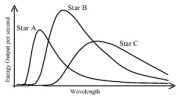 This question is about astronomy, but Physics seemed like the
most relevant topic.
Q: The following graph shows schematic blackbody spectra of
three stars at different temperatures. Use your understanding of
the Stefan-Boltzmann Law and Wien’s Law to explain why this diagram
is wrong and redraw the graph schematically to correct the
error(s).
Star C seems to have an incorrect curve after its peak, but I
cannot discern any other errors. I'd appreciate some help :)
Thanks!
Star B Star...
This question is about astronomy, but Physics seemed like the
most relevant topic.
Q: The following graph shows schematic blackbody spectra of
three stars at different temperatures. Use your understanding of
the Stefan-Boltzmann Law and Wien’s Law to explain why this diagram
is wrong and redraw the graph schematically to correct the
error(s).
Star C seems to have an incorrect curve after its peak, but I
cannot discern any other errors. I'd appreciate some help :)
Thanks!
Star B Star...
evented or corrected. If you did not make any error 8: Describe any errors you may...
 evented or corrected. If you did not make any error 8: Describe any errors you may have made during this procedure and how they could you did not make any errors, provide at least one theoretical source of error T-LAB QUESTIONS: 1. Give two physical properties you observed in your crude (unpurified) asp in your crude (unpurified) aspirin sample. 2. If the theoretical vield of a reaction was calculated to be 3.11g and the actual yield was a yield for...
a) Describe the objectives of an Investment Policy Statement and how the objectives may vary by...
a) Describe the objectives of an Investment Policy Statement and how the objectives may vary by investors, use examples where possible. (15 marks) b) What are the main factors that affect the prices of bonds trading in the secondary market? Give examples of how these factors may have affected prices in the past or may do so in the future.(20 marks)
 This question is about astronomy, but Physics seemed like the
most relevant topic.
Q: The following graph shows schematic blackbody spectra of
three stars at different temperatures. Use your understanding of
the Stefan-Boltzmann Law and Wien’s Law to explain why this diagram
is wrong and redraw the graph schematically to correct the
error(s).
Star C seems to have an incorrect curve after its peak, but I
cannot discern any other errors. I'd appreciate some help :)
Thanks!
Star B Star...
This question is about astronomy, but Physics seemed like the
most relevant topic.
Q: The following graph shows schematic blackbody spectra of
three stars at different temperatures. Use your understanding of
the Stefan-Boltzmann Law and Wien’s Law to explain why this diagram
is wrong and redraw the graph schematically to correct the
error(s).
Star C seems to have an incorrect curve after its peak, but I
cannot discern any other errors. I'd appreciate some help :)
Thanks!
Star B Star...
 evented or corrected. If you did not make any error 8: Describe any errors you may have made during this procedure and how they could you did not make any errors, provide at least one theoretical source of error T-LAB QUESTIONS: 1. Give two physical properties you observed in your crude (unpurified) asp in your crude (unpurified) aspirin sample. 2. If the theoretical vield of a reaction was calculated to be 3.11g and the actual yield was a yield for...
Most questions answered within 3 hours.
-
Where is the error in this code sequence?
String s1 = "Hello";
String s2 = "ello";...
asked 10 months ago -
Financial data for Joel de Paris, Inc., for last year
follow:
Joel de Paris, Inc.
Balance...
asked 10 months ago -
Consider this reaction:
Al2(SO4)3 (aq)+ BaCl3
(aq) Al2Cl6 (aq)- +
3BaSO4(s) . What is the...
asked 10 months ago -
Suppose that Savneet is considering increasing her
recent random sample from 20 car rentals to 40...
asked 10 months ago -
Trucks arrive at an unloading terminal at an average rate of 120
per hour.
Trucks arrive...
asked 10 months ago -
Why are methanol and ethanol completely soluble in water while
octanol is not very little soluble....
asked 10 months ago -
A facilities manager at a university reads in a research report
that the mean amount of...
asked 10 months ago -
When the CuSO4 is rehydrated by adding water to the anhydrous
compound, is this an endothermic...
asked 10 months ago -
A ray of sunlight is passing from diamond into crown glass; the
angle of incidence is...
asked 10 months ago -
A block of mass 0.249 kg is placed on top of a light, vertical
spring of...
asked 10 months ago -
how do the kidneys compensate in the presences of acidosis
a) trigger hyperventilate
b) reserve acid...
asked 10 months ago -
Question 501 pts
The rental rate of capital to the firm increases. Which of the
following...
asked 10 months ago